
When Renko charts work best is one of the most important questions traders can ask, yet it’s rarely explained clearly. Renko charts can feel incredibly powerful during strong trends and frustrating during sideways markets, and the difference usually comes down to market conditions rather than strategy settings.
In this guide, I’ll explain when Renko charts work best, when they tend to struggle, and how to quickly recognize the current market environment so you avoid forcing a trend strategy into a ranging market.
If you are new to brick charts, you may want to review my complete Renko charts guide before diving deeper into market condition filtering.
Educational note: Everything here is shared for educational and experimental purposes only. These are ideas and observations, not financial advice.
When Renko Charts Work Best: Understanding Market Conditions First
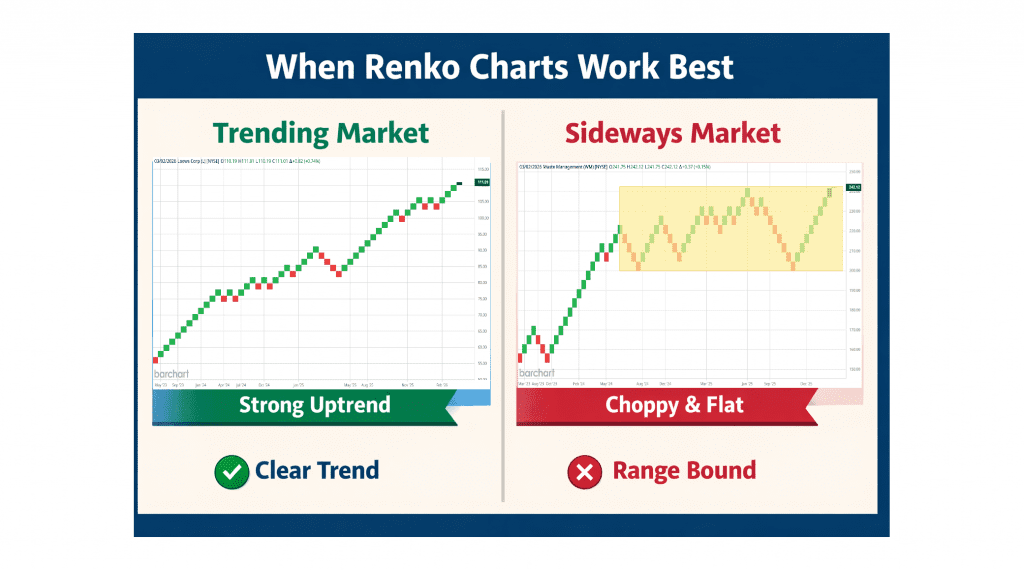
Understanding when Renko charts work best starts with recognizing that markets move through different phases. No indicator or strategy performs equally well in every environment, and Renko charts are specifically designed to highlight directional movement rather than sideways noise.
Quick Answer: When Renko Works Best
- Best environment: smooth, directional trends with consistent volatility
- Worst environment: sideways ranges and “two steps forward, two steps back” price action
- Trickiest environment: high-volatility spikes that look like trends but reverse fast
Why Market Conditions Matter More Than the Indicator
Renko compresses time and emphasizes movement. That helps you stay with a trend and ignore noise. But when the market is not trending, “noise” becomes the whole game, and Renko will print alternating bricks that trigger entries and exits too often.
If you only change indicators, you can accidentally optimize for the last few weeks of behavior and then watch performance fall apart when the regime shifts. A simple market condition filter protects you from that.
External resources that support this market-conditions approach
If you want to go deeper on volatility, market regimes, and how they affect trading systems, these references are a solid starting point:
- Investopedia: Average True Range (ATR) definition
- Investopedia: Support and resistance basics
- Investopedia: Volatility definition and examples
The 3 Market Conditions Every Renko Trader Should Know
Most price action can be grouped into three practical buckets. Your job is not to predict. Your job is to classify the current environment and pick a matching playbook.
1) Trending Market: Renko’s Home Field Advantage
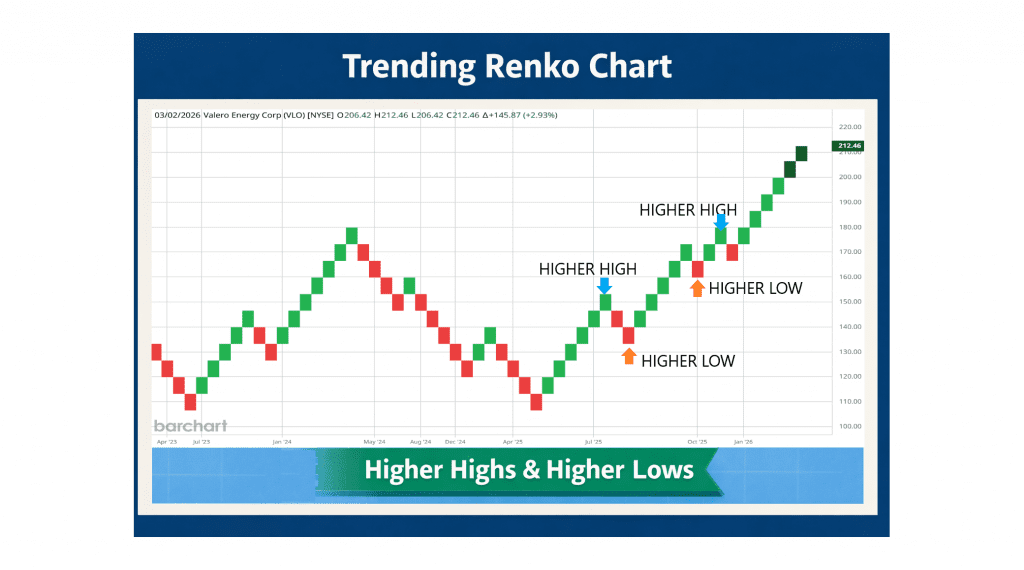
A trending environment is where Renko shines. If you have studied Renko trend trading techniques, you already know that brick structure becomes cleaner and continuation setups become easier to identify. In directional markets, Renko helps you stay focused on structure instead of reacting to every small pullback.
How to spot a trend quickly
- Higher highs and higher lows (or lower highs and lower lows)
- Pullbacks are smaller than the impulse moves
- Breakouts hold instead of snapping back into the range
- Moving average slope is clearly up or down (if you use MAs)
What to do in a trend
- Prioritize trend-following entries over reversal calls.
- Use simple confirmation (for example: MA direction, Supertrend alignment, or structure confirmation).
- Consider holding winners longer and reducing “micro-management” exits.
- When you backtest, test trend periods vs non-trend periods separately to see the difference.
Common mistake in trends
Taking profits too early because your eyes are trained on choppy conditions. In trends, the edge is often staying in the move, not timing the perfect exit.
2) Ranging Market: Where Renko Can Chop You Up
Ranges are the environment that causes most frustration. Renko can print alternating bricks that look like signals, but price is really just rotating around a fair value zone.
How to spot a range quickly
- Repeated reversals from the same approximate levels
- Breakouts fail and snap back into the middle of the range
- Support and resistance feel “sticky”
- Trend indicators flatten and flip frequently
If you rely heavily on structure levels, reviewing Renko support and resistance techniques can help you recognize when price is rotating between defined zones rather than breaking into a new trend.
What to do in a range
- Use a filter that reduces trades (example: only trade when trend filter agrees).
- Shift to range tools (support/resistance bounces, mean reversion ideas) or simply stand aside.
- Be willing to say: “No trade” is a position.
- Consider increasing brick size slightly if your testing shows it reduces flip-flopping in ranges.
Common mistake in ranges
Trying to force a breakout strategy because you “need action.” Ranges punish impatience. The easiest fix is often trading less, not optimizing more.
3) High-Volatility Whipsaw: The Fake Trend Trap
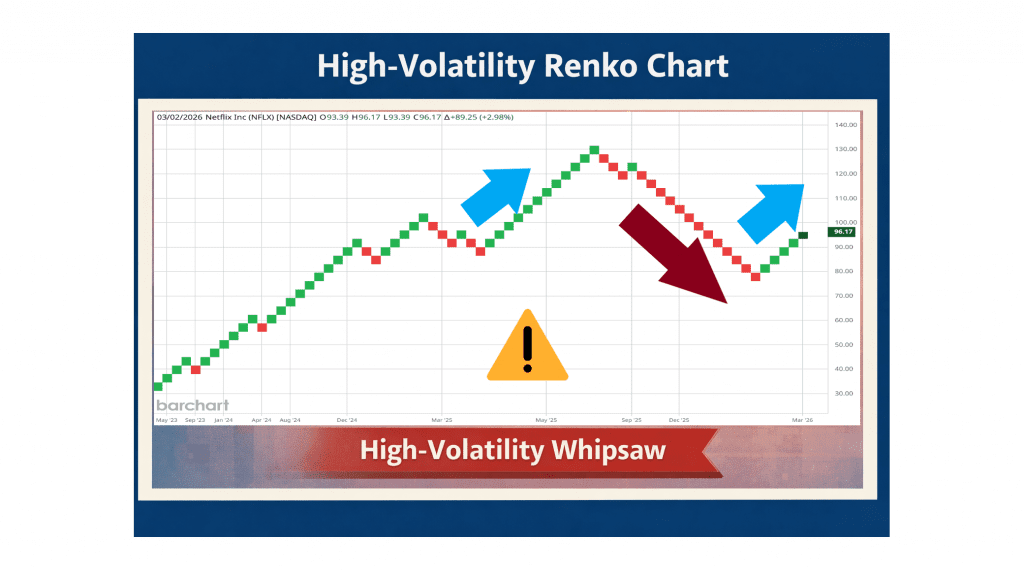
This is the environment where price moves fast enough to look like a trend but reverses hard. Renko can print impressive streaks of bricks that lure you into late entries right before a snapback.
How to spot high-volatility whipsaw
- Large candles on the regular chart (even if Renko looks “clean”)
- Sudden spikes followed by sharp reversals
- Big gaps or news-driven moves
- Stops get hit fast even when you thought the setup was strong
This is also where brick size matters. If your bricks are too small relative to volatility, you may see rapid flips. Understanding ATR-based Renko brick size calculation can help you adapt to changing market conditions.
What to do in high volatility
- Reduce position size if you trade it at all.
- Use stricter confirmation before entries.
- Consider a cooldown rule after a stopout (example: wait for a fresh structure break).
- Backtest with a separate “high vol” window so you know what the strategy does in stress.
The Renko Market Conditions Checklist (Fast Classification)
Here’s a simple decision checklist you can run in under a minute. The goal is not perfect accuracy. The goal is avoiding obvious mismatches.
Step 1: Is price making progress in one direction?
- If yes, you are likely in a trend environment.
- If no, go to Step 2.
Step 2: Are breakouts failing and snapping back?
- If yes, treat it as a range and trade less (or not at all).
- If no, go to Step 3.
Step 3: Are moves unusually fast and violent?
- If yes, treat it as high volatility whipsaw and tighten rules or reduce size.
- If no, you may be in an early trend or a transitioning market. Trade smaller and demand confirmation.
How to Match Your Renko Strategy to the Environment
Think of this as a three-playbook system. You can keep your strategy simple, but your decision to engage or stand aside should be condition-aware.
Trend playbook
Your entry timing should reflect the environment. If you are unsure how early entries compare to confirmation entries, see my breakdown of Renko entry timing: early vs confirmed entries to match timing with volatility and trend strength.
- Trade in the direction of the dominant move.
- Use pullbacks or continuation triggers.
- Use an exit that lets winners breathe.
Range playbook
- Reduce trades dramatically or stand aside.
- If you trade, focus on clear support/resistance rotation logic.
- Avoid breakout chasing.
High-volatility playbook
- Trade smaller, require more confirmation.
- Avoid late entries after long brick streaks.
- Use rules that prevent revenge trading.
Backtesting Tip: Test Market Regimes Separately
If you want a strategy that survives real life, combine regime analysis with structured testing. In my guide on backtesting Renko chart strategies, I explain how separating trending and ranging periods often reveals why a system performs inconsistently.
This is also how you avoid over-optimizing brick size or indicator settings. Often the best improvement is a simple rule that filters out the wrong market condition.
FAQ: Renko Market Conditions
Do Renko charts work in sideways markets?
They can, but sideways conditions often produce frequent flips that create false signals. Many traders either stand aside or switch to a range-specific plan until price shows directional progress.
What is the best market for Renko charts?
Renko tends to work best in clean trends with consistent volatility where pullbacks are smaller than impulse moves and breakouts tend to hold.
How do I avoid getting chopped up on Renko?
Use a market condition filter, trade less in ranges, and demand stronger confirmation in high volatility. In many cases, the biggest edge is avoiding the worst environments.
Wrap Up: The Simple Rule That Helps Most Traders
Renko is a trend tool. It can be adapted to other conditions, but it performs best when you respect what the market is doing right now. If you only remember one thing, remember this:
Stop trying to “fix” a strategy when the market condition is the real problem.
If you want, I can also create an internal linking map that points to the most relevant Renko pages you already have, so this new guide becomes a hub that strengthens your entire site.