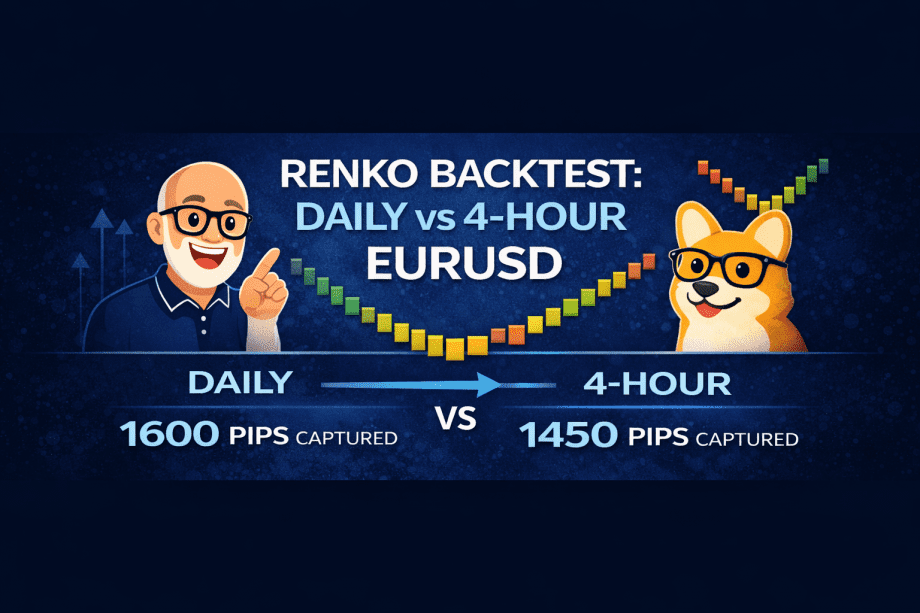
Renko backtesting across timeframes is one of the most effective ways to understand how a trading idea behaves under different market conditions. In this video, I walk through a simple Renko backtest using EURUSD to compare the daily chart versus the 4-hour chart.
This is an educational illustration, not a ready-to-trade strategy. The purpose is to show how I backtest Renko charts, how trade behavior changes when timeframe changes, and why risk tolerance, account size, and position sizing matter just as much as the strategy itself.
What You Can Learn From This Renko Backtest
- How a simple Renko trend-following strategy works
- How Renko chart behavior changes across timeframes
- Why daily charts produce fewer trades but larger drawdowns
- Why 4-hour charts create more trades and more noise
- How much of the EURUSD move was captured
- Why timeframe selection changes the risk profile
- Why backtest results differ from live trading
The Strategy Used in This Illustration
This Renko backtest intentionally uses a bare-minimum framework to isolate price behavior:
- Buy-side only
- Higher highs and higher lows
- Breakout entries after reversal
- Exit on close below the most recent swing low
- No indicators
- No trendlines
- No support and resistance
- No predefined stop loss
The goal is not optimization. The goal is understanding how Renko charts behave across different timeframes.
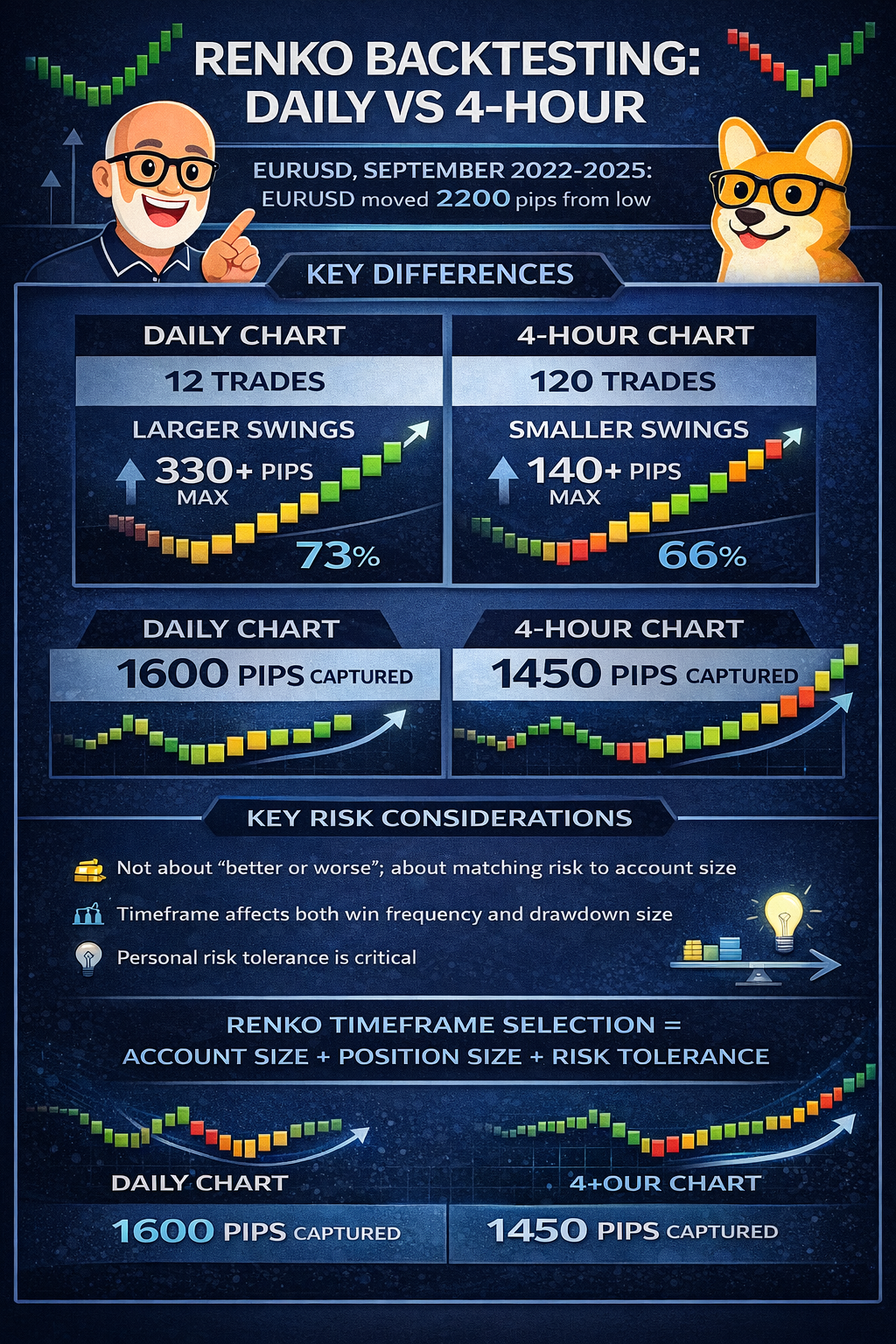
Infographic: Renko Backtesting Across Timeframes
This infographic summarizes the key ideas from the video, including timeframe differences, drawdowns, and overall risk behavior.
Daily vs 4-Hour Renko Backtest Results
From September 2022 through July 2025, EURUSD moved approximately 2200 pips from low to high.
- Daily Renko strategy captured about 1600 pips, roughly 73 percent of the move
- 4-hour Renko strategy captured about 1450 pips, roughly 66 percent of the move
The daily chart produced fewer trades with larger swings. The 4-hour chart produced more trades with smaller, more frequent drawdowns. Neither timeframe is better by default. Each has a different risk profile.
Which Renko Timeframe Works Best?
This backtest shows that higher timeframes reduce noise and improve trend clarity when using Renko charts. The daily Renko chart produced fewer trades but stronger trend-following performance compared to the 4-hour chart.
Understanding Risk Profile in Renko Trading
A strategy’s risk profile is shaped by three factors working together:
- Timeframe
- Account size
- Position size
Larger timeframes often come with larger drawdowns. Whether those drawdowns are acceptable depends entirely on how much capital is being risked per trade and personal tolerance for volatility.
Backtest vs Real-Life Trading
Backtests are a starting point, not a finish line.
- Entries and exits are not perfect in real trading
- Drawdowns feel very different with real money
- Risk management becomes essential
This is why every backtested idea must be adapted to real-world execution before being traded live.
Related Resources for More Learning
- Renko Backtesting Methods
- Renko Trend Trading Tips
- ATR-Based Renko Brick Size Guide
- Renko Chart Buy and Sell Signals
- Advanced Renko Chart Strategies
Connect With Me on YouTube
For more Renko backtests, strategy walkthroughs, and trading psychology discussions, visit my YouTube channel:
Frequently Asked Questions
What is a Renko backtest?
A Renko backtest evaluates how a strategy behaves using price-based Renko charts rather than time-based candlesticks.
Is this Renko strategy ready for live trading?
No. This is an educational illustration and does not account for real-world execution, risk management, or psychology.
Which Renko timeframe is better?
Neither timeframe is universally better. Each offers different trade frequency, drawdowns, and risk characteristics.