Trading success is not just about finding the perfect setup.
A lot of traders spend most of their time searching for better entries, faster indicators, or cleaner chart patterns. But many accounts do not fail because the entry was terrible. They fail because the trader risked too much, sized the trade poorly, or kept trading the same way during a losing streak.
That is one reason I like Renko charts. They can simplify price action and reduce some of the visual noise that shows up on standard candlestick charts. But even with that advantage, Renko charts do not remove risk. They only make it easier to structure decisions.
In this guide, I will walk through the Renko risk process I use to protect capital, control drawdowns, and give strong trends enough room to run. This is educational content based on ideas and experiments, not financial advice.
Renko risk management strategy: why it matters more than the entry
A good entry can help. A strong strategy can help even more. But neither one matters much if the risk side of the trade is weak.
You can be right often and still struggle if your losses are too large. You can also be right only half the time and still make progress if your losses stay controlled and your winners are handled well.
That is why I think of risk management as the structure underneath the strategy. It is what keeps a rough week from turning into a damaged account.
Renko charts help because they force you to think more clearly about structure. Instead of reacting to every little bar of noise, you can use the bricks to define trend, reversal, and invalidation more consistently.
Before risking capital, I also like to score the setup itself using my Renko trade setup checklist. A strong risk plan is important, but it helps even more when the trend, market condition, chart structure, and confirmation all support the trade.
If you are still refining your entry logic, this guide on Renko chart buy and sell signals is a good companion piece.
Simple example
| Scenario | Win Rate | Risk Control | Likely Outcome |
|---|---|---|---|
| Good entries, poor discipline | 60% | Weak | Volatile results, larger drawdowns |
| Average entries, strong discipline | 50% | Strong | More stable long term progress |
The point is simple. Risk control often matters more than being clever.
My core rule: risk a small amount on each trade
The foundation of my approach is that I try to keep the risk per trade small.
For many traders, that means risking around 1% of account value or less per trade. Some traders use slightly more. Some use less. The exact percentage is personal, but the main idea is that one trade should not have the power to damage the account in a major way.
This matters for two reasons.
First, it protects capital.
Second, it protects decision-making.
When a position is too large, every pullback feels emotional. You start moving stops, exiting too soon, or taking low-quality revenge trades after a loss. Smaller risk helps you stay rational.
If you want to go deeper into the math side, I would connect this article with your post on Renko position sizing. Position sizing tells you how big the trade should be. Risk management tells you why the size matters in the first place.
How I place stop losses using Renko structure
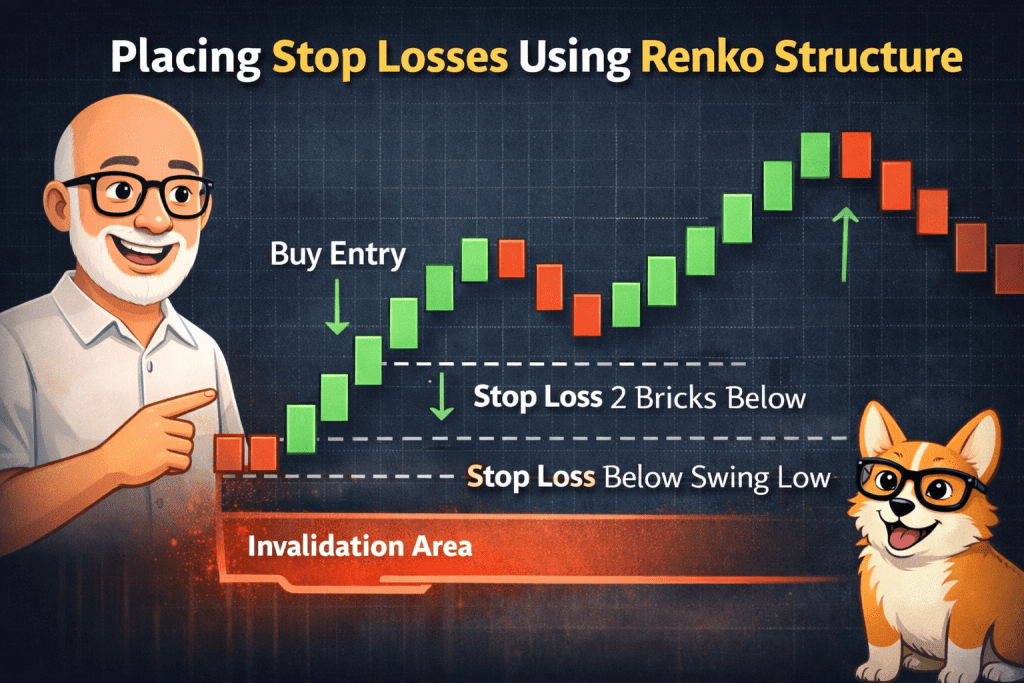
One of the biggest advantages of Renko charts is that stop placement can become more logical.
Instead of placing a stop based on fear or a random dollar amount, I prefer to use chart structure. That means the stop goes where the trade idea would no longer make sense.
Here are a few ways that can work with Renko:
1. A fixed number of bricks beyond the entry
This is the simplest method.
If I enter on a breakout or continuation signal, I may place the stop two or three bricks beyond the entry area, depending on volatility and the instrument.
This can work well when the chart is trending cleanly and the Renko brick size already reflects the pace of the market.
2. Below a swing low or above a swing high
This is often a better structural method.
If I am buying a trend continuation, I want the stop below the recent swing low that supports the trade idea. If price reverses enough to break that structure, the setup may no longer be valid.
3. Beyond a trendline or support/resistance failure
If the trade is based on trendline continuation or a clean support/resistance bounce, the stop should respect that same logic.
If that level breaks, I do not want to stay in the position just because I hope it turns around.
For related reading, these are strong contextual links:
For broader investor education, FINRA explains common order types and how stop orders work in practice: FINRA Order Types.
Drawdown control is where real risk management starts
A lot of traders think risk management begins and ends with the stop loss.
I do not see it that way.
The stop loss matters, but drawdown control is the bigger system. Drawdown is what happens when several trades in a row do not work, when conditions change, or when a strategy hits a rough patch.
That is where traders often lose discipline.
My view is that every trader should have a plan for what happens after losses, not just during the trade.
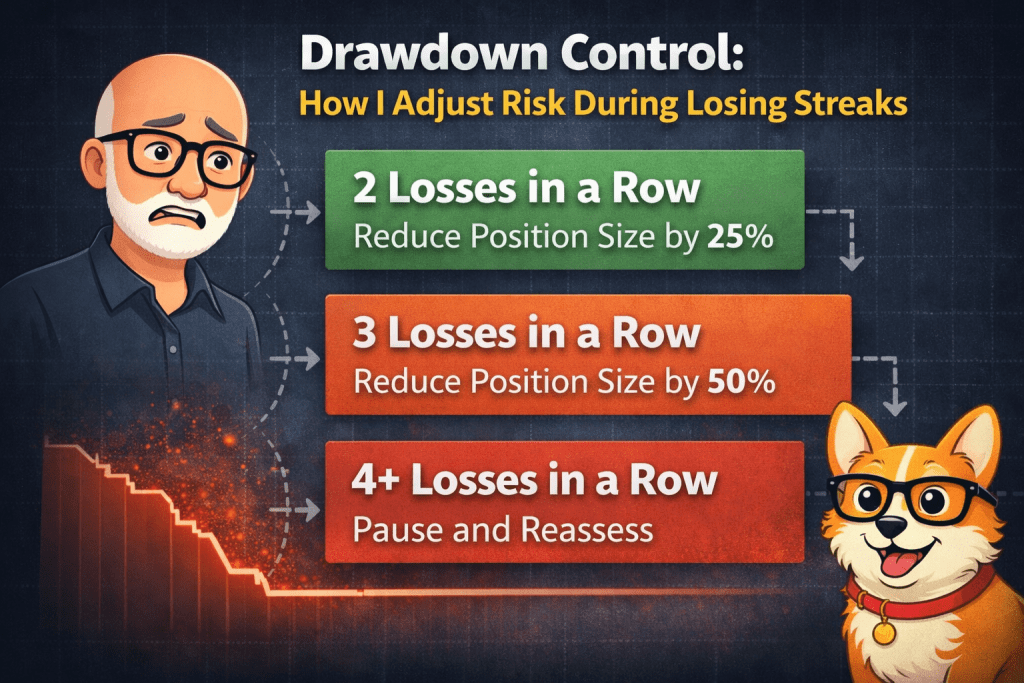
Example drawdown response plan
| Losing Streak | Adjustment |
|---|---|
| 2 losses in a row | Reduce position size by 25% |
| 3 losses in a row | Reduce position size by 50% |
| 4 or more losses | Pause and review conditions before trading again |
This type of rule helps in two ways.
It slows damage.
It also forces you to reassess whether the market environment still fits your strategy.
That is especially important with Renko. When a market becomes choppy, Renko can still print bricks, but the quality of the signals often drops. A drawdown plan gives you a built-in defense.
A useful companion article here is When Renko charts work best because market conditions have a direct effect on risk.
Letting winners run is part of risk management too

Risk management is usually associated with cutting losses. That is true, but it is only half of the job.
The other half is making sure that strong trades have room to produce meaningful gains.
This is where Renko charts can be especially helpful. Since they reduce smaller fluctuations, they can make it easier to stay with a trend instead of panicking at every little pullback.
Here are a few ways I think about holding winners:
Trail using structure
As the trend forms new swings, the stop can move behind those swings. This keeps the trade tied to actual chart behavior instead of a random profit target.
Trail by brick logic
Some traders trail the stop by a set number of bricks once the trade moves in their favor. This can work well in cleaner trends.
Exit only when reversal evidence appears
If the entire reason for entering was trend continuation, then I try not to kill the trade too early. I want the chart to show a reason to leave.
This pairs well with:
- Renko trend trading tips
- Renko entry timing: early vs confirmed entries
- Backtesting Renko chart strategies
Common Renko risk management mistakes
Even when the strategy idea is solid, a few repeat mistakes can quietly hurt performance.
Oversizing because the chart looks cleaner
Renko charts can make markets look simpler. That is helpful, but it can also create false confidence. A cleaner chart does not mean lower real risk.
Ignoring volatility
Brick size changes how the chart looks, but it does not erase volatility. If the instrument is moving aggressively, the position size and stop logic still need to reflect that.
Moving the stop out of emotion
If the stop was placed where the trade idea becomes invalid, moving it farther away usually means the trader is no longer following the plan.
Trading every signal in bad conditions
Not every market environment deserves the same aggression. During chop, lower quality signals often lead to clusters of small losses.
Focusing only on entry precision
Some traders spend hours trying to improve the entry by one brick while ignoring the much larger effect of position size, drawdown rules, and exit discipline.
This article also connects naturally to top Renko chart mistakes and Renko brick size backtesting in TradingView.
My simple Renko risk management framework
Here is the process in plain English.
1. Define the setup
I want to know exactly why I am entering. Breakout, trend continuation, support bounce, reversal confirmation, or something else.
2. Define invalidation
Before entering, I decide where the trade idea fails. That is usually based on brick structure, swing structure, or support/resistance.
3. Measure the risk
I calculate the distance from entry to stop. That tells me the actual risk per share, contract, or unit.
4. Size the position
Then I adjust position size so the total loss stays within my risk limit for that trade.
5. Monitor market conditions
If conditions are clean and trending, I may trade normally. If conditions are noisy or inconsistent, I reduce size or become more selective.
6. Manage winners logically
I do not want to exit a strong trade just because I see a small pause. I want the chart to give me a structural reason.
7. Reduce risk during rough periods
If I hit a losing streak, I scale down and reassess. I do not try to win it back quickly.
That framework is simple on purpose. A complicated risk system is often harder to follow consistently.
Why this matters even more in leveraged markets
This topic becomes even more important in leveraged products, futures, forex, and active short-term trading.
The National Futures Association emphasizes that futures and other leveraged markets can be highly risky and that traders should use risk capital: NFA Investor Best Practices.
That idea matters because leverage can make small mistakes much larger. Renko charts may improve chart clarity, but they do not change the underlying risk of the instrument.
If you trade leveraged products, your risk process has to be even tighter.
It is also worth reviewing general investor education from Investor.gov on diversification and FINRA’s page on stop orders during volatile markets.
Final thoughts
A Renko strategy does not need perfect entries to become useful.
What it needs is a process that protects capital, keeps losses manageable, and allows stronger trends to pay for the inevitable losing trades.
That is what risk management does.
For me, the goal is not to avoid every loss. That is impossible. The goal is to make sure no single trade, no bad week, and no emotional mistake has the power to throw the whole system off track.
Renko charts can help simplify execution. Risk management is what makes that simplicity sustainable.
As always, this is not financial advice. It is educational content built around practical trading ideas, testing, and risk awareness.
Frequently asked questions
What is a Renko risk management strategy?
A Renko risk management strategy is a structured way to control losses and manage open trades when using Renko charts. It usually includes position sizing, stop loss placement, drawdown limits, and rules for staying in winning trades.
How much should I risk per trade with Renko charts?
Many traders choose to risk a small percentage of account value on each trade, often around 1% or less. The exact amount depends on account size, strategy, and risk tolerance, but the key idea is to keep any single loss from causing major damage.
Where should I place a stop loss on a Renko chart?
A stop loss on a Renko chart is often placed where the trade idea becomes invalid. That may be a few bricks beyond the entry, below a swing low, above a swing high, or beyond a key support or resistance level.
Can Renko charts help reduce drawdowns?
Renko charts can help simplify price action and make trend structure easier to read, which may support cleaner risk decisions. However, they do not remove market risk, so traders still need proper position sizing, stop placement, and drawdown rules.
Why is drawdown control important in Renko trading?
Drawdown control matters because losing streaks can happen even with strong strategies. By reducing position size during rough periods and pausing when needed, traders can protect capital and avoid emotional decisions.
Renko Risk Management Strategy: How I Control Drawdowns and Stay in Winning Trades
Trading success is not just about finding the perfect setup.
A lot of traders spend most of their time searching for better entries, faster indicators, or cleaner chart patterns. But many accounts do not fail because the entry was terrible. They fail because the trader risked too much, sized the trade poorly, or kept trading the same way during a losing streak.
That is one reason I like Renko charts. They can simplify price action and reduce some of the visual noise that shows up on standard candlestick charts. But even with that advantage, Renko charts do not remove risk. They only make it easier to structure decisions.
In this guide, I will walk through the Renko risk process I use to protect capital, control drawdowns, and give strong trends enough room to run. This is educational content based on ideas and experiments, not financial advice.
Renko risk management strategy: why it matters more than the entry
A good entry can help. A strong strategy can help even more. But neither one matters much if the risk side of the trade is weak.
You can be right often and still struggle if your losses are too large. You can also be right only half the time and still make progress if your losses stay controlled and your winners are handled well.
That is why I think of risk management as the structure underneath the strategy. It is what keeps a rough week from turning into a damaged account.
Renko charts help because they force you to think more clearly about structure. Instead of reacting to every little bar of noise, you can use the bricks to define trend, reversal, and invalidation more consistently.
If you are still refining your entry logic, this guide on Renko chart buy and sell signals is a good companion piece.
Simple example
| Scenario | Win Rate | Risk Control | Likely Outcome |
|---|---|---|---|
| Good entries, poor discipline | 60% | Weak | Volatile results, larger drawdowns |
| Average entries, strong discipline | 50% | Strong | More stable long term progress |
The point is simple. Risk control often matters more than being clever.
My core rule: risk a small amount on each trade
The foundation of my approach is that I try to keep the risk per trade small.
For many traders, that means risking around 1% of account value or less per trade. Some traders use slightly more. Some use less. The exact percentage is personal, but the main idea is that one trade should not have the power to damage the account in a major way.
This matters for two reasons.
First, it protects capital.
Second, it protects decision-making.
When a position is too large, every pullback feels emotional. You start moving stops, exiting too soon, or taking low-quality revenge trades after a loss. Smaller risk helps you stay rational.
If you want to go deeper into the math side, I would connect this article with your post on Renko position sizing. Position sizing tells you how big the trade should be. Risk management tells you why the size matters in the first place.
How I place stop losses using Renko structure
One of the biggest advantages of Renko charts is that stop placement can become more logical.
Instead of placing a stop based on fear or a random dollar amount, I prefer to use chart structure. That means the stop goes where the trade idea would no longer make sense.
Here are a few ways that can work with Renko:
1. A fixed number of bricks beyond the entry
This is the simplest method.
If I enter on a breakout or continuation signal, I may place the stop two or three bricks beyond the entry area, depending on volatility and the instrument.
This can work well when the chart is trending cleanly and the Renko brick size already reflects the pace of the market.
2. Below a swing low or above a swing high
This is often a better structural method.
If I am buying a trend continuation, I want the stop below the recent swing low that supports the trade idea. If price reverses enough to break that structure, the setup may no longer be valid.
3. Beyond a trendline or support/resistance failure
If the trade is based on trendline continuation or a clean support/resistance bounce, the stop should respect that same logic.
If that level breaks, I do not want to stay in the position just because I hope it turns around.
For related reading, these are strong contextual links:
For broader investor education, FINRA explains common order types and how stop orders work in practice: FINRA Order Types.
Drawdown control is where real risk management starts
A lot of traders think risk management begins and ends with the stop loss.
I do not see it that way.
The stop loss matters, but drawdown control is the bigger system. Drawdown is what happens when several trades in a row do not work, when conditions change, or when a strategy hits a rough patch.
That is where traders often lose discipline.
My view is that every trader should have a plan for what happens after losses, not just during the trade.
Example drawdown response plan
| Losing Streak | Adjustment |
|---|---|
| 2 losses in a row | Reduce position size by 25% |
| 3 losses in a row | Reduce position size by 50% |
| 4 or more losses | Pause and review conditions before trading again |
This type of rule helps in two ways.
It slows damage.
It also forces you to reassess whether the market environment still fits your strategy.
That is especially important with Renko. When a market becomes choppy, Renko can still print bricks, but the quality of the signals often drops. A drawdown plan gives you a built-in defense.
A useful companion article here is When Renko charts work best because market conditions have a direct effect on risk.
Letting winners run is part of risk management too
Risk management is usually associated with cutting losses. That is true, but it is only half of the job.
The other half is making sure that strong trades have room to produce meaningful gains.
This is where Renko charts can be especially helpful. Since they reduce smaller fluctuations, they can make it easier to stay with a trend instead of panicking at every little pullback.
Here are a few ways I think about holding winners:
Trail using structure
As the trend forms new swings, the stop can move behind those swings. This keeps the trade tied to actual chart behavior instead of a random profit target.
Trail by brick logic
Some traders trail the stop by a set number of bricks once the trade moves in their favor. This can work well in cleaner trends.
Exit only when reversal evidence appears
If the entire reason for entering was trend continuation, then I try not to kill the trade too early. I want the chart to show a reason to leave.
This pairs well with:
- Renko trend trading tips
- Renko entry timing: early vs confirmed entries
- Backtesting Renko chart strategies
Common Renko risk management mistakes
Even when the strategy idea is solid, a few repeat mistakes can quietly hurt performance.
Oversizing because the chart looks cleaner
Renko charts can make markets look simpler. That is helpful, but it can also create false confidence. A cleaner chart does not mean lower real risk.
Ignoring volatility
Brick size changes how the chart looks, but it does not erase volatility. If the instrument is moving aggressively, the position size and stop logic still need to reflect that.
Moving the stop out of emotion
If the stop was placed where the trade idea becomes invalid, moving it farther away usually means the trader is no longer following the plan.
Trading every signal in bad conditions
Not every market environment deserves the same aggression. During chop, lower quality signals often lead to clusters of small losses.
Focusing only on entry precision
Some traders spend hours trying to improve the entry by one brick while ignoring the much larger effect of position size, drawdown rules, and exit discipline.
This article also connects naturally to top Renko chart mistakes and Renko brick size backtesting in TradingView.
My simple Renko risk management framework
Here is the process in plain English.
1. Define the setup
I want to know exactly why I am entering. Breakout, trend continuation, support bounce, reversal confirmation, or something else.
2. Define invalidation
Before entering, I decide where the trade idea fails. That is usually based on brick structure, swing structure, or support/resistance.
3. Measure the risk
I calculate the distance from entry to stop. That tells me the actual risk per share, contract, or unit.
4. Size the position
Then I adjust position size so the total loss stays within my risk limit for that trade.
5. Monitor market conditions
If conditions are clean and trending, I may trade normally. If conditions are noisy or inconsistent, I reduce size or become more selective.
6. Manage winners logically
I do not want to exit a strong trade just because I see a small pause. I want the chart to give me a structural reason.
7. Reduce risk during rough periods
If I hit a losing streak, I scale down and reassess. I do not try to win it back quickly.
That framework is simple on purpose. A complicated risk system is often harder to follow consistently.
Why this matters even more in leveraged markets
This topic becomes even more important in leveraged products, futures, forex, and active short-term trading.
The National Futures Association emphasizes that futures and other leveraged markets can be highly risky and that traders should use risk capital: NFA Investor Best Practices.
That idea matters because leverage can make small mistakes much larger. Renko charts may improve chart clarity, but they do not change the underlying risk of the instrument.
If you trade leveraged products, your risk process has to be even tighter.
It is also worth reviewing general investor education from Investor.gov on diversification and FINRA’s page on stop orders during volatile markets.
Final thoughts
A Renko strategy does not need perfect entries to become useful.
What it needs is a process that protects capital, keeps losses manageable, and allows stronger trends to pay for the inevitable losing trades.
That is what risk management does.
For me, the goal is not to avoid every loss. That is impossible. The goal is to make sure no single trade, no bad week, and no emotional mistake has the power to throw the whole system off track.
Renko charts can help simplify execution. Risk management is what makes that simplicity sustainable.
As always, this is not financial advice. It is educational content built around practical trading ideas, testing, and risk awareness.
Frequently asked questions
What is a Renko risk management strategy?
A Renko risk management strategy is a structured way to control losses and manage open trades when using Renko charts. It usually includes position sizing, stop loss placement, drawdown limits, and rules for staying in winning trades.
How much should I risk per trade with Renko charts?
Many traders choose to risk a small percentage of account value on each trade, often around 1% or less. The exact amount depends on account size, strategy, and risk tolerance, but the key idea is to keep any single loss from causing major damage.
Where should I place a stop loss on a Renko chart?
A stop loss on a Renko chart is often placed where the trade idea becomes invalid. That may be a few bricks beyond the entry, below a swing low, above a swing high, or beyond a key support or resistance level.
Can Renko charts help reduce drawdowns?
Renko charts can help simplify price action and make trend structure easier to read, which may support cleaner risk decisions. However, they do not remove market risk, so traders still need proper position sizing, stop placement, and drawdown rules.
Why is drawdown control important in Renko trading?
Drawdown control matters because losing streaks can happen even with strong strategies. By reducing position size during rough periods and pausing when needed, traders can protect capital and avoid emotional decisions.