
Finding the optimal Renko brick size is one of the most persistent hurdles for systematic price-action traders. The standard approach—guessing a box size based on visual aesthetics, cloning another trader’s settings, or curve-fitting a strategy to find the single highest historical return—frequently leads to severe strategy breakdown when live capital is introduced.
In this guide, we walk through a repeatable, data-driven framework using TradingView and Pine Script to systematically backtest multiple Renko brick sizes across different asset classes. By exporting these data distributions into Google Sheets, you can eliminate emotional bias and isolate stable setting configurations that prioritize long-term consistency over historical luck.
As always, this content is provided strictly for educational and experimentation purposes. It does not constitute financial advice.
Step-by-Step Video Walkthrough
Watch the complete video demonstration to see this Pine Script backtesting process in action, including how to structure your script data outputs and organize your tracking spreadsheets:
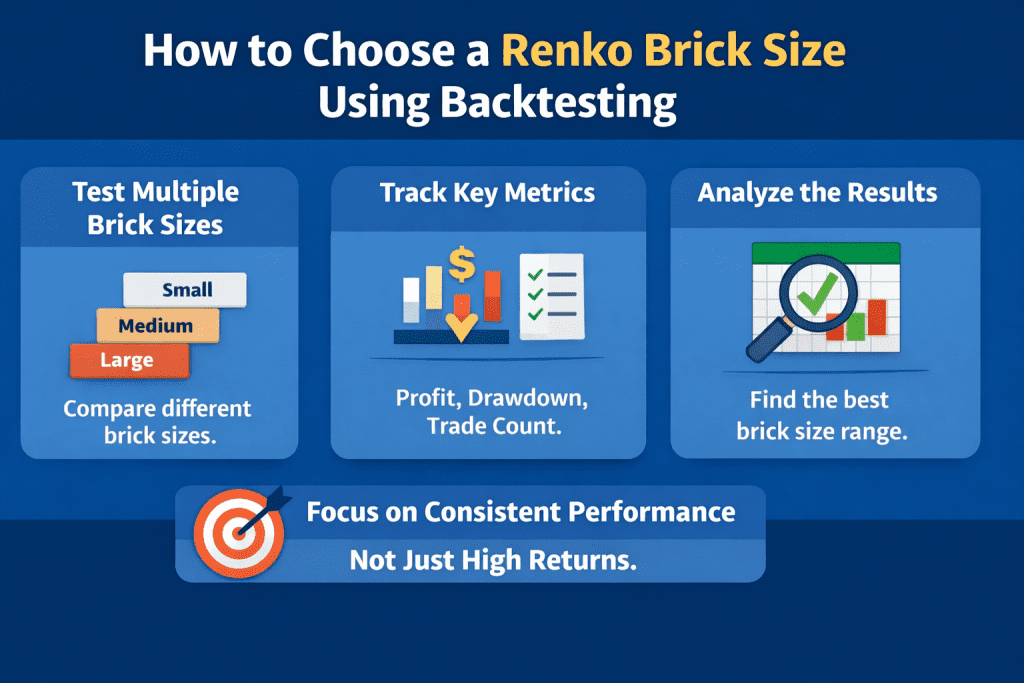
How to Choose a Renko Brick Size Using Backtesting
The most reliable way to select your baseline settings is by testing a single trading strategy across a wide range of box properties while keeping your underlying script execution rules completely frozen. When you modify only the Renko brick size as your lone independent variable, distinct data clusters emerge that reveal the true stability of your rules.
For this experiment, we applied a standardized long-only 3-brick trend-following system across multiple increments. For every individual size tested, we logged vital performance metrics, including total net profit, maximum peak-to-trough drawdown percentages, profit factor ratios, and total executed trade sample sizes. This multi-metric approach ensures you do not mistake a brief string of lucky trades for a structurally sound configuration.
Remember, the primary objective is never to hunt down a single, isolated “magic number” that printed a massive historical equity curve. Instead, your goal is to locate a stable Renko brick size cluster where performance remains resilient even if the underlying asset’s volatility fluctuates slightly. Shifting to an objective testing model helps you protect your trading account from sudden regime shifts.
Evaluating your rule sets across multiple layouts is critical to determining whether a Renko chart strategy beats buy and hold over extended market cycles. Furthermore, testing broader sizing distributions helps you actively minimize exposure to choppy Renko chart false signals that routinely deplete accounts during low-momentum consolidations.
Advanced Spreadsheeting: Advanced Performance Evaluation Metrics
Once your raw backtesting data is exported from TradingView into Google Sheets for side-by-side analysis, standard performance numbers like net profit are not enough to give you a full picture. To achieve true historical validation, you should build two custom evaluation parameters into your analysis spreadsheets:
1. Calculating Return over Drawdown (The Efficiency Score)
The Return over Drawdown metric serves as a direct efficiency rating for your strategy settings. It is calculated by dividing your total absolute net profit by the maximum historical drawdown percentage experienced over the exact same testing horizon. A strategy that generates a 100% return alongside a massive 50% drawdown yields an efficiency score of 2.0. Conversely, a layout generating a 60% return with an ultra-tight 10% drawdown produces a far superior score of 6.0. Prioritizing higher efficiency clusters ensures you preserve trading longevity.
2. Evaluating the Trades Score (Statistical Confidence)
The Trades Score acts as your primary defense against curve-fitting and statistical fragility. When you scale up to extremely large box sizes, your strategy’s trade count drops significantly. While a low trade sample size can occasionally show an artificially inflated profit factor or high return due to one or two massive trend moves, it lacks statistical relevance. Ensuring your configuration maintains a healthy trade count provides the mathematical confidence required to verify that the edge is truly repeatable.
Realistic Backtesting Rules: Next Brick Close Fills
A frequent error when executing a Renko brick size backtest within TradingView is relying on default order fill assumptions that assume perfect execution at the exact moment a box edge is touched. This mistake creates highly unrealistic performance metrics that cannot be duplicated in live order books.
To keep our framework conservative and realistic, our Pine Script testing routine enforces a strict **next brick close** execution rule. This logic prevents the engine from printing simulated fills inside active box boundaries before the price action has explicitly verified a complete structural close, drastically reducing backtest inflation and tracking error.
Additional Optimization Resources
To further refine your automated charting environment and strategy design, review these deep-dive analysis articles:
- ATR-Based Renko Brick Size Calculation: Proven Tips and Implementation Tricks
- Backtesting Renko Chart Strategies: Essential Optimization Techniques
- Renko Buy and Sell Signals: A Practical Workspace Execution Guide
- How to Choose the Best Renko Brick Size for Your Specific Strategy Rules
Connect With Our Trading Community
If you want to track live script experiments, custom indicator breakdowns, and algorithmic backtesting tutorials, join our global trading community on YouTube:
👉 Subscribe to the Renko Trading Channel on YouTube