Renko position sizing is one of the most important skills a trader can learn if the goal is to protect capital and stay consistent over time. Many traders spend most of their time searching for better entries, stronger indicators, or cleaner setups. But even a good entry can turn into a bad trade when the position size is too large for the account. Position sizing is only one part of the equation. You also need a complete Renko risk management strategy to control drawdowns and stay consistent over time.
One reason I like working with Renko charts is that they simplify price movement. Each brick represents a defined move in price, which makes it easier to estimate risk and plan a trade before entering it. If you are still learning how brick size works, you may want to review my guide on how to calculate Renko brick size because brick size directly affects stop distance and position sizing.
In this guide we will look at how account risk, brick size, and stop distance combine to determine trade size. This article is for educational purposes only. Trading strategies are ideas and experiments, not financial advice.
Why Position Sizing Matters More Than Most Traders Think
A surprising number of trading losses are not caused by a bad strategy. They happen because of poor risk control. A trader might have a reasonable entry signal but still lose too much money because the position size was too large.
Position sizing answers a critical question before the trade begins: How much money am I willing to lose if this trade fails?
- protect your account from large losses
- stay emotionally calm during trades
- keep drawdowns manageable
- evaluate strategies more fairly
- trade consistently across different setups
Even a strong strategy can struggle if trades are oversized. Good risk control allows traders to survive losing streaks and stay focused on the long term.
Why Renko Charts Help Simplify Risk Management
Renko charts remove much of the noise that exists in time-based charts. Instead of forming candles every minute or every hour, bricks form only when price moves a specific distance.
This structure can make it easier to understand risk. A trader can measure stop loss distance directly in bricks rather than relying on irregular candle sizes. If you are interested in how Renko signals work, you may also want to review my article on Renko buy and sell signals.
Because the brick size is known in advance, calculating risk becomes more structured. That is the foundation of renko position sizing.
The Basic Renko Position Sizing Formula
The logic behind position sizing is simple. You begin with the amount of money you are willing to risk on the trade.
Position Size = Dollar Risk per Trade ÷ Risk Per UnitIn Renko trading, the risk per unit comes from the brick size and the distance between the entry price and the stop loss.
Risk Per Unit = Brick Size × Stop Distance in BricksThis approach converts the chart structure into a clear and repeatable risk calculation.
Step 1: Decide Your Maximum Risk Per Trade
Before calculating trade size, decide how much of your account you are willing to risk on a single trade.
| Account Size | Risk % | Dollar Risk |
|---|---|---|
| $5,000 | 1% | $50 |
| $10,000 | 1% | $100 |
| $25,000 | 1% | $250 |
| $50,000 | 1% | $500 |
Many traders risk around one percent of their account per trade, although the exact number depends on personal risk tolerance and strategy design.
Step 2: Measure Stop Distance Using Renko Bricks
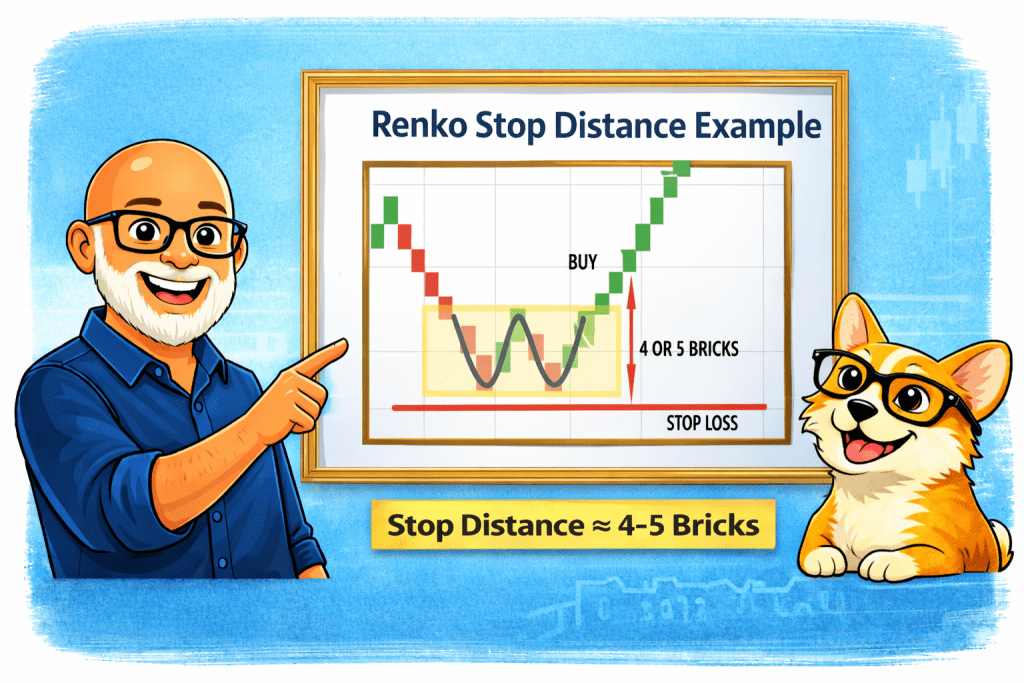
Once your maximum risk is known, the next step is determining where the trade becomes invalid. Renko traders often place stops a certain number of bricks away from the entry point.
If you want additional exit techniques, see my article on Renko stop loss and take profit methods.
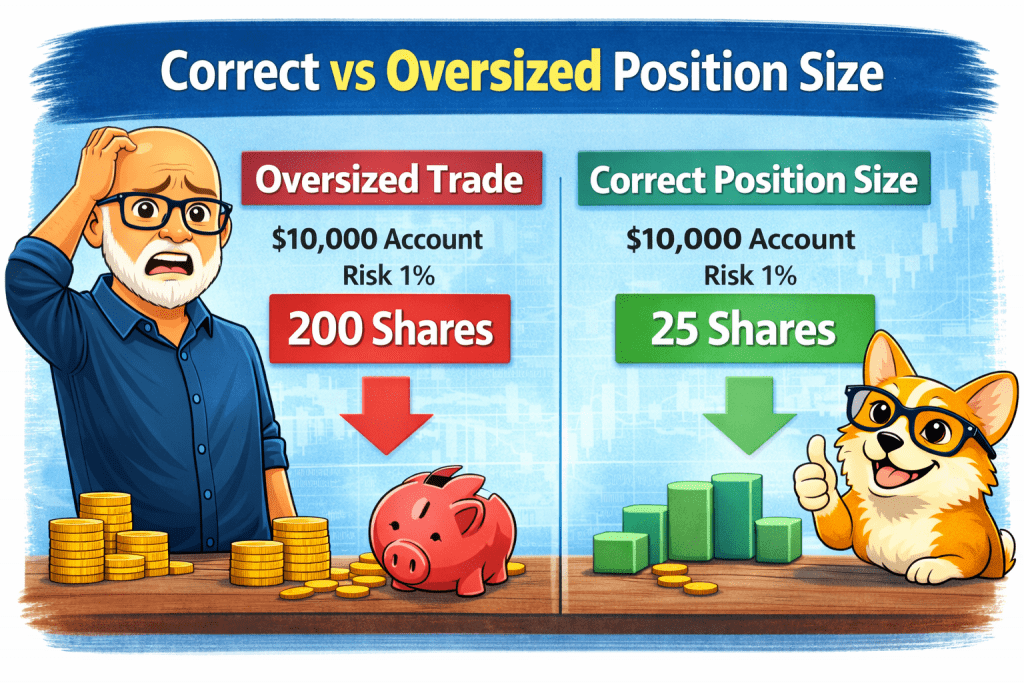
In a stock trade this would mean 25 shares. In other markets it could represent contracts, lots, or another unit size depending on the instrument.
How Renko Confirmation Timing Affects Position Sizing
Renko bricks only appear after price moves enough to meet the minimum brick size. In many charting platforms this calculation is based on the closing price of the underlying timeframe.
Because of this, Renko signals can appear after part of the move has already occurred. This slight delay is normal and part of how Renko filtering works.
If you want to understand this concept in more detail, see my article on early versus confirmed Renko entries.
Understanding confirmation timing helps traders avoid oversizing positions when a move is already extended.
Why Margin and Leverage Increase Risk
Margin trading allows traders to control larger positions using borrowed capital. This is common in forex and cryptocurrency markets where leverage levels can be very high.
While leverage can increase potential returns, it also magnifies losses. Incorrect position sizing in a leveraged environment can lead to rapid account drawdowns.
If you want to learn more about how margin works, the FINRA margin education page provides a helpful overview.
When Renko confirmation timing and leverage are combined, careful position sizing becomes even more important.
Common Mistakes Traders Make With Renko Position Sizing
- ignoring brick size when calculating trade risk
- risking too much capital on one position
- changing stop distance after entering a trade
- using the same position size across different markets
- forgetting to adjust size when brick size changes
How This Fits With Backtesting
Position sizing should also be part of the strategy development process. If you want to learn more about testing Renko strategies, see my article on backtesting Renko chart strategies.
Testing with realistic position sizing provides a more accurate view of drawdowns, trade consistency, and long-term performance.
Keeping Position Sizing Consistent Across Trades
One of the biggest advantages of structured position sizing is consistency. When traders calculate position size the same way on every trade, it becomes easier to evaluate performance objectively. Instead of guessing how much capital to commit, each trade follows the same risk framework.
For example, if you always risk a fixed percentage of your account and calculate the stop distance using Renko bricks, position size automatically adjusts to the setup. Trades with wider stops will use smaller position sizes, while trades with tighter stops can use slightly larger positions. This keeps overall risk balanced across different market conditions.
Over time, this consistency helps traders manage drawdowns, compare strategy performance more accurately, and avoid emotional decision making during volatile markets.
Final Thoughts on Renko Position Sizing
Renko position sizing converts chart structure into practical risk management. By combining account risk, brick size, and stop distance, traders can determine position size before entering a trade.
Renko charts simplify price movement, and position sizing can follow the same philosophy. Keep the process structured, consistent, and focused on protecting capital.
Educational purposes only. Trading strategies are ideas and experiments, not financial advice.