
Renko brick size wicks reversal confirmation video
Note: This content is for education and experimentation only, not financial advice.
Intro
If your Renko chart feels random, it is usually not you. It is usually the settings. In this video, we break down Renko brick size wicks reversal confirmation and show how these settings change what you see on the chart, how signals trigger, and why entries and exits can feel early or late.
This lesson focuses on the three Renko settings that matter most in TradingView and on most platforms: Renko brick size, wicks, and reversal confirmation. Together, these determine chart sensitivity, how much intrabrick movement you see, and when a trend flip is considered real.
What you’ll learn
- How Renko brick size wicks reversal confirmation changes chart behavior and signal timing.
- Why smaller bricks can mean more signals and more whipsaws, and why larger bricks can mean smoother trends but later exits.
- What Renko wicks really represent, and why wicks add detail without changing brick close logic.
- How reversal confirmation works and why it can reduce fake flips but delay entries and exits.
- A practical way to think about drawdown versus giveback when brick size and confirmation are involved.
Key takeaways for Renko brick size wicks reversal confirmation
Brick size
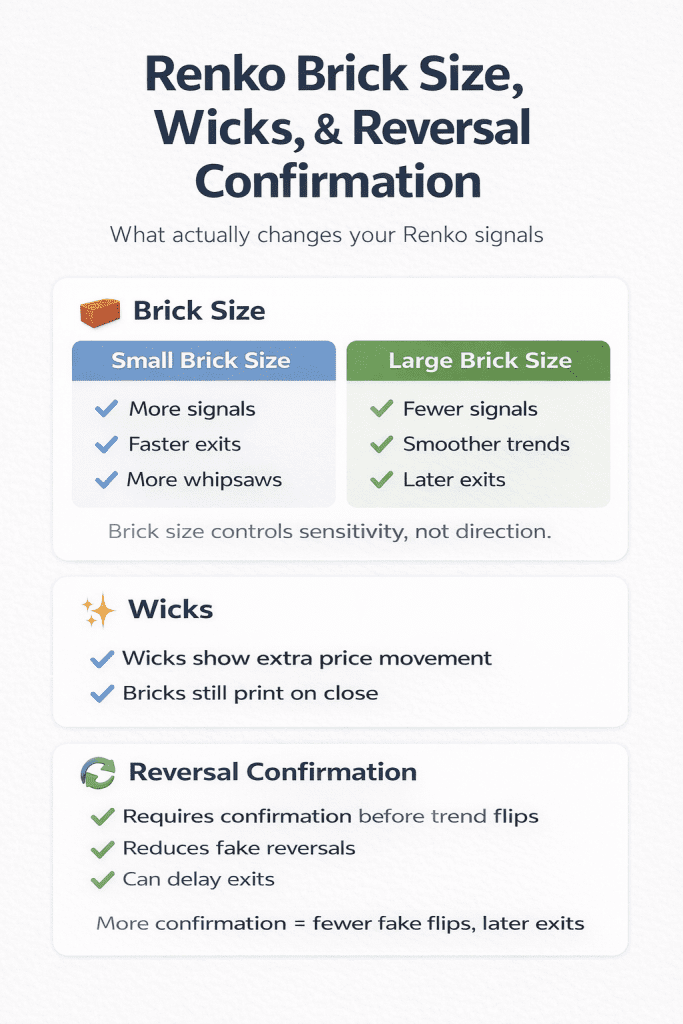
Brick size is the sensitivity dial. Smaller bricks react faster but can chop you up. Larger bricks filter noise but can confirm reversals later.
Wicks
Wicks show extra price movement inside the brick. Bricks still print based on closes. Wicks can help with context and trade management, but they do not change your core signal rules.
Reversal confirmation
Confirmation reduces fake flips. The trade-off is timing. Later confirmation often means later exits, which can increase giveback during reversals.
Additional learning
If you want to go deeper into Renko brick size wicks reversal confirmation, these related guides expand on the concepts covered in the video and show how to apply them in real TradingView workflows.
- How to calculate Renko brick size using ATR (and when fixed size works better)
- Best Renko chart settings for TradingView including brick size, wicks, timeframe, and signal setup
- Renko buy and sell signals explained with real chart examples
- Backtesting Renko strategies in TradingView step by step
- Advanced Renko strategies for experienced traders
- Renko indicators that work well with brick size and trend confirmation
Connect with me on YouTube
Subscribe for more Renko tutorials, TradingView testing, and practical strategy experiments on my YouTube channel: Renko Trading Channel.
FAQ
What is the best Renko brick size?
There is no single best size. Smaller bricks increase signal frequency and noise. Larger bricks smooth trends but can confirm reversals later. Choose a brick size that matches your time horizon and risk tolerance, then keep it consistent during testing.
Do wicks change Renko strategy signals?
No. Wicks add visual detail showing intrabrick extremes, but Renko signals and decisions are still based on brick closes and your rules. In other words, Renko brick size wicks reversal confirmation strategy decisions should rely on closes and confirmation rules, not wick spikes.
Why do Renko reversals feel late?
Many Renko settings use reversal confirmation, which requires additional movement before printing a reversal. This can reduce fake flips, but it can also delay exits and increase giveback during fast reversals.
Is drawdown the same as exit giveback?
No. Drawdown is peak-to-trough movement against your position. Exit giveback includes the extra movement that happens before your confirmation rule triggers an exit signal.