
How to Choose the Best Renko Brick Size for Your Strategy
How to choose the best Renko brick size for your strategy is one of the most important questions a Renko trader can ask. Brick size affects how much noise you see, how quickly trends appear, how often reversals show up, and how realistic your entries and exits feel during backtesting. If your brick size is too small, your chart can become noisy and trigger too many signals. If it is too large, you may miss important moves or enter trends too late. In this guide, I will walk through a simple practical way to choose a brick size that fits your strategy, market, and risk tolerance.
This article is educational and based on practical experimentation. It is not financial advice.
Why brick size matters so much on a Renko chart
On a Renko chart, brick size changes how price action is displayed. That means it directly influences the way your strategy behaves. A smaller brick size can create more signals, faster reversals, and more trading opportunities, but it can also create more false starts. A larger brick size can smooth out noise and make trend direction easier to see, but it may delay entries and exits.
That is why choosing the best Renko brick size is not just a technical setting. It is a strategy decision.
- Smaller bricks usually create more signals
- Larger bricks usually create cleaner trends
- Brick size affects stop loss distance and position sizing
- Brick size affects how often your strategy trades
- Brick size can change backtest results dramatically
How to choose the best Renko brick size for your strategy
My view is simple. The best Renko brick size is the one that matches the way your strategy is supposed to behave. Instead of asking, “What is the perfect brick size?” ask these better questions:
- Do I want faster entries or smoother trends?
- Am I trying to catch short swings or larger moves?
- Can I handle frequent signals and possible whipsaws?
- Does my stop loss still make sense with this brick size?
- Do my backtest results stay consistent across multiple periods?
If a brick size makes your chart clearer, helps your rules stay consistent, and performs reasonably well across different market conditions, that is usually a strong candidate.
Choosing the right brick size is only one part of building a successful trading approach. I also recommend creating clear rules for market selection, entries, exits, risk management, and trade review. You can see how I combine all of these pieces in my complete Renko trading system guide.
Fixed vs ATR-based brick size
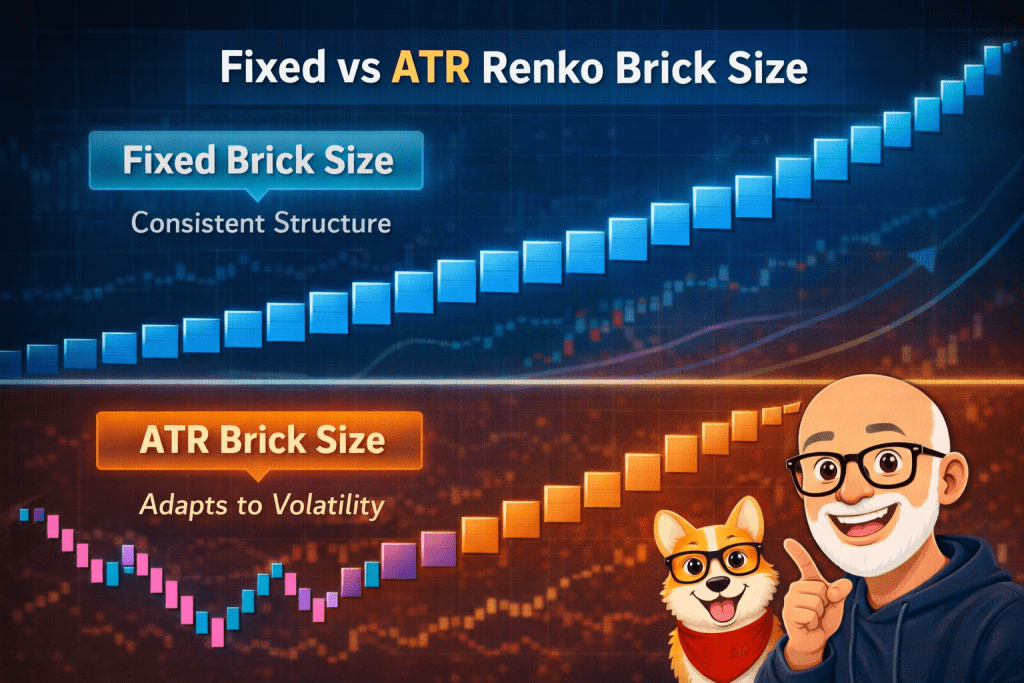
One of the biggest decisions in learning how to choose the best Renko brick size for your strategy is deciding between fixed-size bricks and ATR-based bricks.
Brick size is only one piece of the overall setup. Wicks, timeframe selection, and signal confirmation can also change how Renko charts behave during live trading and backtesting. For a complete walkthrough, see my guide to the best Renko chart settings for TradingView.
Fixed brick size
Fixed brick sizes stay the same until you change them manually. Many traders like them because they make charts easier to compare over time. They can also make backtesting more straightforward because the rules stay visually consistent.
- Good for consistent chart structure
- Easy to compare tests
- Often useful for strategy development
- May need adjustment when volatility changes a lot
ATR-based brick size
ATR-based brick sizes adjust with market volatility. When volatility rises, brick size can expand. When volatility falls, brick size can shrink. This can make the chart adapt more naturally, but it also means the chart behavior can change over time.
- Adapts to changing volatility
- Can be useful in fast-moving markets
- May be less visually consistent for comparison
- Can make backtest interpretation more nuanced
If you want a deeper look at ATR calculations, read ATR-Based Renko Chart Brick Size Calculation: Proven Tips and Tricks.
Match your Renko brick size to your strategy type
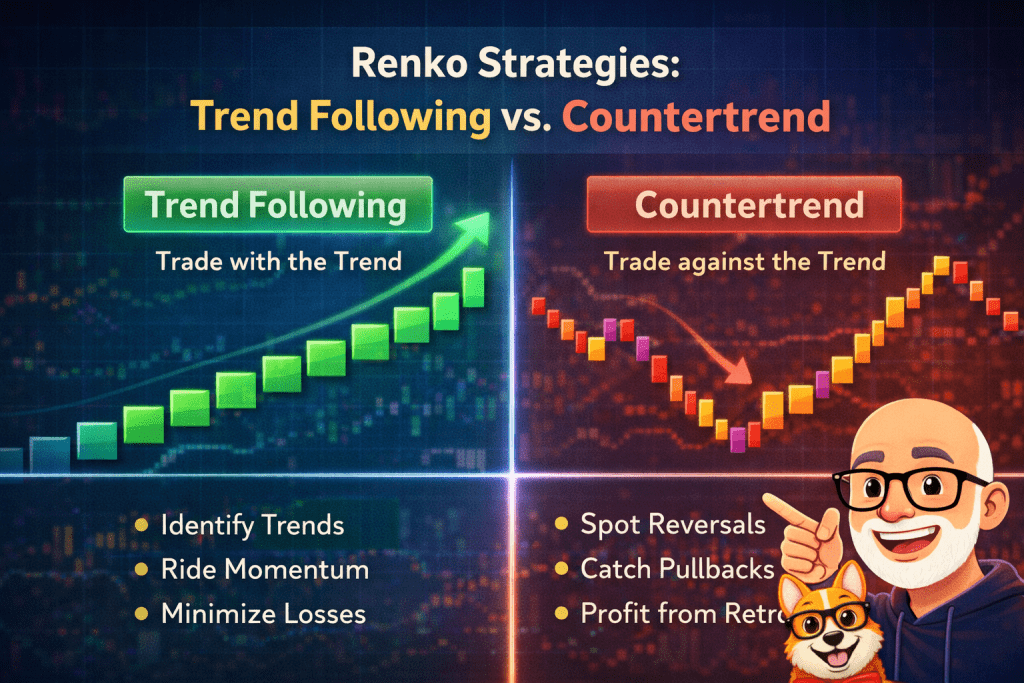
The best way to choose a Renko brick size is to match it to the job you want the chart to do.
| Strategy type | General brick size tendency | What to expect |
|---|---|---|
| Scalping or very short-term trading | Smaller bricks | More signals, more noise, faster reversals |
| Breakout trading | Small to medium bricks | Earlier signals with moderate filtering |
| Swing trading | Medium bricks | Better balance between responsiveness and clarity |
| Trend following | Medium to larger bricks | Cleaner trends, fewer false moves |
| Longer-term position trading | Larger bricks | Fewer signals, stronger focus on major moves |
If your strategy depends on catching early entries, a smaller brick may help. If your strategy depends on staying with the trend and avoiding overtrading, a larger brick often works better.
How market type affects the best Renko brick size
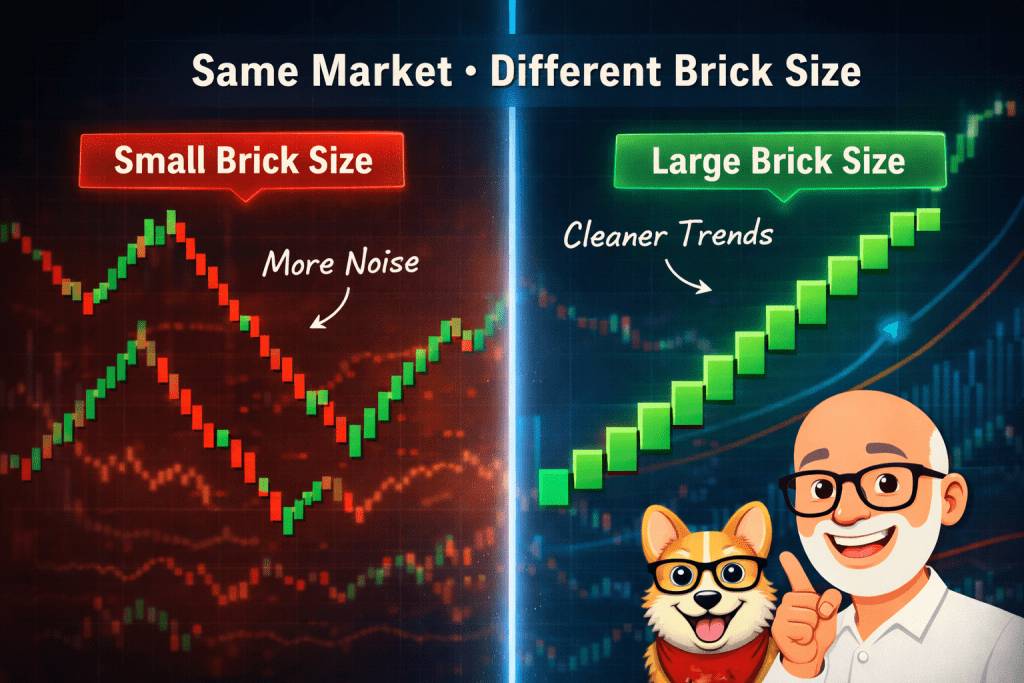
Different markets behave differently. That means the best Renko brick size for one market may not work well in another. For example, stocks can vary significantly in volatility and trend behavior, which is why I recommend reviewing examples of the best stocks for Renko trading before settling on a brick size.
- Stocks: Many traders use fixed brick sizes when testing a single stock over time, especially when trying to compare chart behavior clearly.
- Forex: Brick size often needs to reflect the pair’s typical movement and noise level.
- Crypto: Volatility can change quickly, so some traders prefer ATR-based bricks or at least more frequent review of fixed settings.
- Gold and commodities: These can move sharply, so brick size may need extra testing to avoid overly noisy charts.
For more on this, you can explore Best Markets for Renko Charts and Renko Brick Size for Gold.
The tradeoff between smaller and larger Renko bricks
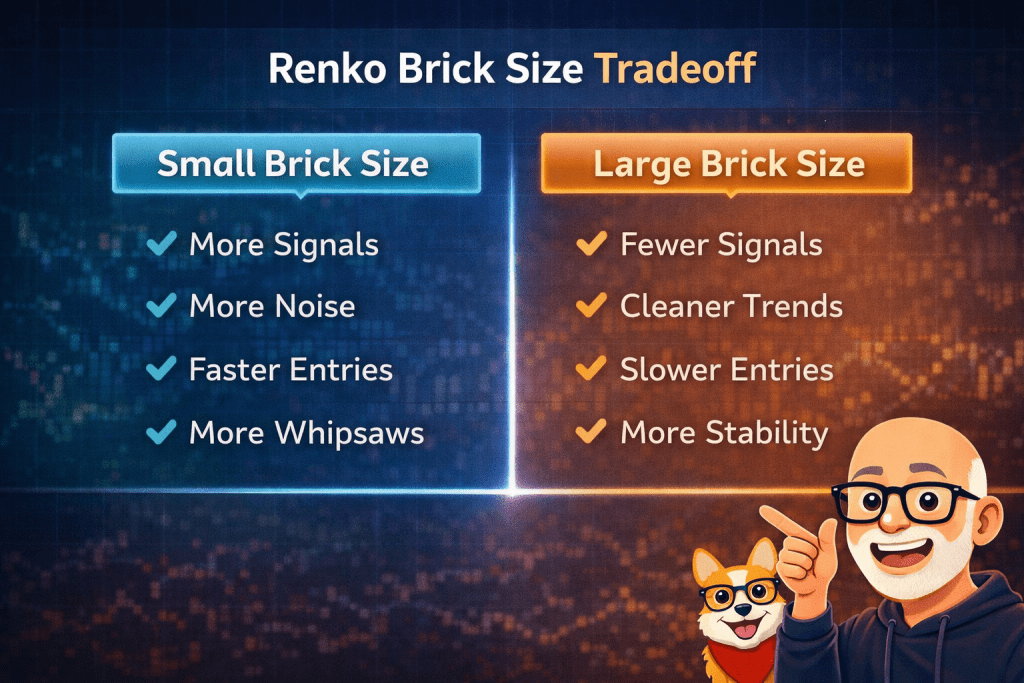
| Smaller bricks | Larger bricks |
|---|---|
| More trading signals | Fewer trading signals |
| More chart noise | Cleaner trends |
| Earlier entries | Later but often more stable entries |
| Higher chance of whipsaws | Higher chance of delayed reversals |
| Can fit aggressive strategies | Can fit trend-following strategies |
This tradeoff is why there is no universal best Renko brick size. The right setting depends on your goals, your risk management, and how much chart noise you are willing to tolerate.
A simple process I use to test Renko brick size
When I test Renko brick size, I try to keep the process simple and repeatable.
- Start with a reasonable brick size based on the market and strategy
- Run a backtest over a meaningful period
- Try one slightly smaller and one slightly larger setting
- Compare trade count, drawdown, trend quality, and overall clarity
- Avoid choosing a setting just because it produced one unusually strong backtest
If one setting only works well in a narrow period, that can be a warning sign. I prefer a brick size that performs reasonably well across different periods rather than one that looks amazing in only one sample.
You may also want to review Renko Brick Size Backtesting in TradingView and Backtesting Renko Chart Strategies: Tips and Techniques.
Common mistakes when choosing Renko brick size
- Choosing bricks that are too small: This can make the chart look busy and lead to overtrading.
- Choosing bricks that are too large: This can hide useful detail and delay entries or exits.
- Ignoring risk management: Brick size affects stop distance, trade size, and position risk.
- Optimizing too aggressively: A perfect historical result may not hold up later.
- Using the same setting for every market: Stocks, forex, crypto, and commodities can behave very differently.
That is also why risk control matters. See Renko Risk Management Strategy and Renko Position Sizing for related ideas.
My practical view on the best Renko brick size
If you are wondering how to choose the best Renko brick size for your strategy, my practical answer is this: choose the brick size that makes your strategy easier to execute consistently, not the one that looks most impressive in one backtest. Good Renko settings help you see trend structure clearly, manage trades logically, and avoid unnecessary noise.
In many cases, a medium setting that balances clarity and responsiveness is a better starting point than going to extremes. From there, test slightly up and slightly down, compare behavior, and keep the process simple.
Helpful tools and next steps
- Use my free Renko brick size calculator if you want a practical starting point
- Compare timing tradeoffs in Renko Entry Timing: Early vs Confirmed Entries
- Review timeframe considerations in Best Timeframe for Renko Charts
If you want official platform documentation, you can also review external resources like TradingView Support or read more about average true range at Investopedia.
Frequently Asked Questions
What is the best Renko brick size for beginners?
For beginners, the best Renko brick size is usually one that balances clarity and responsiveness. A medium brick size often makes trends easier to see without creating too much noise. The key is to start simple and test the setting against your strategy.
Is ATR or fixed brick size better for Renko charts?
Neither is automatically better in every situation. Fixed brick sizes offer consistency and can be easier to compare in backtesting, while ATR-based bricks adjust to volatility and may adapt better in changing markets.
How do I know if my Renko brick size is too small?
If your chart produces too many signals, frequent reversals, and a lot of noise, your brick size may be too small. That can make it harder to follow trends and may lead to overtrading.
How do I know if my Renko brick size is too large?
If your chart reacts too slowly, hides useful price movement, or delays entries and exits too much, your brick size may be too large. Larger bricks can improve clarity, but they can also reduce responsiveness.
Should I use the same Renko brick size for every market?
No. Different markets have different volatility patterns. A brick size that works for one stock, forex pair, or crypto asset may not work well for another. It is usually better to test settings based on the market you trade.
Conclusion
Learning how to choose the best Renko brick size for your strategy is really about matching chart structure to trading purpose. Smaller bricks can help you react faster, while larger bricks can help you stay focused on bigger trends. Fixed settings can improve consistency, while ATR-based settings can adapt to changing volatility. The best choice depends on what you trade, how you manage risk, and how your rules perform across multiple tests.
Keep it practical, test carefully, and avoid overfitting. A clear repeatable process will usually beat a complicated one.