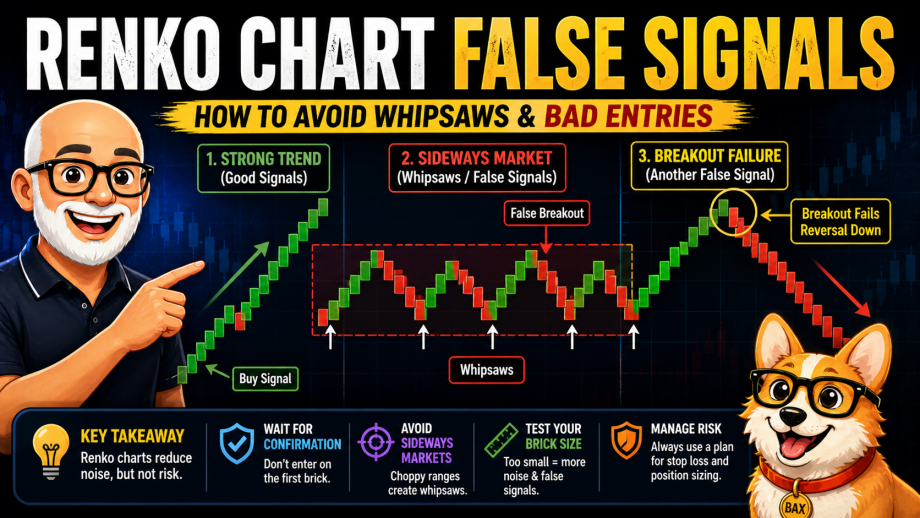
Renko charts can make trading feel cleaner, calmer, and easier to read. Instead of watching every tiny candle wiggle, you get a chart built around price movement. That is one of the biggest reasons I like using Renko charts for trading experiments.
But here is the important part: Renko charts are not magic. They reduce noise, but they do not remove risk. Renko chart false signals can still happen, especially in choppy markets, sideways ranges, and during sudden reversals.
In this guide, I will walk through why Renko false signals happen, what they look like, and how I try to avoid bad entries using confirmation, brick size testing, trend direction, support and resistance, and simple risk management rules.
What Are Renko Chart False Signals?
A Renko chart false signal happens when the chart appears to show a new trade opportunity, but the move does not follow through. This can happen after a color change, a breakout, a trendline break, or a short sequence of new bricks in the opposite direction.
For example, you might see a new green Renko brick after a downtrend and think a bullish reversal is starting. But instead of continuing higher, price quickly reverses and prints red bricks again. That is a common Renko whipsaw.
Before acting on a signal like this, I like to slow down and score the full setup using my Renko trade setup checklist. It helps me check trend direction, market condition, confirmation, and risk before entering.
The problem is not that the Renko chart is broken. The problem is that Renko charts are still based on price movement, and price movement can be messy. No chart type can completely eliminate false signals.
If you are new to Renko charts, this Renko chart explanation provides a helpful overview of how bricks are formed and why signals can sometimes fail.
Why Renko Charts Still Create False Signals
Renko charts filter out time, but they do not filter out uncertainty. That is an important distinction.
A Renko chart only prints a new brick when price moves far enough to meet the selected brick size. This can make trends look smoother. But when the market is moving sideways, price may still travel far enough to print alternating bricks without creating a real trend.
That is where many Renko chart false signals come from. The chart looks clean, but the market underneath may still be undecided.
Common Types of Renko Chart False Signals
Not all false signals look the same. Here are the most common ones I watch for when testing Renko strategies.
1. Brick Color Flip Traps
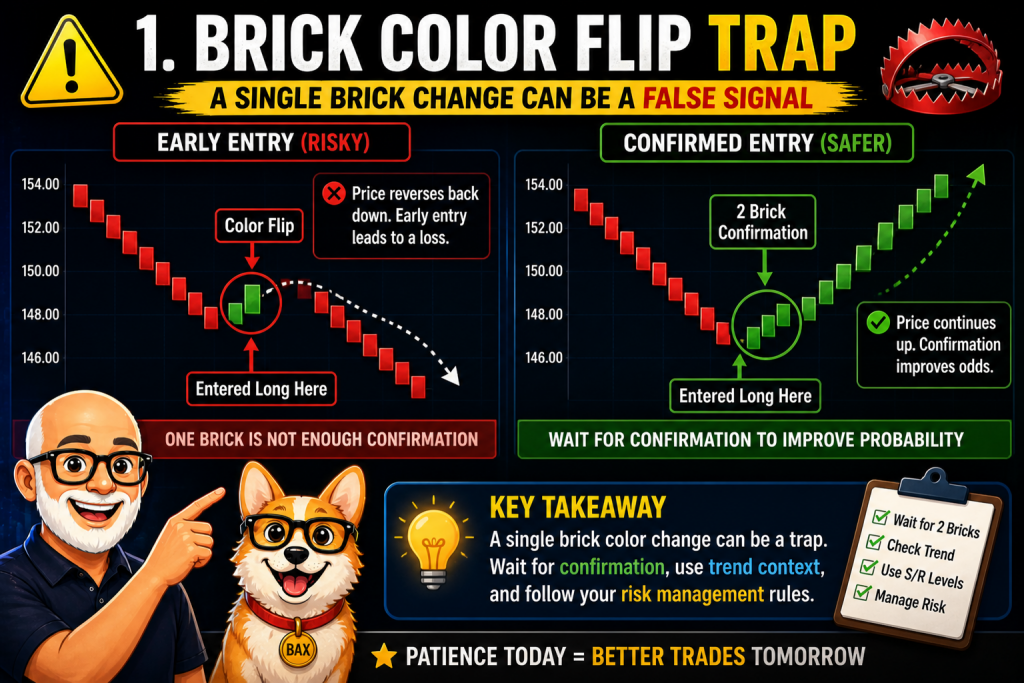
This is one of the simplest and most tempting signals. A red brick changes to green, or a green brick changes to red. It feels like a reversal is starting.
The danger is entering too quickly. A single color change can be useful information, but by itself it may not be enough confirmation. The market may only be pausing before continuing in the original direction.
One way to reduce this problem is to wait for additional confirmation, such as a second brick in the new direction, a trendline break, or a move beyond a recent support or resistance level.
2. Sideways Range Whipsaws
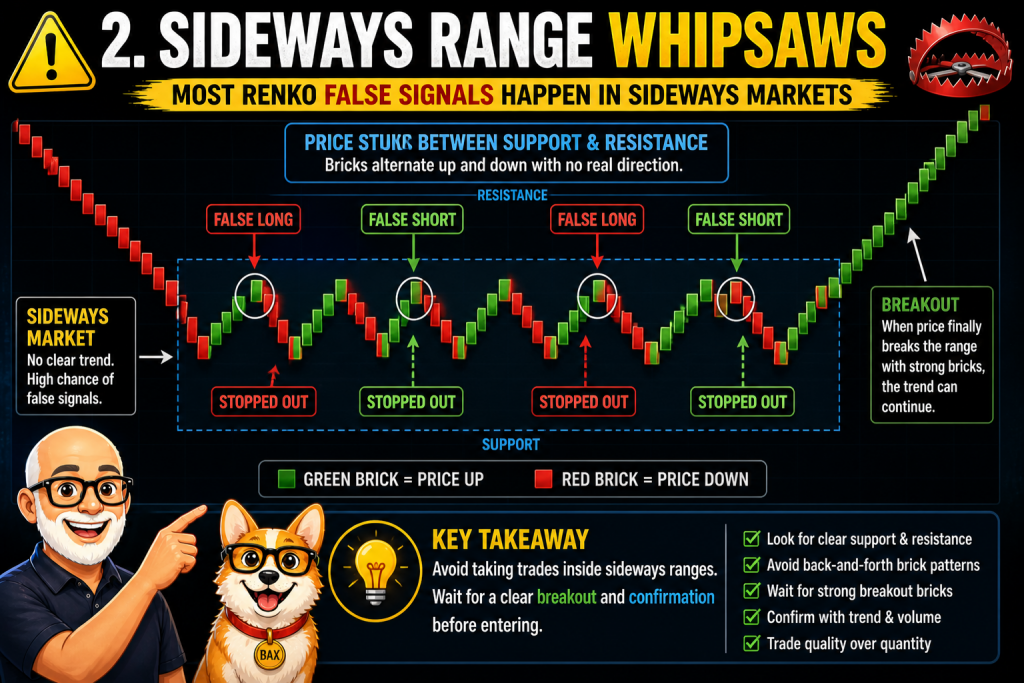
Sideways markets are where Renko charts can become tricky. A chart may print green bricks, then red bricks, then green bricks again, but price is really just moving inside a range.
This is where traders can get chopped up. You buy the green signal, then get stopped out. You short the red signal, then get stopped out again.
When I see a Renko chart moving sideways between clear support and resistance, I become more cautious. I would rather miss one early breakout than take several low-quality trades inside a messy range.
3. Brick Size Too Small
A small brick size can create more signals. That sounds good at first, but more signals do not always mean better results.
If the brick size is too small, the Renko chart may react to normal price movement instead of meaningful price movement. This can lead to more false entries, more exits, and more emotional decision-making.
This is why I like testing different brick sizes in TradingView. A slightly larger brick size may reduce the number of trades but improve the quality of the signals.
4. False Breakouts
A false breakout happens when price appears to break above resistance or below support, but the move fails quickly.
On a Renko chart, this can look convincing because the breakout may print a clean new brick. But if the breakout does not continue, the trader may be stuck in a bad entry.
One filter I like is to ask: did the breakout actually clear an important level, or did it only print one exciting brick near the edge of a range?
How to Avoid Renko Chart False Signals
You cannot avoid every false signal. That is not realistic. But you can create rules that help reduce the number of weak entries.
1. Wait for Confirmation
The easiest way to reduce Renko chart false signals is to avoid entering on the very first clue.
Instead of entering on the first color change, you might wait for:
- A second brick in the new direction
- A break of a recent swing level
- A trendline breakout
- A close beyond support or resistance
- Confirmation from a moving average or Supertrend
The trade-off is simple. Waiting for confirmation may give you a later entry, but it may also help you avoid some of the weakest signals.
2. Test Your Brick Size
Brick size is one of the most important Renko settings. It controls how sensitive the chart is.
A smaller brick size may create earlier signals, but it can also create more whipsaws. A larger brick size may smooth the chart, but it can also create later entries and wider stops.
That is why I prefer testing multiple brick sizes instead of assuming one setting is best. The best brick size depends on the market, timeframe, volatility, and strategy rules.
Related guide: Renko Brick Size Backtesting in TradingView
3. Avoid Choppy Ranges
Some of the worst Renko false signals happen when the market has no clear direction.
Before taking a trade, I like to ask:
- Is the chart making higher highs and higher lows?
- Is the chart making lower highs and lower lows?
- Is price stuck between support and resistance?
- Are bricks alternating back and forth with no follow-through?
If the chart is stuck in a sideways box, I usually become more selective. Renko charts can help identify trends, but they can still struggle when there is no real trend to follow.
Related guide: Renko Support and Resistance
4. Use Trend Direction as a Filter
One simple filter is to trade with the larger trend. For example, if the broader Renko structure is bullish, I may be more interested in long setups than short setups.
This does not guarantee success, but it can help avoid fighting the larger move. A countertrend signal may still work, but it usually needs stronger confirmation.
Trendlines can also help. If price is above a rising trendline, a single red brick may not be enough to call a full bearish reversal. If price breaks the trendline and continues lower, that may be more meaningful.
Related guide: Renko Trend Trading Tips
5. Use Stop Loss Rules Before Entering
A false signal becomes much more dangerous when there is no exit plan.
Before entering a Renko trade, I want to know where the setup is wrong. That could be:
- A reversal brick
- A break below recent support
- A close below a moving average
- A fixed number of bricks against the trade
- A percentage-based stop
The exact rule depends on the strategy. The key is to define the risk before the trade starts.
Related guide: Renko Stop Loss and Take Profit Methods
Early Entry vs Confirmed Entry
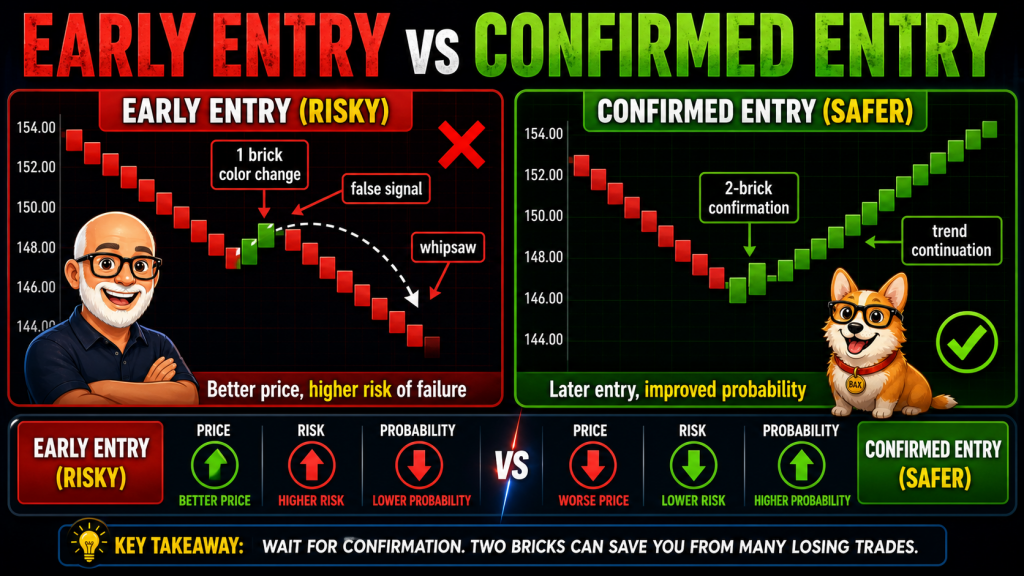
One of the biggest decisions in Renko trading is whether to enter early or wait for confirmation.
| Entry Type | Advantage | Risk |
|---|---|---|
| Early entry | Better price if the move works | More false signals |
| Confirmed entry | More evidence before entering | Later entry |
There is no perfect answer. Early entries can be powerful, but they can also create more losses. Confirmed entries may be safer, but they can miss part of the move.
That is why I like testing both. A good Renko strategy should not just look good visually. It should be tested across enough trades to see whether the rules actually hold up.
Related guide: Renko Entry Timing: Early vs Confirmed Entries
Do Renko Charts Repaint?
This is an important question, especially for TradingView users.
Renko charts can behave differently from regular time-based candles because they are built from price movement instead of fixed time intervals. Depending on the platform, settings, and whether you are using historical or real-time data, signals may appear cleaner in hindsight than they felt in real time.
That does not mean Renko charts are useless. It means traders should be careful when backtesting and avoid assuming that every historical signal would have been easy to trade live.
When testing Renko strategies, I like to pay attention to:
- How the chart behaves in real time
- Whether entries are based on confirmed bricks
- Whether the strategy uses realistic order assumptions
- Whether the same rules work across different markets
- How much drawdown the strategy creates
Trading platforms can handle Renko data differently, so it is worth reviewing how Renko charts work in TradingView to better understand how bricks are calculated and displayed.
My Simple Checklist for Avoiding Bad Renko Entries
Here is a simple checklist I would use before taking a Renko signal:
- Is the market trending or moving sideways?
- Is the brick size reasonable for this market?
- Is this only a one-brick color change?
- Has price cleared support or resistance?
- Is there confirmation from trend direction?
- Do I know where my stop loss goes?
- Have I tested this rule before trusting it?
This checklist will not remove all losing trades. Nothing will. But it can help avoid impulsive entries based on one exciting brick.
Final Thoughts on Renko Chart False Signals
Renko chart false signals are part of trading. Renko charts can reduce noise, but they cannot remove uncertainty, bad entries, or market chop.
The goal is not to find a perfect signal. The goal is to build a practical process. For me, that means testing brick sizes, waiting for confirmation, respecting support and resistance, using clear exit rules, and remembering that every strategy needs risk management.
Renko charts can be a powerful tool, but they work best when combined with patience, structure, and realistic expectations.
If you are experimenting with Renko strategies, treat every setup as an idea to test, not a guarantee. That mindset keeps the process educational, practical, and safer.