
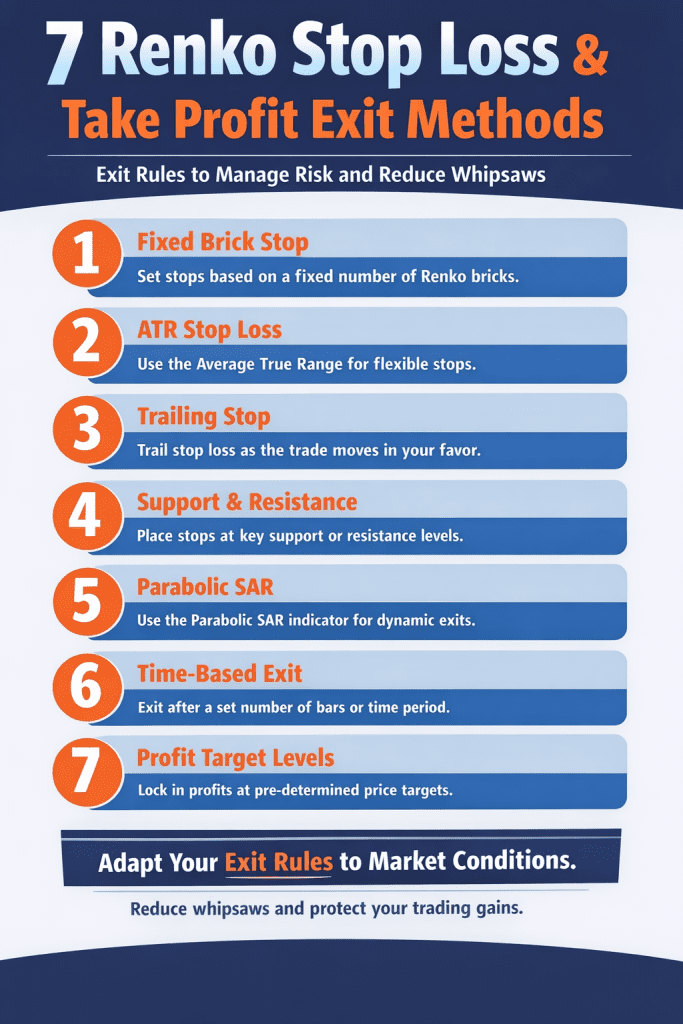
If you trade Renko charts, your entries usually look cleaner than candlestick charts. Exits are where most traders still struggle.
This page breaks down seven practical Renko stop loss and take profit methods, explains when each one works best, and outlines a clean way to test them consistently across different market conditions.
Educational only. These are strategy ideas and experiments, not financial advice.
Why Renko Exits Feel Different
Renko charts are built on price movement, not time. That changes how exits behave compared to traditional candles.
- Stops based on time candles often translate poorly
- Tight stops can get clipped during sideways movement
- Wide stops can inflate drawdowns unnecessarily
The goal is not perfect exits. The goal is repeatable exit rules that survive different market conditions.
Renko Stop Loss Quick Start
If you want a simple starting point, use a fixed Renko stop loss of 3 to 6 bricks and only adjust after you have enough trades to review.
Renko Stop Loss Methods: 7 Exit Rules You Can Use
Each exit method below should be tested independently. Change only one variable at a time when backtesting.
| Exit Method | Best For | Main Weakness |
|---|---|---|
| Fixed Brick Stop | Simple systems | Too tight in chop |
| Swing Stop (W / M) | Structure-based exits | Needs clean swings |
| Trendline Break Exit | Trend following | Rule definition matters |
| ATR-Based Stop | Volatility adjustment | Can widen quickly |
| Moving Average Exit | Smoother exits | Late signals |
| Trailing Brick Stop | Strong trends | Profit giveback |
| Time Stop | Avoiding dead trades | Can exit early |
1) Renko Stop Loss Using a Fixed Brick Stop
Place your stop a fixed number of bricks against your position.
- Example: stop 4 bricks below entry
- Optional take profit at 2R or 3R
This approach is easy to test and keeps risk consistent. It struggles most during sideways markets, where Renko chart false signals can lead to repeated stopouts and inconsistent results.
2) Swing Stop Using W and M Structure
Stops are placed beyond the most recent swing low for longs or swing high for shorts.
This method aligns exits with visible Renko structure and works best when price forms clean reversals.
3) Trendline Break Exit
Stay in the trade until a clearly defined trendline is broken, then exit on confirmation.
This approach is effective for trend riding but requires strict, repeatable trendline rules.
4) ATR-Based Stop for Renko
ATR can be used as a volatility guide by converting ATR distance into Renko brick distance.
This helps stops adapt to changing volatility while still respecting Renko structure.
5) Moving Average Exit
Exit when price closes on the opposite side of a moving average or when the slope changes direction.
This reduces micromanagement but often exits later than other methods.
6) Trailing Stop by Bricks
Trail your stop a fixed number of bricks behind the most favorable price movement.
This locks in profits during strong trends while allowing room for continuation.
7) Time Stop
If a trade does not progress after a defined number of Renko bars or sessions, exit.
This prevents capital from getting stuck in low-momentum conditions.
If you feel like your exits are “wrong,” it may be the market condition instead of the method. Stops behave very differently in trends vs ranges. I break that down here: when Renko charts work best and how to spot choppy periods that cause rapid stopouts.
Stop losses are just one tool. A full Renko risk management strategy helps you manage losing streaks, position size, and overall exposure. Exit strategies play a major role in results, especially when comparing whether Renko beats buy and hold in different market environments.
How to Backtest Renko Exit Rules Correctly
- Use one market and one brick size
- Keep entry rules fixed
- Test one exit method at a time
- Track drawdown, profit factor, win rate, and trade count
If your drawdown explodes, the exit rule is doing its job by revealing risk.
Connect With Me on YouTube
If you prefer learning visually, I share step-by-step Renko trading experiments, strategy breakdowns, and rule-based decision making on my YouTube channel.
You can find all of my Renko-focused videos here: Renko Trading Channel on YouTube.
The channel focuses on education, testing ideas, and understanding how Renko charts behave across different market conditions. Nothing is presented as financial advice.
Additional Reading and Learning
- What Is a Renko Chart? Beginner’s Guide to Trading with Brick Charts
- Renko Chart Basics: A Beginner’s Guide to Reading and Trading
- Renko Charts and Trendlines: Exit Rules That Protect Your Profits
- Backtesting Renko Chart Strategies Like a Pro
- Best Renko Chart Indicators: Full List and Examples
- Renko Buy and Sell Signals: Patterns and Examples