
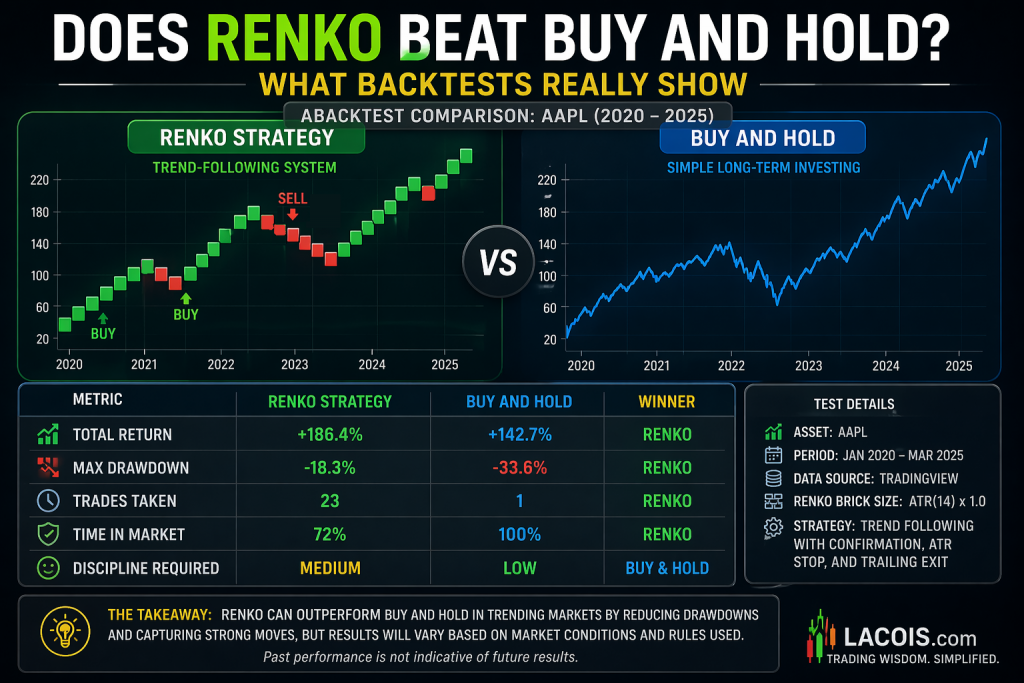
If you spend enough time testing Renko strategies, one question eventually rises above the rest: does Renko beat buy and hold?
It is a fair question. Buy and hold is simple, low maintenance, and very hard to beat over long periods when strong assets keep climbing. Renko, on the other hand, promises cleaner trends, less noise, and more disciplined entries and exits. So which approach actually performs better?
The honest answer is this: sometimes Renko beats buy and hold, and sometimes it does not. What backtests really show depends on the market, the time period, the brick size, the rules you use, and how realistic your testing process is.
In this article, I will walk through how to think about the comparison, when Renko has an edge, when buy and hold still wins, and what mistakes can make Renko backtests look better than they really are.
This content is for educational purposes only and reflects testing ideas, not financial advice or a recommendation to buy or sell any asset.
The Real Question Behind “Does Renko Beat Buy and Hold?”
Most traders do not ask this question at the beginning. First, they learn how Renko charts work. Then they test entries, exits, brick sizes, and indicators. After that, they start looking at strategy results and wonder whether all that extra effort is actually improving performance compared to simply holding a strong asset.
That is why this comparison matters. If a Renko strategy cannot improve returns, reduce drawdowns, or help you follow a more disciplined process, then buy and hold may remain the better fit for that situation.
If you are still building your Renko foundation, you may want to start with my guide on how Renko charts work and my article on how to choose the best Renko brick size.
How I Think About the Comparison
When asking whether Renko beats buy and hold, I do not think only in terms of raw return. I look at the bigger picture:
- Total return
- Maximum drawdown
- Trade frequency
- Time spent in the market
- Emotional difficulty of following the method
- Consistency across different market conditions
A strategy that slightly underperforms buy and hold but cuts drawdown significantly may still be valuable for some traders. Likewise, a strategy that beats buy and hold in one backtest but falls apart in choppy periods may not be as strong as it first appears.
When Renko Can Beat Buy and Hold
Renko tends to perform best when markets show strong, sustained directional movement. Because Renko filters out a lot of small price fluctuations, it can help traders stay focused on the bigger trend instead of reacting to every short-term wiggle.
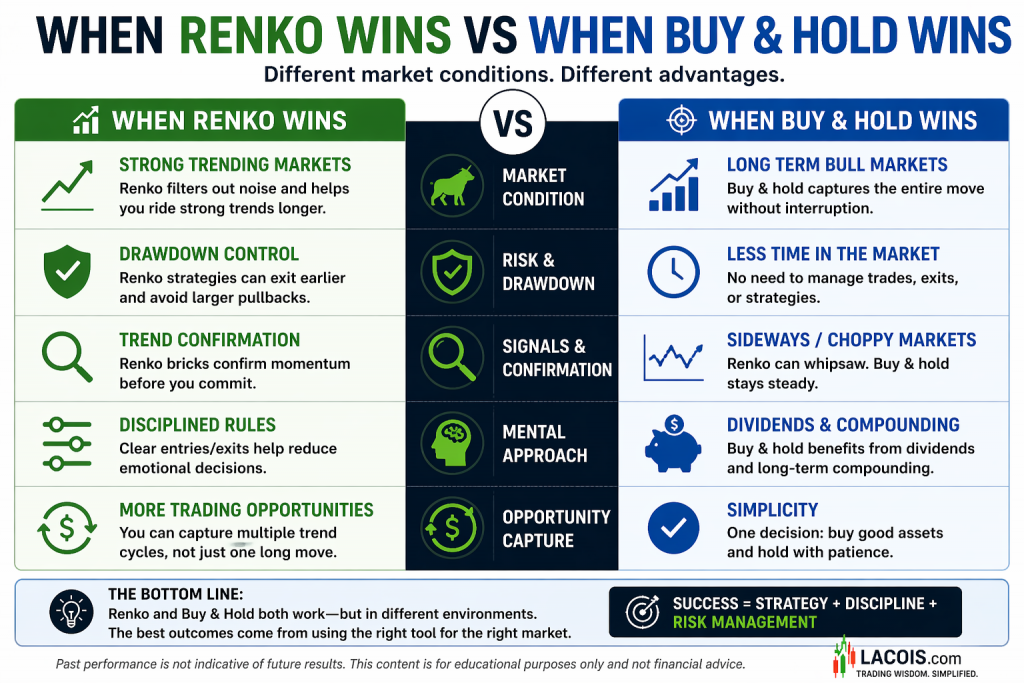
In those environments, a good Renko strategy may outperform buy and hold in a few ways:
- It may enter after trend confirmation and avoid some weak periods.
- It may exit during meaningful reversals instead of sitting through large drops.
- It may reduce emotional overreaction by simplifying the chart.
- It may help traders stay disciplined enough to actually follow their system.
This is especially true when your method is designed around trend continuation and risk control. If that is your style, see my articles on Renko trend trading and Renko entry timing.
When Buy and Hold Still Wins
Buy and hold still has powerful advantages. It is simple. It avoids frequent trading decisions. It can capture the full move of a strong long-term winner without interruption. And it does not depend on fine-tuning entries, exits, or brick size settings.
Buy and hold often wins when:
- The asset trends strongly upward over a long period.
- Your Renko strategy exits too early and misses big continuation moves.
- Your system gets chopped up by whipsaws.
- Your backtest includes too many rules that do not generalize well.
This is where many traders get humbled. A complicated Renko strategy can look smart, but if it repeatedly exits good positions too early or re-enters late, buy and hold can still come out ahead.
What Backtests Really Show
Backtests can be extremely useful, but they need to be interpreted carefully. A Renko backtest is not automatically proof that Renko beats buy and hold. It is only evidence of how a particular set of rules performed on a particular asset during a particular period.
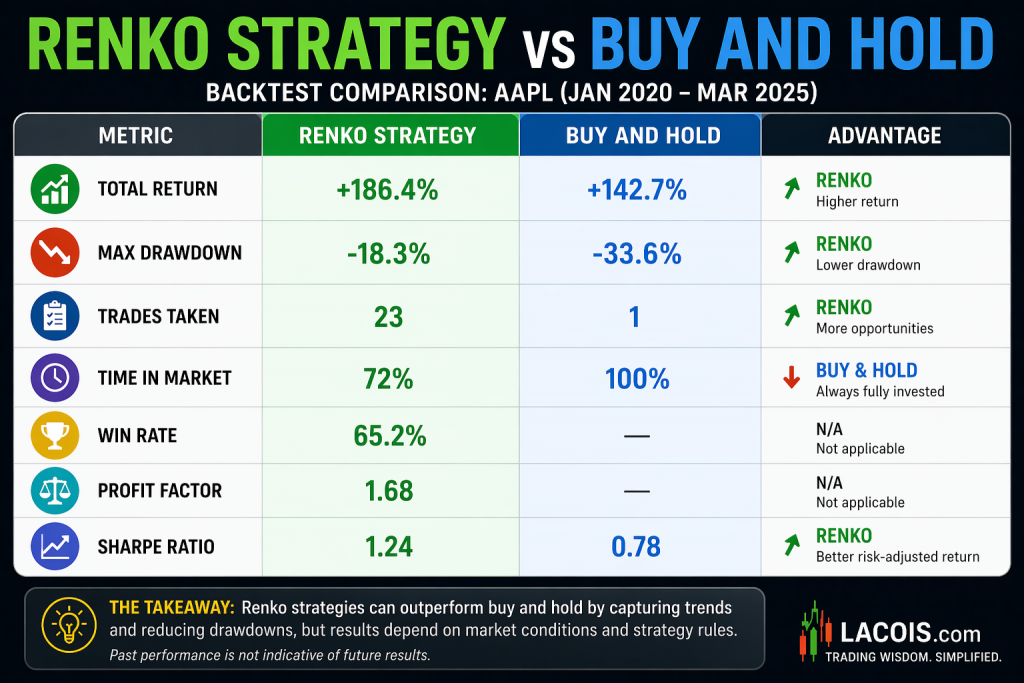
That means you should pay attention to questions like these:
- What asset was tested?
- What date range was used?
- Was the market mostly trending or choppy?
- Was the brick size fixed or ATR-based?
- Were commissions, slippage, or unrealistic fills ignored?
- Did the strategy perform well across multiple symbols or only one?
If you only test one strong period on one strong asset, it is easy to convince yourself that Renko beats buy and hold. That conclusion may not survive broader testing.
For more on realistic testing, TradingView has documentation explaining how non-standard chart types such as Renko are constructed and how strategy testing works on their platform: Understanding Renko Charts on TradingView and TradingView strategy tools and automation resources.
The Biggest Mistakes in Renko vs Buy and Hold Comparisons
If you really want to answer the question does Renko beat buy and hold, avoid these common mistakes:
1. Using only one market
A strategy that beats buy and hold on one chart may fail badly on another. Test multiple assets and different market conditions.
2. Over-optimizing the brick size
If you keep adjusting the brick size until the backtest looks amazing, you may be fitting the past rather than building a durable method. My article on Renko brick size backtesting in TradingView goes deeper into this problem.
3. Ignoring drawdowns
A higher return does not always mean a better strategy. If Renko slightly beats buy and hold but requires much more effort and still suffers painful drawdowns, the advantage may not be meaningful.
4. Forgetting execution reality
Backtests do not always reflect the stress, hesitation, slippage, and imperfect fills that happen in live trading.
5. Assuming every Renko strategy is the same
There is no single Renko method. One breakout strategy may beat buy and hold in a trend, while another may lag badly.
A Better Way to Compare Renko and Buy and Hold
If you want a more honest comparison, use a simple evaluation framework:
- Choose one asset and one date range.
- Define the buy and hold result clearly.
- Define the Renko strategy rules clearly.
- Use the same period for both.
- Compare return, drawdown, and trade behavior.
- Repeat the process on multiple assets.
This helps you avoid turning one lucky backtest into a sweeping conclusion.
So, Does Renko Beat Buy and Hold?
Sometimes, yes. But not automatically.
If your Renko method is built to ride trends, control risk, and avoid major drawdowns, it can absolutely outperform buy and hold in certain environments. But in strong long-term bull moves, especially when your system exits too early or gets whipsawed, buy and hold can still win.
That is why I think the better conclusion is this:
Renko does not magically beat buy and hold. A well-tested Renko strategy can beat buy and hold under the right conditions, but only if the rules are realistic and the testing is honest.
My Practical Take
I do not look at Renko as a magic replacement for investing. I look at it as a tool that can help improve structure, timing, and discipline. In some cases, that can lead to better results than buy and hold. In other cases, the biggest benefit may be lower stress, cleaner trend visibility, or a more repeatable process.
If you want to see how I combine stock selection with Renko chart analysis, watch my Value Stocks 2025: Screening + Renko Charts for Smarter Entries video. It shows how I use fundamental screening first, then review Renko charts for possible trend structure and entry timing.
If you want to improve your exits and risk controls as part of that process, you may also find these guides helpful:
- Renko stop loss and take profit exit methods
- Renko risk management strategy
- Backtesting Renko chart strategies
Final Thoughts
If you have been wondering does Renko beat buy and hold, the best answer is to stop looking for hype and start looking for honest comparisons. Test multiple markets. Compare return and drawdown. Keep the rules simple. And remember that a strategy only matters if you can actually follow it in real life.
Renko can be a powerful tool, but what backtests really show is that context matters. The market matters. The rules matter. And disciplined testing matters most of all.