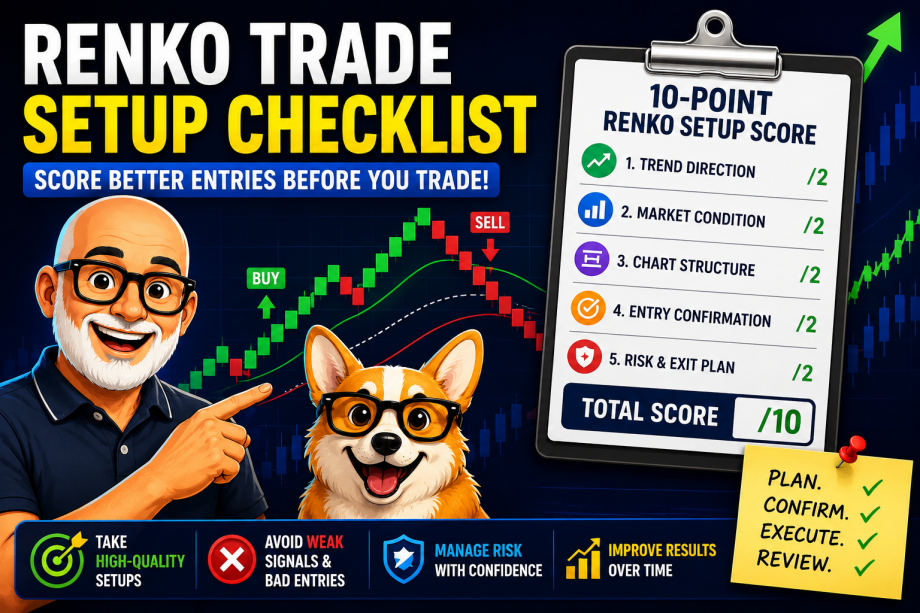
Not every Renko signal deserves a trade.
That may sound simple, but it is one of the biggest lessons I have learned from working with Renko charts. A color change, breakout, trendline touch, or indicator signal can look exciting in the moment, but that does not automatically mean the setup is strong.
That is why I like using a simple Renko trade setup checklist before entering a trade. Instead of reacting emotionally to one signal, I want to score the full setup first.
This checklist is not a perfect trading system. It is an educational framework that helps me slow down, compare setups more clearly, and avoid taking weak Renko trades just because the chart looks active.
Important: This article is for education and idea testing only. It is not financial advice, and it is not a recommendation to buy or sell any security. Always do your own research and consider your own risk tolerance.
Why a Renko Trade Setup Checklist Matters
Renko charts are excellent at filtering out smaller price movements and making trends easier to see. But they can still produce weak signals, especially in choppy markets, during low-quality breakouts, or when the brick size does not match the market.
I have already written about topics like Renko chart settings in TradingView, how to choose the best Renko brick size, and how to avoid Renko false signals. Those are important pieces of the puzzle.
But once the chart is set up, the next question becomes more practical:
Is this specific Renko setup worth trading right now?
That is where a checklist can help.
The 10-Point Renko Trade Setup Score
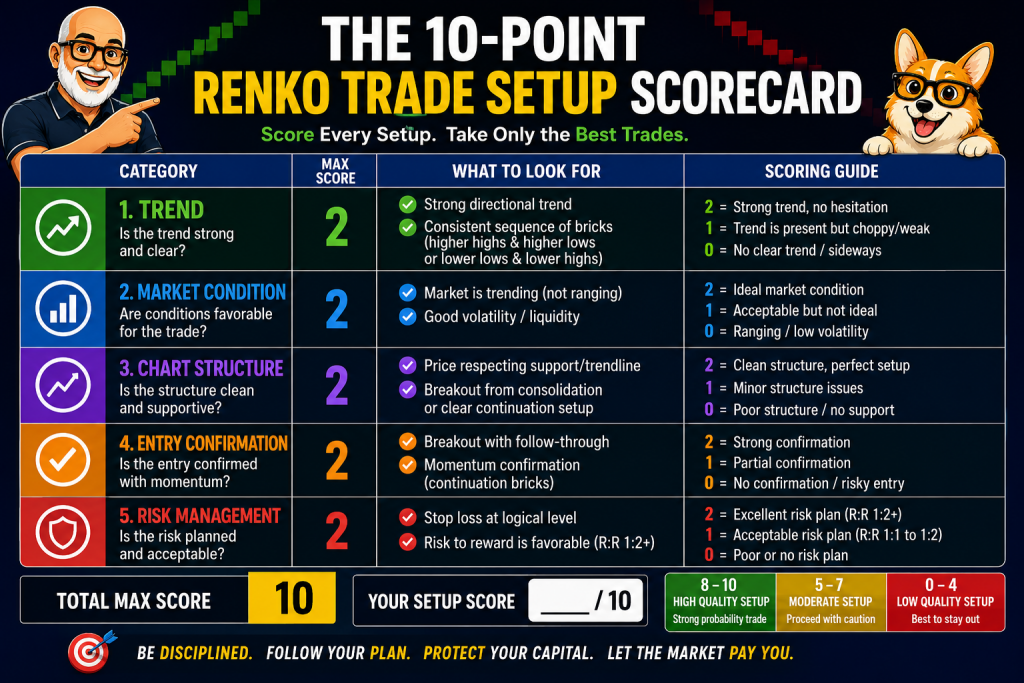
Here is the simple scoring model I like to use. Each category is worth up to 2 points, for a total score of 10.
| Checklist Item | Points | What I Want to See |
|---|---|---|
| Trend direction | 0 to 2 | The Renko chart shows a clear directional bias |
| Market condition | 0 to 2 | The market is trending, not chopping sideways |
| Chart structure | 0 to 2 | Support, resistance, or trendlines are easy to identify |
| Entry confirmation | 0 to 2 | The entry is based on confirmation, not emotion |
| Risk and exit plan | 0 to 2 | The stop, position size, and exit plan make sense |
For me, a setup scoring 8 to 10 is worth studying more closely. A setup scoring 5 to 7 may need more confirmation. A setup below 5 is usually a warning sign that I may be forcing a trade.
1. Is the Renko Trend Clear?
The first part of my Renko trade setup checklist is trend direction. Before thinking about an entry, I want to know whether the chart is showing a clean trend or a messy back-and-forth pattern.
A strong score means the chart has a clear series of bricks moving in one direction, clean pullbacks, and a structure that is easy to understand. A weak score means the chart is flipping colors often and giving mixed messages.
This is where Renko charts can be very helpful. They remove much of the time-based noise that appears on candlestick charts. But even with Renko, I still want the trend to be obvious enough that I do not have to talk myself into the trade.
Before I ever score an individual trade setup, I first build a focused watchlist of high-quality charts. That weekly process helps me narrow hundreds of potential candidates down to a manageable list before applying this checklist. If you’d like to see how I organize that workflow, read How to Build a Renko Watchlist.
- 2 points: Clear uptrend or downtrend
- 1 point: Trend exists, but it is not very clean
- 0 points: No clear trend or too much back-and-forth movement
If you are still learning how Renko trends behave, start with my guide on Renko trend trading tips.
2. Does the Market Condition Support Renko Trading?
Renko charts often work best when the market is moving directionally. They can struggle when price is stuck in a range, constantly reversing, or producing small moves that do not follow through.
This is why I do not want to judge a trade setup by the entry signal alone. I also want to understand the market environment.
For example, a bullish Renko breakout may look promising. But if the broader market is weak, the stock is moving sideways, and the most recent breakouts have failed, I may reduce the score.
- 2 points: Trending market with clean follow-through
- 1 point: Mixed conditions with some directional movement
- 0 points: Choppy, sideways, or unreliable conditions
For a deeper look at this idea, read when Renko charts work best and best markets for Renko charts.
3. Is There Clean Support, Resistance, or Trendline Structure?
A Renko setup becomes more useful when it lines up with clear chart structure. I like seeing support, resistance, trendlines, prior swing levels, or a recognizable pattern that gives the trade context.
Without structure, a signal can feel random. With structure, I can better understand where the setup is happening and where the trade idea may be invalidated.
For example, a bullish Renko signal near a clear support zone may be more interesting than a bullish signal in the middle of a messy range. A bearish signal after price breaks below a well-tested trendline may carry more meaning than a random color flip.
- 2 points: Clean structure with obvious support, resistance, or trendline context
- 1 point: Some structure exists, but it is not very clean
- 0 points: No useful structure or the chart looks random
You may also find these guides helpful: Renko support and resistance and Renko chart trend trading.
4. Is the Entry Confirmed?
This may be the most important part of the Renko trade setup checklist. I do not want to enter just because I feel like a move is starting. I want some form of confirmation.
Confirmation can come from different places. It might be a breakout above resistance, a confirmed trendline break, a pattern completion, a Supertrend flip, a moving average signal, or a Renko brick continuation after a reversal.
The key is that the entry should have a reason.
- 2 points: Entry has clear confirmation
- 1 point: Entry has partial confirmation, but still needs caution
- 0 points: Entry is mostly emotional or based on guessing
If you want to compare entry styles, see my article on Renko entry timing: early vs confirmed entries.
5. Does the Risk and Exit Plan Make Sense?
A good-looking Renko setup can still be a poor trade if the risk is too large, the stop is unclear, or the exit plan is vague.
Before entering, I want to know three things:
- Where would this trade idea be wrong?
- How much am I willing to risk?
- What exit method will I use if the trade works?
This is where Renko can help create more objective trade management. Stops may be based on structure, brick reversals, support and resistance, or trendline breaks. Exits may be based on opposite signals, trailing stops, partial profits, or a predefined rule.
- 2 points: Clear stop, position size, and exit plan
- 1 point: Risk plan exists, but needs refinement
- 0 points: No clear risk or exit plan
For more detail, read Renko risk management strategy, Renko position sizing, and Renko chart exit rules.
Example Renko Setup Score
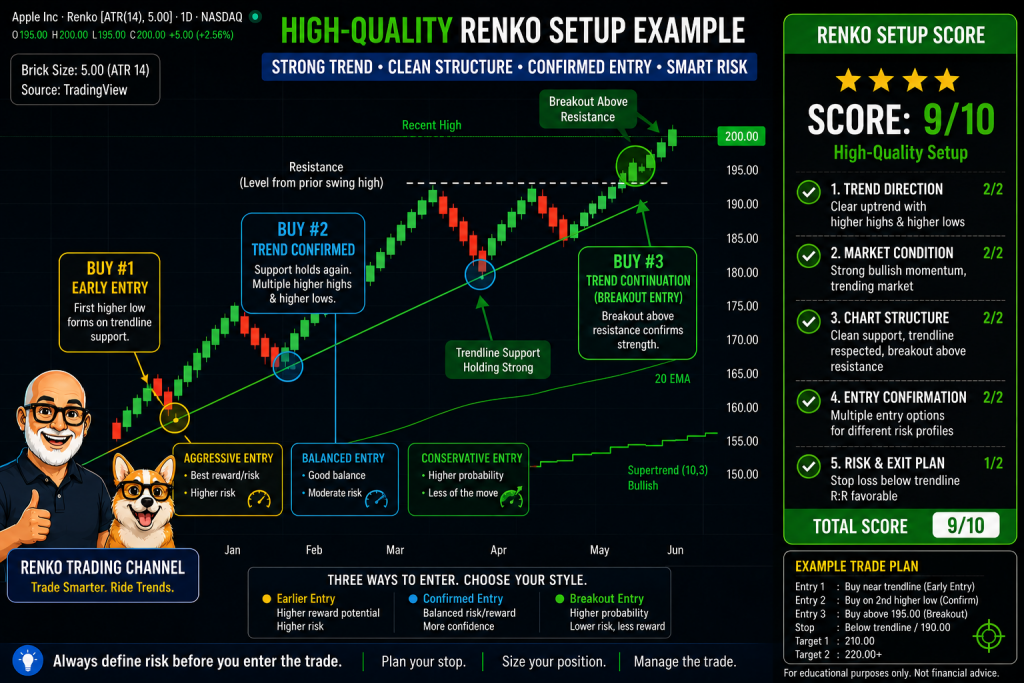
Here is how a sample trade might score using this checklist.
| Checklist Item | Score | Reason |
|---|---|---|
| Trend direction | 2 | Renko chart is making a clean series of higher bricks |
| Market condition | 2 | Price is trending and not stuck in a sideways range |
| Chart structure | 1 | There is support nearby, but resistance is not far away |
| Entry confirmation | 2 | Entry follows a confirmed breakout |
| Risk and exit plan | 2 | Stop and exit rule are defined before entry |
Total score: 9 out of 10
This does not mean the trade will win. It only means the setup is organized, logical, and worth studying further. A high score should not replace risk management. It simply helps me avoid random trades.
When I Would Avoid a Renko Trade
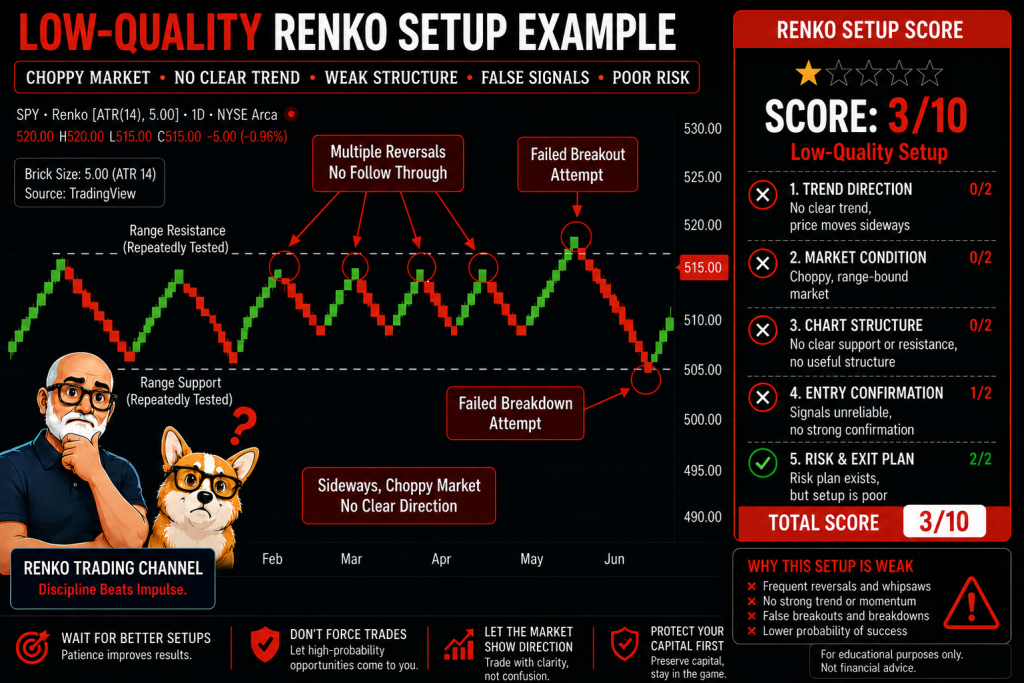
This checklist is also useful because it helps identify weak trades. I would be cautious if I see several of these problems:
- The chart keeps flipping brick colors
- The market is stuck in a range
- The entry is too far from a logical stop
- The setup is based on hope instead of confirmation
- The reward does not appear to justify the risk
- I cannot explain the trade in one or two sentences
That last point is important. If I cannot clearly explain why I am considering a trade, I probably do not understand the setup well enough.
How This Checklist Fits With TradingView Renko Charts
I usually think of the checklist as a layer that sits on top of the chart setup. In TradingView, Renko settings such as brick size, ATR calculation, wicks, and timeframe can affect how the chart behaves. TradingView also has its own Renko chart documentation here: TradingView Renko charts support guide.
Once the chart is configured, the checklist helps me evaluate the trade idea itself. That means I am not just asking whether the chart looks clean. I am asking whether the full setup deserves attention.
My Simple Renko Trade Setup Checklist
Here is the short version you can use before taking a Renko trade:
- ✅ Is the Renko trend clear?
- ✅ Is the market condition favorable?
- ✅ Is there clean support, resistance, or trendline structure?
- ✅ Is the entry confirmed?
- ✅ Is the stop loss logical?
- ✅ Is the position size appropriate?
- ✅ Do I know how I will exit if the trade works?
- ✅ Do I know how I will exit if the trade fails?
- ✅ Am I trading the setup, or am I reacting emotionally?
- ✅ Can I explain the trade idea clearly?
If too many answers are unclear, that is usually a sign to wait.
Final Thoughts
A Renko trade setup checklist will not make every trade profitable. Nothing does. But it can help create a more disciplined process.
For me, the goal is not to predict every move. The goal is to take better-quality setups, avoid emotional decisions, and manage risk more consistently.
Renko charts can make trends easier to see, but the trader still has to decide whether the setup is worth taking. A simple scoring system helps turn that decision into something more structured.
If you are still building your Renko process, you may want to continue with these guides:
- Renko trading strategies
- Backtesting Renko chart strategies
- Renko stop loss and take profit methods
- Best indicators for Renko charts in TradingView
Use the checklist as a starting point, adjust it for your own strategy, and always remember that these are educational ideas and experiments, not financial advice.