
Looking for the best stocks for Renko trading? The answer is not just about picking popular tickers. A good Renko stock usually has liquidity, movement, clean trends, and enough volatility to form meaningful bricks without constant noise.
In this guide, I’ll walk through what makes a stock work well with Renko charts, examples of stocks to study, and how I personally think about matching brick size, volatility, and trend behavior. This is educational only and not financial advice.
If you’re new to Renko charts, Investopedia provides a helpful overview of how Renko charts filter price movement and differ from traditional candlestick charts.
Read Investopedia’s Renko chart guide.
What Makes a Stock Good for Renko Trading?
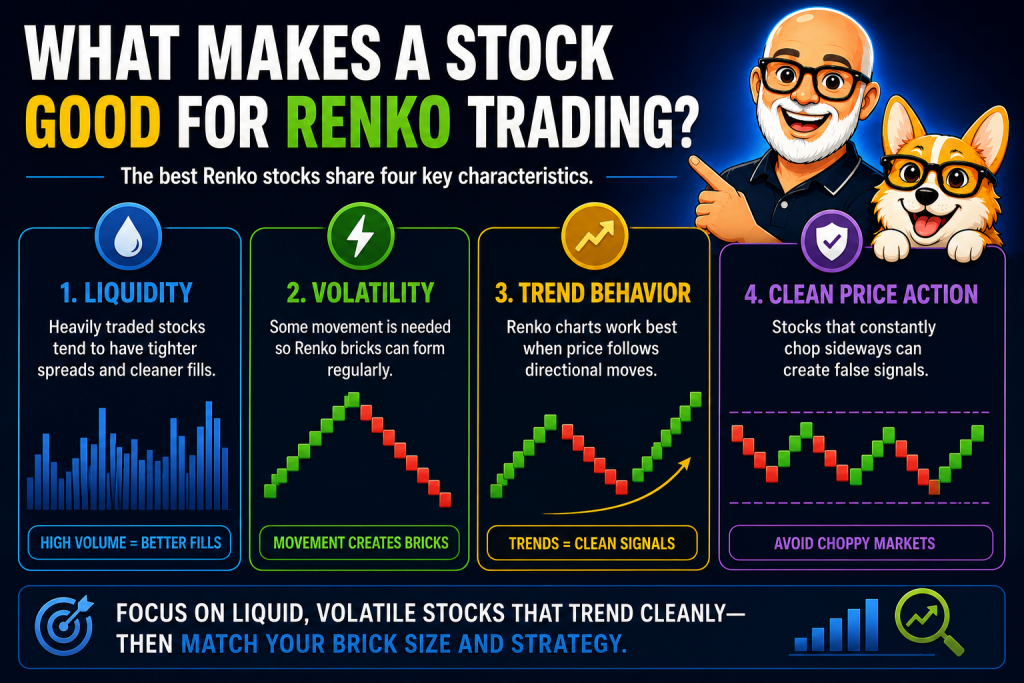
The best stocks for Renko trading usually share four traits: strong liquidity, consistent price movement, recognizable trends, and enough volatility to create useful Renko bricks.
- Liquidity: Heavily traded stocks tend to have tighter spreads and cleaner fills.
- Volatility: Some movement is needed so Renko bricks can form regularly.
- Trend behavior: Renko charts work best when price follows directional moves.
- Clean price action: Stocks that constantly chop sideways can create false signals.
Best Types of Stocks for Renko Trading
Instead of starting with a random list of tickers, I prefer to group stocks by behavior. This makes it easier to decide whether a stock fits your trading style.
1. Large-Cap Technology Stocks
Large-cap technology stocks are often useful for Renko traders because they can combine strong liquidity with meaningful price movement. Stocks like Apple, Microsoft, Nvidia, Amazon, Meta, and Tesla are often worth studying because they tend to attract volume and trend-following attention.
2. Momentum Stocks
Momentum stocks can work well with Renko charts because Renko is designed to filter smaller price movement and highlight directional price action. The challenge is that these stocks can also reverse sharply, so risk management matters.
3. High-Volume ETFs
ETFs such as SPY, QQQ, and IWM can also be good Renko candidates because they are liquid and often trend during strong market phases. They may not move as aggressively as individual stocks, but they can provide cleaner diversification.
Example Stocks to Study with Renko Charts
| Stock or ETF | Why It May Work with Renko | What to Watch |
|---|---|---|
| AAPL | Liquid, widely followed, often develops clean trends | Can consolidate for long periods |
| MSFT | Strong institutional interest and smoother trend behavior | May need a smaller brick size than faster stocks |
| NVDA | High momentum and strong price movement | Can be volatile and fast-moving |
| TSLA | Large swings can create active Renko signals | False reversals can happen quickly |
| AMZN | Good liquidity and trend potential | Can be choppy during range periods |
| META | Often produces strong directional moves | News-driven gaps can affect signals |
| SPY | Broad market ETF with excellent liquidity | Moves slower than many individual stocks |
| QQQ | Tech-heavy ETF with strong trend potential | Can be sensitive to tech sector reversals |
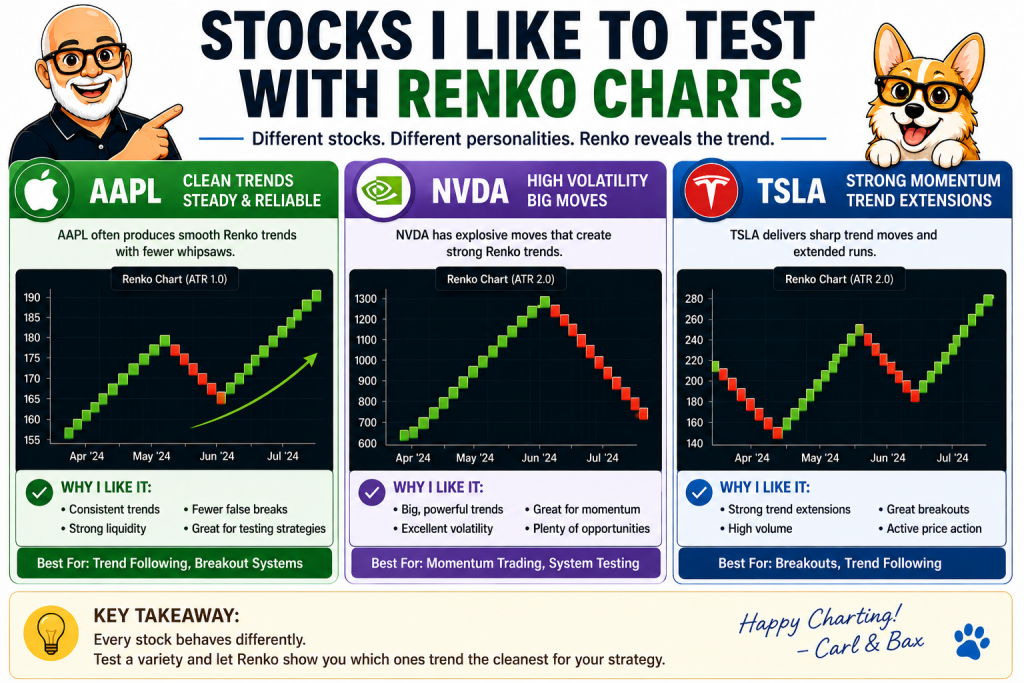
In my own testing, I often start with AAPL because it has a long history of trending behavior and plenty of historical data available for backtesting. However, every trader should test multiple stocks because a brick size that works well on AAPL may not work as effectively on TSLA or NVDA.
This list is not a recommendation to buy or sell any security. It is simply a starting point for testing how different stocks behave on Renko charts.
How to Choose a Renko Brick Size for Stocks
Brick size is one of the biggest decisions in Renko trading. A brick that is too small may create too many signals. A brick that is too large may react too slowly. For stocks, I usually like to compare fixed brick sizes with ATR-based Renko settings.
For a deeper guide, see my article on how to choose the best Renko brick size and my guide to ATR-based Renko brick size calculation.
If you use TradingView, you can experiment with both fixed and ATR-based Renko settings directly within the platform. TradingView provides several Renko configuration options that make it easy to compare chart behavior across different stocks and ETFs.
Learn more about Renko charts from TradingView.
Stocks That May Not Work Well with Renko
Not every stock is a good Renko candidate. Some stocks look interesting on a regular candlestick chart but perform poorly when converted into Renko bricks. These conditions can also contribute to false Renko signals during choppy market environments.
- Very low-volume stocks
- Penny stocks with wide spreads
- Stocks that gap frequently without follow-through
- Names that move sideways for long periods
- Stocks with sudden news-driven spikes and reversals
How I Find Stocks to Test with Renko Charts
When searching for the best stocks for Renko trading, I usually start with a stock screener rather than individual recommendations. My goal is to find stocks with strong liquidity, healthy trading volume, and enough price movement to generate meaningful Renko bricks.
- Average daily volume above 1 million shares
- Consistent price movement over recent months
- Strong relative strength compared to the broader market
- Stocks making new highs or emerging from consolidations
- ETFs with strong sector momentum
Once I identify potential candidates, I switch to a Renko chart and test different brick sizes to see whether trends remain clear and easy to follow. I also compare results using a structured Renko backtesting process before considering any strategy idea. Once I’m satisfied with the results, I combine market selection, brick size, entries, exits, risk management, and trade review into a repeatable workflow. You can see my complete process in How I Build a Complete Renko Trading System.
Finding good Renko stocks is only the beginning. Before I look for an actual entry, I organize those candidates into a structured watchlist so I can focus on the strongest opportunities instead of constantly jumping between charts. My guide on How to Build a Renko Watchlist explains how I screen, score, and prioritize markets each week using a repeatable workflow.
My Simple Renko Stock Selection Checklist
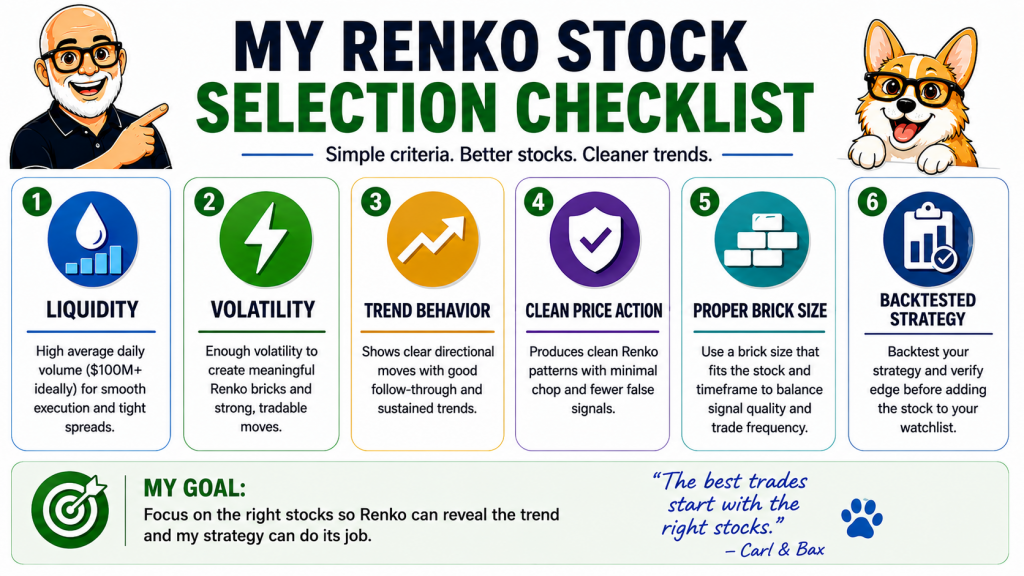
- Start with liquid stocks or ETFs.
- Check whether the chart forms clean Renko trends.
- Compare fixed brick size versus ATR brick size.
- Look for enough movement to create useful signals.
- Avoid stocks that constantly chop sideways.
- Backtest before risking real money.
Final Thoughts on the Best Stocks for Renko Trading
The best stocks for Renko trading are not always the most exciting names. They are the stocks that give you enough movement, enough liquidity, and enough trend structure to test a repeatable strategy.
For me, the goal is not to find a perfect stock. The goal is to find stocks that behave well enough on Renko charts to support a clear trading plan. Test first, compare results, and remember that every strategy idea should be treated as an experiment, not financial advice.
Frequently Asked Questions
What are the best stocks for Renko trading?
Many Renko traders start with highly liquid stocks such as AAPL, MSFT, NVDA, AMZN, and TSLA because they often provide enough trading volume and price movement to generate meaningful Renko signals.
Are ETFs good for Renko trading?
Yes. ETFs such as SPY, QQQ, and IWM are popular choices because they are highly liquid and often produce cleaner trends than individual stocks.
Should I use fixed or ATR-based Renko brick sizes for stocks?
Both approaches can work. Fixed brick sizes provide consistency, while ATR-based brick sizes automatically adjust to changing market volatility.
How do I find stocks that work well with Renko charts?
A good starting point is to use a stock screener to find liquid stocks with strong trading volume and consistent price movement. After identifying candidates, review their Renko charts and test different brick sizes to see whether trends remain clear and easy to follow.
Can Renko charts be used for long-term investing?
Yes. While many traders use Renko charts for swing trading, some investors use them to identify long-term trends, reduce market noise, and help guide portfolio decisions. The effectiveness depends on the selected brick size and overall investment strategy.