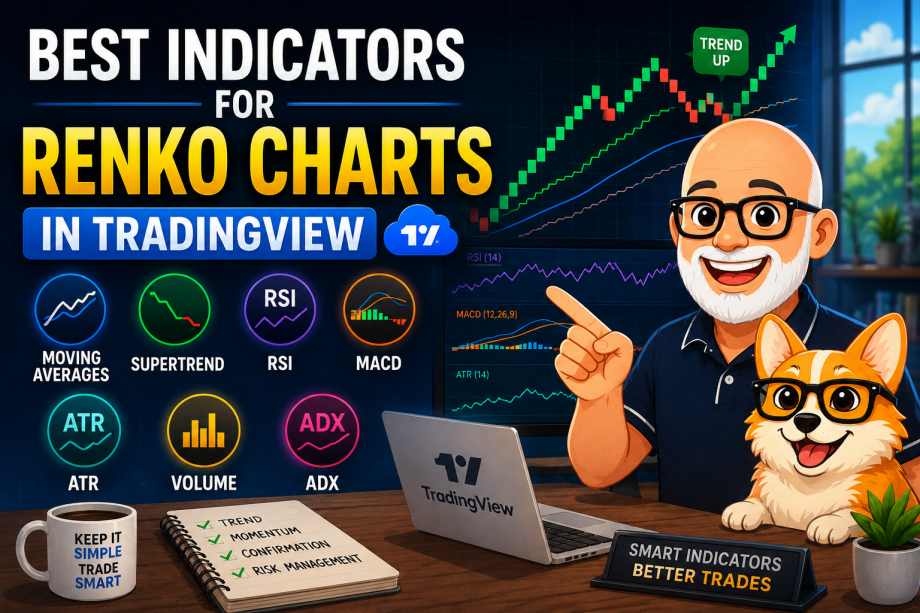
Renko charts already do something powerful before you add a single indicator: they filter out a lot of market noise by focusing on price movement instead of time. That is why choosing the best indicators for Renko charts is a little different from choosing indicators for candlestick charts.
On a regular time-based chart, indicators react to every candle. On a Renko chart, the chart only updates when price moves enough to create a new brick. This can make trends easier to see, but it can also change how indicators behave.
In this guide, I’ll walk through some of the best indicators to use with Renko charts in TradingView, including moving averages, Supertrend, RSI, MACD, ATR, volume, and ADX. I’ll also share how I think about combining indicators without making the chart too complicated.
If you are newer to Renko charts in TradingView, you can also review the official TradingView Renko chart documentation to better understand how Renko bricks are constructed.
Strategies and indicator combinations discussed in this article are educational ideas only. They are not financial advice. Always test any trading approach carefully before risking real money.
Table of Contents
Why the Best Indicators for Renko Charts Work Differently
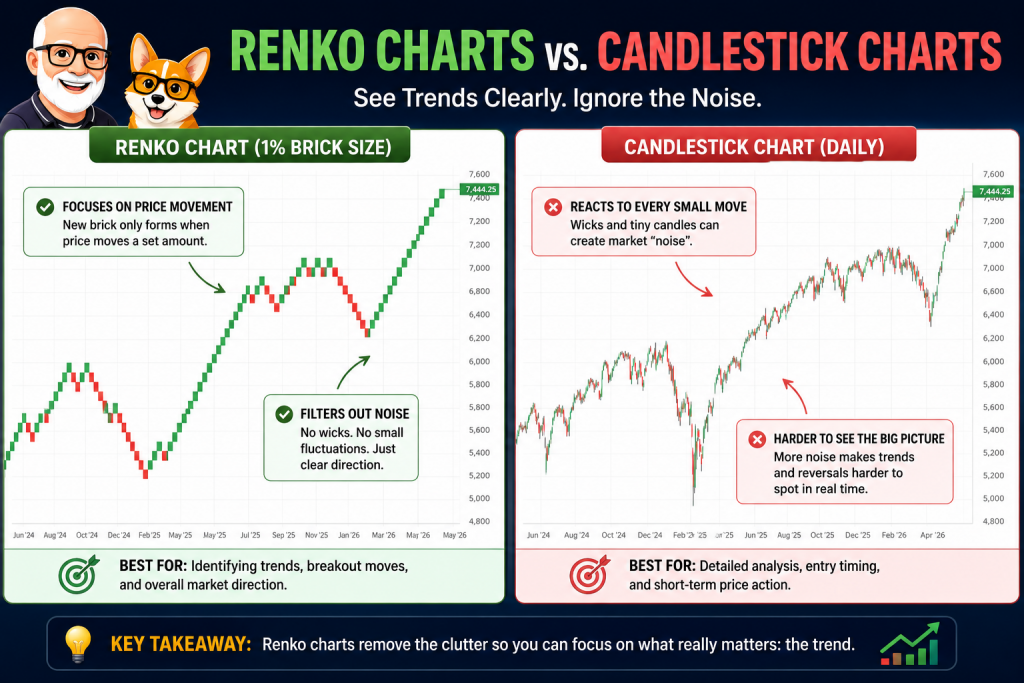
Renko charts remove the time element from the chart and focus on price movement. That makes them useful for spotting trends, reversals, support, resistance, and momentum shifts.
But because Renko charts are built from price movement, indicators may look cleaner than they do on candlestick charts. A moving average, for example, may appear smoother. RSI may stay overbought or oversold longer during strong trends. MACD may produce fewer signals, but those signals may arrive after a move is already underway.
This is why I like using Renko indicators as confirmation tools, not as automatic buy or sell buttons.
If you are new to Renko charts, start with my guide on Renko chart basics before adding indicators.
1. Moving Averages
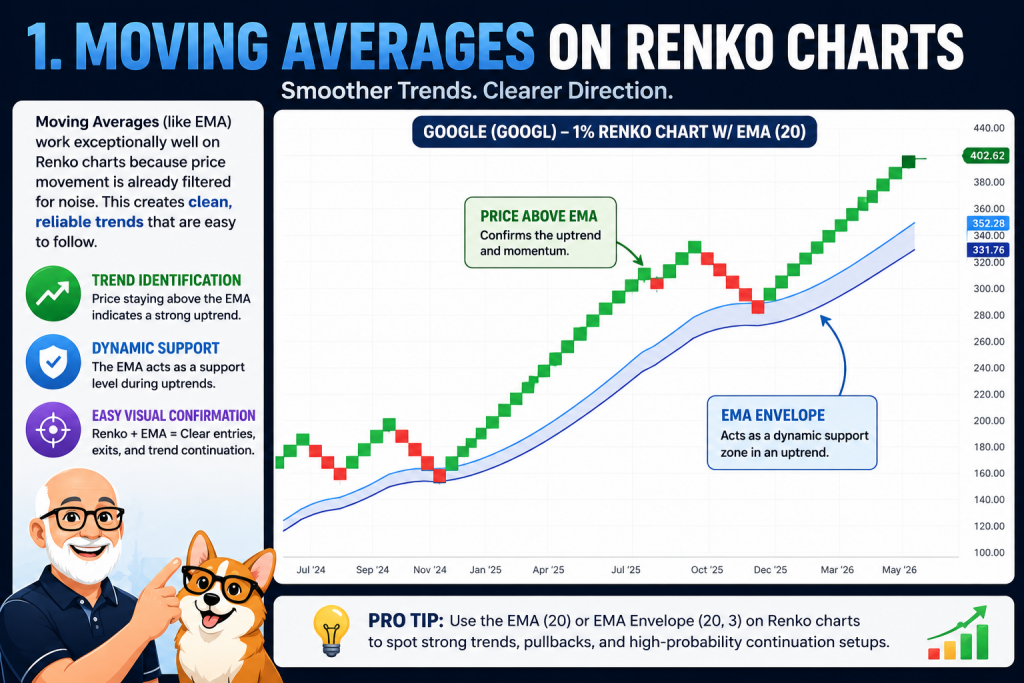
Moving averages are one of the simplest and most useful indicators for Renko charts. They help identify the direction of the trend and can make it easier to avoid trading against momentum.
For example, if price is above a rising moving average, I usually view that as a bullish trend filter. If price is below a falling moving average, I view that as a bearish trend filter.
How I Use Moving Averages With Renko
- Use a shorter moving average for faster trend changes.
- Use a longer moving average to filter out weaker signals.
- Look for Renko brick reversals near the moving average.
- Avoid taking every crossover without confirmation.
For a deeper look, see my guide on how to use moving averages with Renko charts.
2. Supertrend
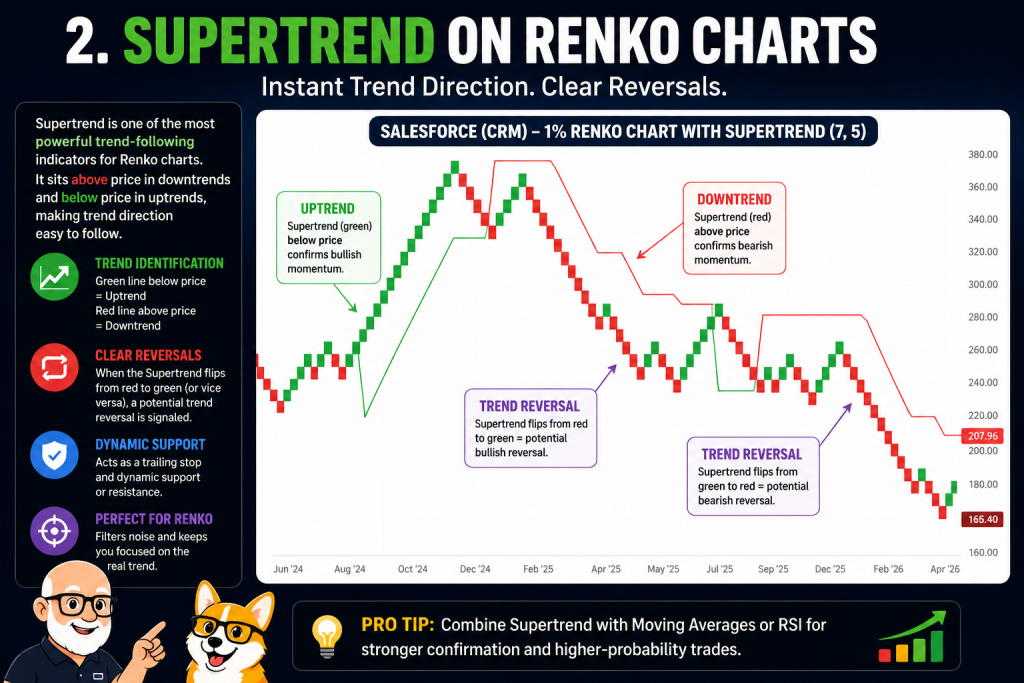
Supertrend is one of my favorite indicators to test with Renko charts because it is visually simple. It can help show whether price is in a bullish or bearish trend and may work well as a trend-following confirmation tool.
The advantage of Supertrend is that it gives a clear directional bias. The downside is that it can still flip during choppy markets, especially if the Renko brick size is too small.
Best Use Case
I prefer using Supertrend as a trend filter rather than a standalone entry system. For example, a trader might only consider bullish Renko entries when Supertrend is bullish, and only consider bearish entries when Supertrend is bearish.
You can see more examples in my Renko Supertrend strategy guide.
3. RSI
RSI can be useful on Renko charts, but I do not like treating overbought and oversold levels the same way I would on a normal candlestick chart.
On a strong Renko trend, RSI can stay overbought or oversold for a long time. That does not automatically mean the trend is about to reverse. In many cases, it may simply confirm that momentum is strong.
How I Use RSI With Renko
- Use RSI to confirm momentum.
- Watch for divergence near possible reversals.
- Avoid shorting every overbought reading.
- Avoid buying every oversold reading.
RSI works best when paired with price structure, brick reversals, support and resistance, or another trend filter.
4. MACD
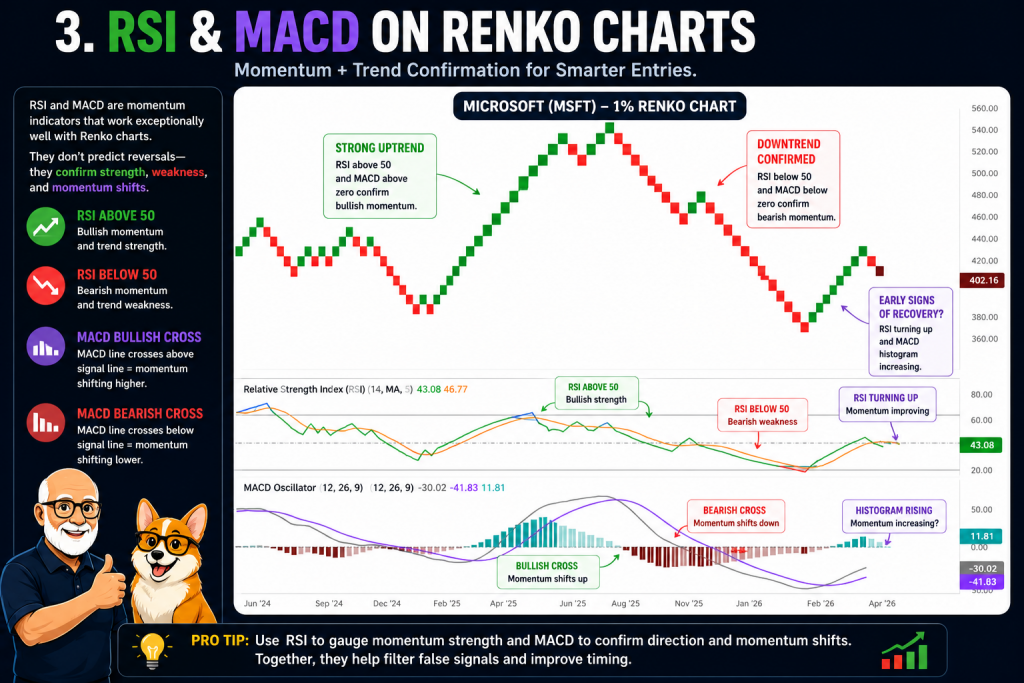
MACD can help identify momentum shifts on Renko charts. Because Renko charts are already smoother than time-based charts, MACD signals may look cleaner, but they can still be delayed.
I usually think of MACD as a confirmation indicator. If Renko bricks begin reversing upward and MACD is also improving, that can strengthen the case for a bullish setup. If Renko bricks reverse downward and MACD is weakening, that can support a bearish setup.
MACD may be especially helpful when testing Renko strategies in TradingView because it gives clear historical signals to compare against price action.
5. ATR
ATR is not just an indicator for entries and exits. With Renko charts, ATR is especially important because it can help determine brick size.
An ATR-based Renko chart adjusts to market volatility. When volatility increases, the brick size may become larger. When volatility decreases, the brick size may become smaller. This can make ATR-based Renko charts useful for adapting to changing market conditions.
However, ATR-based Renko charts can also make backtesting more complicated because historical brick construction may differ from fixed-size Renko charts.
For more detail, read my guide on ATR-based Renko brick size calculation.
6. Volume
Volume can be helpful with Renko charts, especially when you are looking for confirmation behind a breakout or reversal. A Renko breakout with stronger volume may carry more weight than a breakout with weak participation.
That said, volume depends on the market. Stocks and ETFs usually have useful volume data. Forex volume in TradingView may be tick volume or broker-dependent, so I treat it differently.
Volume is best used as supporting evidence, not as the only reason to enter a trade.
7. ADX
ADX can help measure trend strength. This can be useful because Renko strategies often work best in trending markets and struggle in sideways chop.
If ADX is rising, it may suggest that the trend is strengthening. If ADX is weak or falling, it may suggest that the market is not trending strongly enough for a Renko trend-following setup.
I would not use ADX by itself, but it can be useful as a market condition filter.
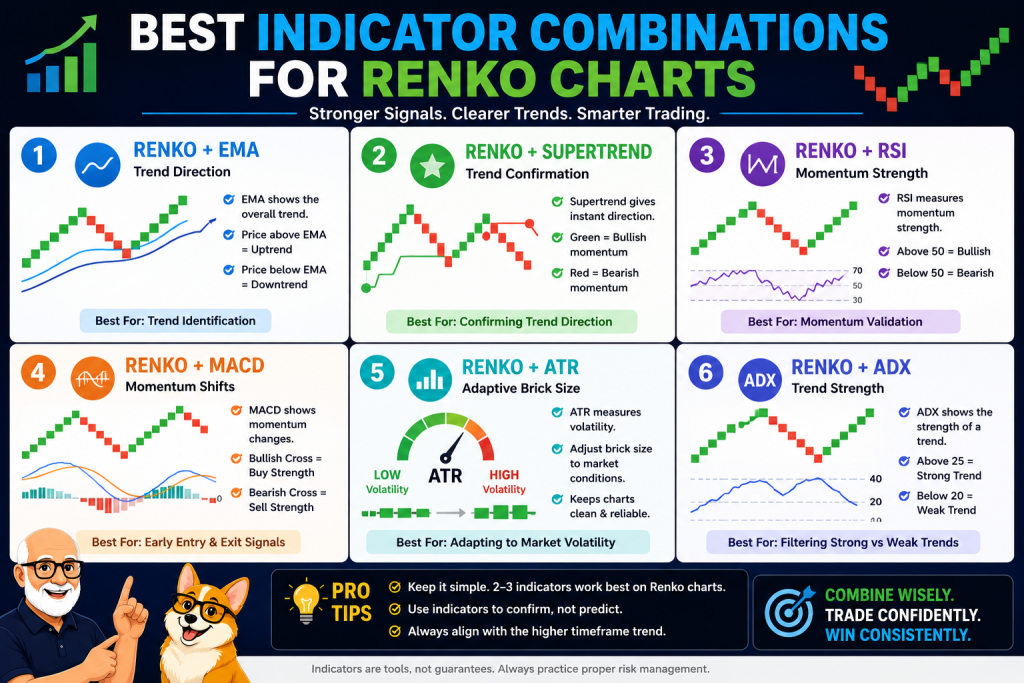
Best Indicator Combinations for Renko Charts
The best Renko indicator setup is usually simple. Too many indicators can create conflicting signals and make the chart harder to read.
| Combination | Purpose | Best For |
|---|---|---|
| Renko + Moving Average | Trend direction | Beginners and swing traders |
| Renko + Supertrend | Trend confirmation | Trend-following strategies |
| Renko + RSI | Momentum confirmation | Reversal and continuation setups |
| Renko + MACD | Momentum shift confirmation | Backtesting and trend changes |
| Renko + ATR | Brick size and volatility | Adaptive Renko charts |
| Renko + ADX | Trend strength | Avoiding sideways markets |
If I had to start with one simple setup, I would test Renko plus a moving average plus one momentum indicator. That keeps the chart readable and gives you trend direction plus confirmation.
Best Indicators for Different Trading Styles
For Day Trading
For day trading, I would focus on faster confirmation tools like moving averages, Supertrend, RSI, and volume. The challenge is avoiding false signals when the brick size is too small.
You may also want to review my article on Renko chart day trading strategies.
For Swing Trading
For swing trading, I prefer slower confirmation tools like longer moving averages, Supertrend, MACD, and ADX. These can help filter out smaller moves and focus on larger trend changes.
See also: Renko swing trading strategies.
For Backtesting
For backtesting, I like indicators that create clear rules. Moving averages, Supertrend, MACD, RSI, and ATR are all easier to test because they can be turned into specific conditions.
If you are building TradingView strategies, read my guide on backtesting Renko chart strategies.
Common Mistakes When Using Indicators With Renko Charts
- Using too many indicators: More indicators do not always mean better signals.
- Ignoring brick size: The wrong brick size can make any indicator look unreliable.
- Expecting perfect reversals: Indicators confirm conditions. They do not predict the future.
- Not backtesting: A setup that looks good visually may perform poorly over time.
- Using Renko like candlesticks: Renko charts behave differently because they are based on price movement, not time.
One of the most important things to remember is that false signals can still happen. Renko charts reduce noise, but they do not eliminate risk. For more on that, read Renko chart false signals and how to avoid them.
My Simple Renko Indicator Testing Process
When I test a Renko indicator setup, I like to keep the process simple:
- Choose the market first.
- Select a fixed or ATR-based brick size.
- Add only one or two indicators.
- Create clear entry and exit rules.
- Backtest the strategy in TradingView.
- Compare the results against buy and hold when appropriate.
- Review drawdown, win rate, profit factor, and number of trades.
This helps prevent the biggest mistake I see with Renko charts: changing the rules after seeing the result.
If you are still working on brick size selection, this guide may help: how to choose the best Renko brick size.
So, What Is the Best Indicator for Renko Charts?
There is no single best indicator for every Renko chart. The best indicator depends on your market, brick size, trading style, and risk tolerance.
That said, if I were starting from scratch, I would begin with one of these simple combinations:
- Renko + moving average
- Renko + Supertrend
- Renko + moving average + RSI
- Renko + Supertrend + MACD
- Renko + ATR brick size + trend filter
Simple systems are easier to understand, easier to test, and easier to improve. That is especially important when using Renko charts because small changes in brick size can completely change the results.
Frequently Asked Questions
What is the best indicator for Renko charts?
There is no single best indicator for every Renko chart strategy. Moving averages, Supertrend, RSI, MACD, ATR, and ADX are all popular choices depending on whether the goal is trend identification, momentum confirmation, or volatility analysis. Many traders prefer combining Renko charts with one trend indicator and one momentum indicator for clearer signals.
Does RSI work on Renko charts?
Yes, RSI can work well on Renko charts because Renko bricks already filter out some market noise. RSI is often used to confirm momentum strength and potential reversals. However, during strong Renko trends, RSI may remain overbought or oversold for extended periods.
Is Supertrend good for Renko charts?
Supertrend is one of the most popular trend-following indicators for Renko charts because it provides simple visual trend direction. Many traders use Supertrend to confirm bullish or bearish momentum and avoid trading against the dominant trend.
Which moving average works best with Renko charts?
Exponential Moving Averages (EMAs) are commonly used with Renko charts because they respond more quickly to price movement than simple moving averages. Popular EMA settings include the 20 EMA, 50 EMA, and combinations of fast and slow EMAs for trend confirmation.
Are Renko indicators better than candlestick indicators?
Indicators themselves are not necessarily better on Renko charts, but Renko charts can make indicator signals appear cleaner because they reduce smaller price fluctuations and market noise. This may help traders focus more on trend direction and momentum.
What is the best brick size for Renko indicators?
The best Renko brick size depends on the market, timeframe, and trading style. Smaller brick sizes may generate more signals but can increase noise, while larger brick sizes may produce smoother trends with fewer trades. Many traders experiment with fixed-size or ATR-based Renko brick settings in TradingView.
Final Thoughts
The best indicators for Renko charts are the ones that help you make better decisions without cluttering the chart. Moving averages, Supertrend, RSI, MACD, ATR, volume, and ADX can all be useful, but only if they are tested with clear rules.
My preference is to use Renko charts for structure, then use indicators for confirmation. That keeps the chart clean and helps avoid turning every indicator signal into a trade. In my own TradingView testing, I’ve found that simpler Renko indicator combinations usually perform more consistently than heavily layered systems.
As always, treat these strategies as ideas to test, not financial advice. Renko charts can be powerful, but every setup should be backtested, reviewed, and managed with proper risk controls.
Next, you may want to read my guide on Renko risk management strategy so you can connect indicator signals with position sizing, stop losses, and trade management.