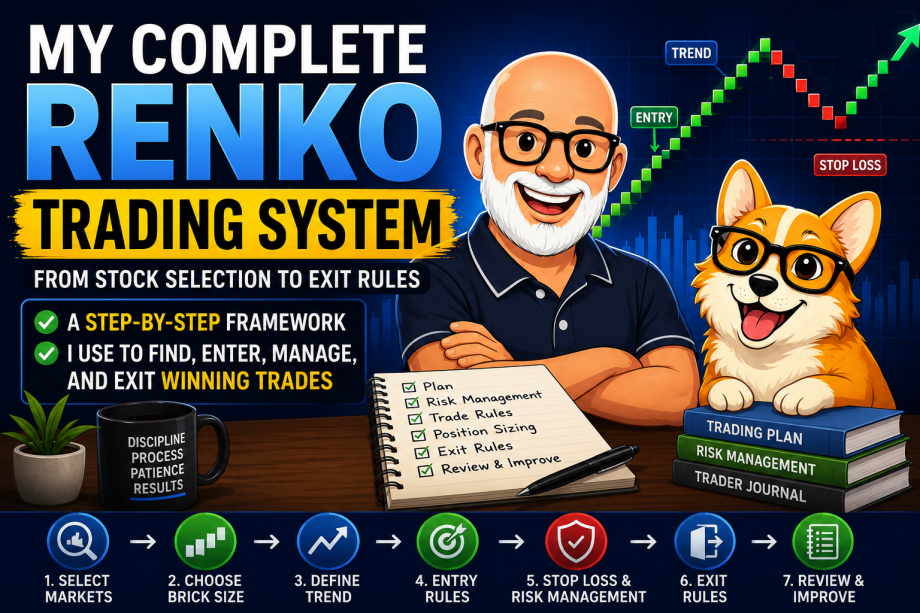
A lot of traders learn Renko charts one piece at a time. First they learn what a Renko brick is. Then they try a moving average. Then they test an indicator. Then they adjust the brick size. Then they wonder why the strategy still feels incomplete.
That is because a Renko chart is not a complete trading system by itself.
In my experience, Renko works best when it becomes part of a full decision-making process. I want to know what I am trading, why I am trading it, how much I am risking, where I am entering, where I am exiting, and how I will review the trade later.
In this guide, I will walk through how I think about building a complete Renko trading system, from stock selection all the way to trade review.
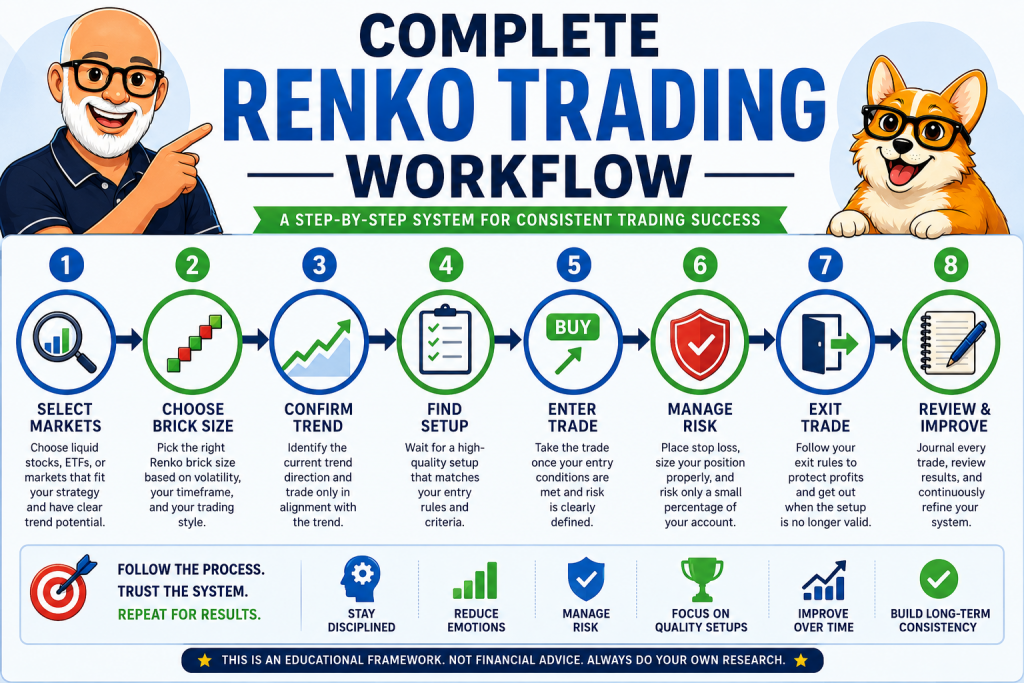
Table of Contents
Disclosure: This article is for educational purposes only. The ideas shared here are not financial advice, investment advice, or a recommendation to buy or sell any security. Always do your own research and consider speaking with a qualified financial professional before making trading or investing decisions.
What Is a Renko Trading System?
A Renko trading system is a repeatable process that uses Renko charts to help identify trends, entries, exits, and risk levels. The key word is system. It is not just one signal or one indicator.
A complete system should answer these questions:
- What markets or stocks am I willing to trade?
- What Renko brick size will I use?
- What confirms a trade setup?
- Where is my stop loss?
- How much am I willing to risk?
- When do I exit?
- How do I review whether the idea is working?
If those questions are not answered before the trade, emotions usually answer them during the trade.
Step 1: Choose the Right Market Before Opening the Renko Chart
The first mistake I see traders make is opening a Renko chart on anything that moves. That can create a lot of noise, even on a chart type designed to reduce noise.
Before I even look at a Renko setup, I want to know whether the stock, ETF, crypto, or forex pair is suitable for the type of trading I am testing.

For stocks and ETFs, I usually care about things like liquidity, trend behavior, average daily volume, volatility, and whether the symbol has enough movement to create useful Renko bricks. I covered this idea more deeply in my guide on best stocks for Renko trading.
Choosing the market is only the first filter. After I identify suitable stocks, ETFs, or other markets, I organize them into a focused weekly watchlist so I can compare trend quality, liquidity, brick behavior, and setup readiness before looking for an entry. See How to Build a Renko Watchlist for the step-by-step process I use to screen, score, and prioritize potential opportunities.
If the market does not move enough, Renko can become too slow. If it moves too wildly, the chart may create whipsaws. The goal is to find something that trends often enough to make the system worth testing.
Step 2: Decide Whether the System Is for Trading or Investing
Not every Renko system needs the same rules. A short-term trading system and a long-term investing system should not be built the same way.
For example, a short-term Renko trading system may focus on:
- Fast entries
- Tighter stops
- Shorter holding periods
- More frequent signals
- Strict risk control
A longer-term Renko investing system may focus on:
- Major trend direction
- Scaled entries
- Partial exits
- Covered calls or dividend income
- Reducing emotional decisions
I have used Renko charts for both trading ideas and longer-term investing decisions. The rules need to match the goal. If the goal is income, the system may connect with ideas like rolling covered calls. If the goal is trend following, the system may focus more on brick direction, support and resistance, and exits.
Step 3: Pick a Renko Brick Size That Matches the Strategy
The brick size is one of the most important decisions in any Renko trading system.
A smaller brick size creates more signals. That can help with earlier entries, but it may also create more false signals. A larger brick size filters more movement, but it may enter later and give back more profit before an exit appears.
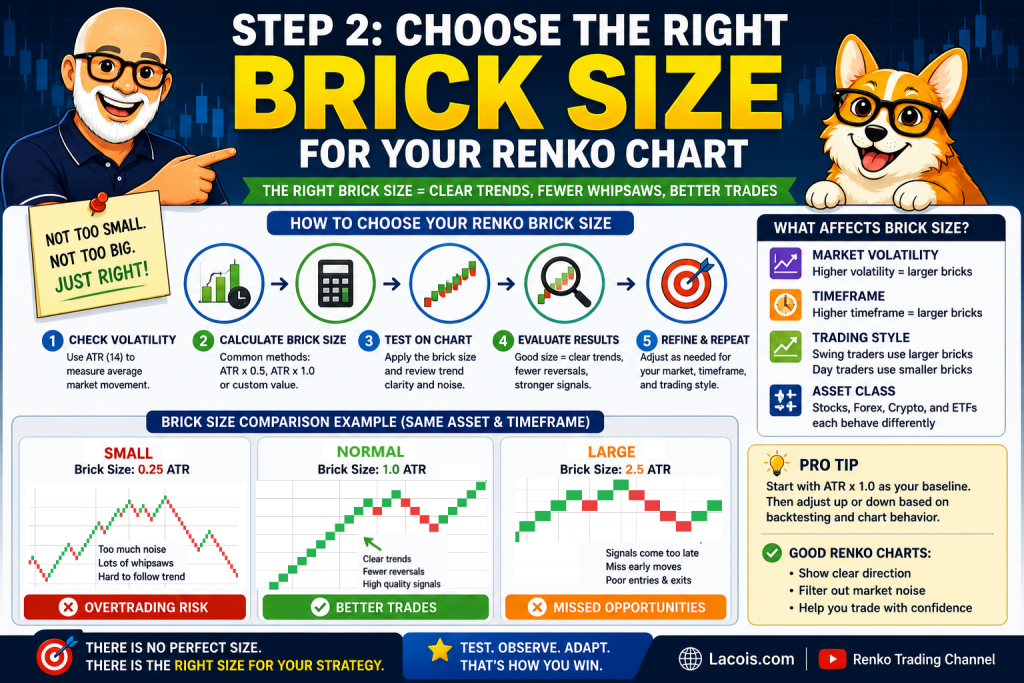
There are several ways to choose a brick size:
- Fixed dollar amount
- Percentage-based brick size
- ATR-based brick size
- Backtested brick size
- Market-specific brick size
I have written several guides on this because brick size affects almost everything else in the system. A good starting point is my article on how to choose the best Renko brick size. If you use TradingView, you may also want to review my post on best Renko chart settings for TradingView.
TradingView also has a helpful support article explaining how Renko charts work on its platform: Understanding Renko Charts.
Step 4: Define the Trend Before Looking for an Entry
One of the reasons I like Renko charts is that they can make trend direction easier to see. But I still want clear rules.
A basic Renko trend rule might be:
- Higher Renko bricks suggest an uptrend
- Lower Renko bricks suggest a downtrend
- Sideways bricks between support and resistance suggest no trade
That sounds simple, but simplicity is one of the strengths of Renko. The goal is not to predict every move. The goal is to avoid forcing trades when the chart is unclear.
For trend-based ideas, I often combine Renko with support, resistance, trendlines, or moving averages. You can see related examples in my guides on Renko support and resistance and using moving averages with Renko charts.
Step 5: Create Entry Rules That Are Easy to Repeat
A good entry rule should be specific enough that you can test it, repeat it, and review it later.
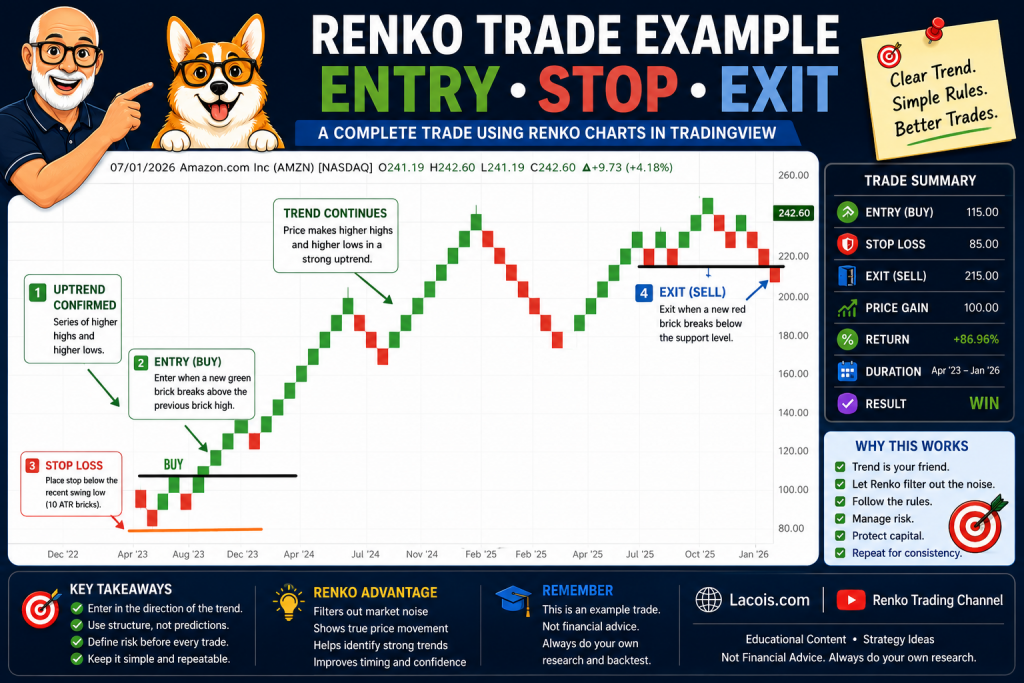
Here are a few example Renko entry rules:
- Enter after two or three bricks in the same direction
- Enter after a breakout above resistance
- Enter after a pullback and continuation brick
- Enter after a W pattern confirms
- Enter only when price is above a moving average
The exact rule matters less than whether it is clear and testable. A vague rule like “enter when it looks strong” is hard to improve. A rule like “enter after a breakout brick closes above resistance” is much easier to study.
If you want examples of specific setup styles, I have separate posts on early vs confirmed Renko entries, Renko chart patterns, and Renko buy and sell signals.
Step 6: Build the Stop Loss Into the System
The stop loss should not be an afterthought. It should be part of the system before the trade begins.
With Renko charts, possible stop methods include:
- A stop below the recent swing low
- A stop below a support zone
- A stop based on one or two Renko bricks
- A volatility-based stop
- A time-based exit if the setup fails to move
The stop should match the brick size. If the brick size is too large and the stop is too wide, the position size may need to be smaller. If the brick size is too small, the stop may get hit too often.
This is why I like connecting stop placement with position sizing. I covered that in more detail in Renko position sizing and Renko risk management strategy.
CME Group has a good educational discussion of risk per trade and the 2% rule here: The 2% Rule.
Step 7: Decide the Exit Rules Before the Trade Starts
Entries get attention, but exits usually determine whether the system survives.
A Renko exit rule could be:
- Exit after a reversal brick
- Exit after two opposite bricks
- Exit at a major resistance level
- Exit when price breaks a trendline
- Take partial profits and trail the rest
There is no perfect exit. A fast exit protects profits but can remove you from a trend too early. A slower exit can capture bigger moves but may give back more profit.
That trade-off is normal. The key is to choose an exit rule that fits the goal of the system. If I am testing a trend-following Renko system, I may accept more giveback in exchange for staying with the trend longer. If I am testing a shorter-term system, I may want faster exits.
For more exit examples, see my guide on Renko chart exit rules and my article on Renko stop loss and take profit methods.
Step 8: Use Risk Management to Keep the System Realistic
A strategy can look great on a chart and still fail if the risk is too large.
Before I judge a Renko system, I want to know:
- How much am I risking per trade?
- How many losing trades can happen in a row?
- What is the maximum drawdown?
- What happens if the market gaps?
- Am I using margin?
- Can I follow the system emotionally?
This is where many trading ideas become more realistic. A setup that looks exciting with oversized trades may look very different when risk is limited to a small percentage of the account.
FINRA has a risk disclosure explaining that day trading can be extremely risky, especially for traders with limited resources or limited experience: Day-Trading Risk Disclosure Statement.
That is why I treat every strategy as an experiment first. I want to understand the risk before I trust the signal.
Step 9: Backtest the System Before Trusting It
Backtesting does not guarantee future results, but it can help reveal whether the idea has structure.
When I backtest a Renko system, I want to look beyond the final return. I also want to review:
- Win rate
- Average win
- Average loss
- Maximum drawdown
- Number of trades
- Profit factor
- Worst losing streak
- Whether the system depends on one lucky trade
A system with a high return but a massive drawdown may not be usable in real life. A system with a lower return but smoother behavior may be easier to follow.
If you are new to this process, start with my guide on backtesting Renko chart strategies. You may also find my TradingView walkthrough on Renko brick size backtesting in TradingView useful.
Step 10: Add a Trade Checklist
A checklist helps prevent random trades. It also helps me slow down before clicking buy or sell.
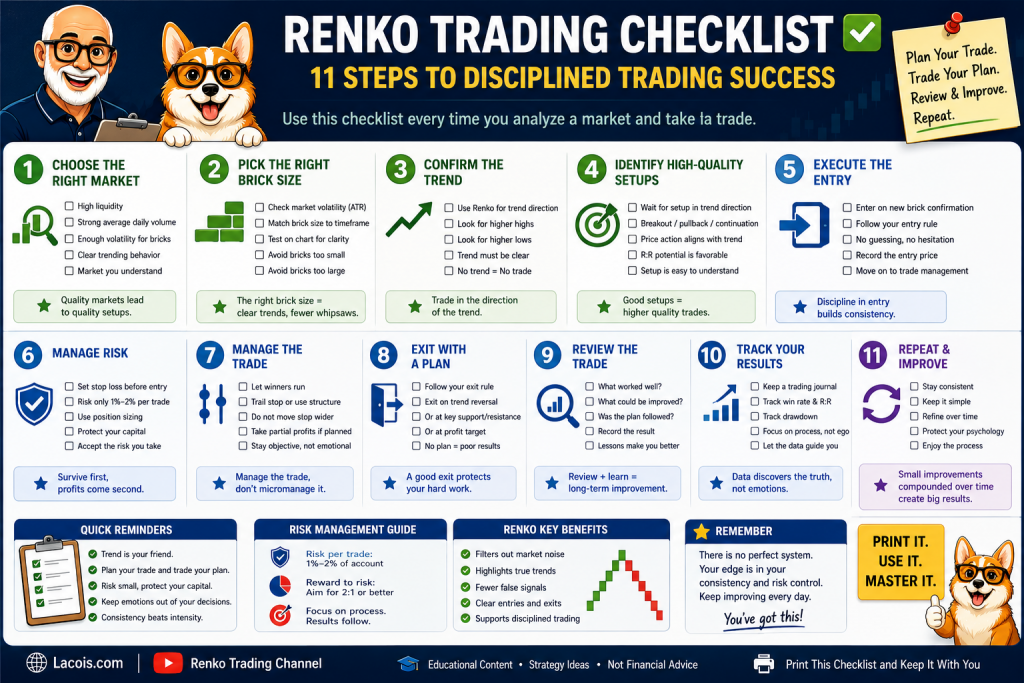
Here is a simple Renko trading system checklist:
- Is the market liquid enough?
- Does the symbol trend well with Renko?
- Is the brick size appropriate?
- Is the trend clear?
- Is the entry rule confirmed?
- Is the stop loss defined?
- Is the position size calculated?
- Is the exit rule clear?
- Is there major news or earnings ahead?
- Would I still take this trade if I had to explain it later?
📥 Free Download: Printable Renko Trading Checklist
Print this checklist and keep it next to your trading desk or save it on your computer for quick reference. Review it before every trade to help you stay disciplined, reduce emotional decisions, and follow a consistent Renko trading process.
What’s included:
- ✅ Pre-trade checklist
- ✅ Brick size reminder
- ✅ Risk management checklist
- ✅ Trade notes section
- ✅ Post-trade review
I like checklists because they make trading less emotional. They do not remove risk, but they help reduce impulsive decisions. That’s exactly why I created the printable checklist above. Use it before every trade until the process becomes second nature.
Step 11: Review Trades Like a System Builder
The trade is not finished when the position closes. That is when the learning starts.
After a trade, I want to know:
- Did I follow the rules?
- Was the setup valid?
- Was the stop too tight or too wide?
- Did I exit too early?
- Did I ignore the trend?
- Was the loss part of the system or a mistake?
This is where a Renko journal can become powerful. Screenshot the setup, write down the reason for the trade, and track whether the same mistake keeps showing up.
Over time, the journal may show patterns that are hard to see from memory alone. Maybe the system works better in strong trends. Maybe it struggles around earnings. Maybe the brick size is too small. Maybe the exits need work.
Example Renko Trading System Framework
Here is an example framework. This is not a recommendation, just a sample structure for educational purposes.
| System Component | Example Rule |
|---|---|
| Market | Liquid stocks or ETFs with clear trend behavior |
| Brick Size | Fixed or ATR-based brick size tested in TradingView |
| Trend Rule | Trade only in the direction of the current Renko trend |
| Entry Rule | Enter after breakout confirmation or continuation brick |
| Stop Loss | Below recent Renko swing low or support zone |
| Position Size | Risk a small fixed percentage of account value |
| Exit Rule | Exit on reversal brick, trendline break, or target zone |
| Review | Log every trade with screenshot and notes |
This kind of structure is much easier to test than a loose idea like “buy when the chart looks good.”
Common Mistakes When Building a Renko Trading System
Here are some mistakes I would try to avoid:
- Changing the brick size after every losing trade
- Adding too many indicators
- Ignoring position sizing
- Backtesting only the best-looking chart
- Using a stop loss that does not match the brick size
- Trading every signal without market context
- Confusing a good trade with a winning trade
- Confusing a bad trade with a losing trade
One losing trade does not mean the system is broken. One winning trade does not mean the system is good. The real test is whether the process holds up over many trades and different market conditions.
Why Renko Works Best as a Decision Framework
Renko charts can help filter smaller price movements and make trends easier to see. Investopedia has a useful overview of how Renko charts focus on price movement rather than traditional time intervals: Renko Chart: Definition, Uses, and Example.
But Renko does not remove uncertainty. It does not guarantee profits. It does not know your account size, your risk tolerance, your emotions, or your goals.
That is why I think Renko is most useful as a decision framework. It helps simplify price action, but the trader still needs rules for selection, entry, exit, risk, and review.
Before you go: If you haven’t already, download my free Printable Renko Trading Checklist (PDF) and use it before every trade. It’s a simple way to stay disciplined and build consistent trading habits.
Final Thoughts: Build the System Before Taking the Signal
A Renko signal is only one part of the process. The bigger question is whether the signal belongs inside a complete system.
Before I take a Renko setup, I want to know what I am trading, why I am trading it, how I am sizing it, where I am wrong, and how I will exit. That does not make the trade risk-free, but it does make the process more disciplined.
For me, the goal is not to find a magic Renko setting. The goal is to build a repeatable process that can be tested, improved, and followed without guessing every step of the way.
If you are building your own Renko trading system, start simple. Pick one market, one brick size, one entry rule, one stop method, and one exit rule. Test it. Review it. Improve it. Then decide whether it deserves real capital.
That is how Renko becomes more than a chart style. It becomes part of a complete trading plan.