
Video
Introduction
In this post, I’ll show you a repeatable way to test Renko brick size settings using TradingView and Pine Script, then compare results in Google Sheets. Choosing the “right” Renko brick size is one of the biggest challenges for Renko traders. The mistake most traders make is guessing a brick size, copying someone else’s settings, or optimizing for the best-looking equity curve.
In this video, I show a practical and repeatable process using TradingView + Pine Script to test multiple Renko brick sizes across different products. The goal isn’t to present a perfect strategy. It’s to demonstrate a testing framework you can reuse for your own ideas.
Educational only. This content is for learning and experimentation, not financial advice.
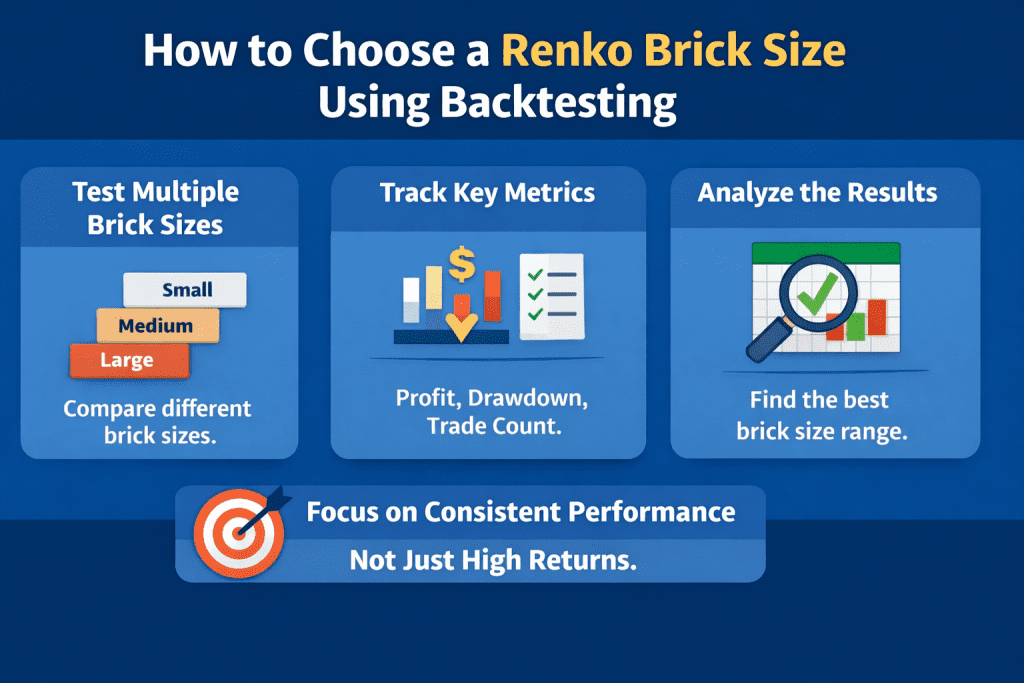
How to Choose a Renko Brick Size Using Backtesting
The easiest way to choose a Renko brick size is not by guessing. It’s by testing one strategy across multiple brick sizes and watching how the performance changes. When you do this systematically, patterns start to appear and you’ll usually find a brick size range that produces more stable results.
In this experiment, I used TradingView and Pine Script to keep the strategy logic consistent, then changed only one variable: Renko brick size. For each brick size, I recorded key metrics like total profit, maximum drawdown, number of trades, and profit factor. That gives you a clearer picture of whether results are driven by repeatable behavior or just a small number of lucky trades.
The goal isn’t to find one “perfect” setting that looks amazing in a backtest. The goal is to find a Renko brick size range that makes sense for your market, your strategy, and your tolerance for drawdown. This process helps you focus on consistency and reliability instead of chasing the highest return number.
What You’ll Learn
- How to backtest a Renko strategy in TradingView using Pine Script
- Why brick size changes strategy behavior (not just results)
- The Renko 3-brick trend strategy used for testing (long-only)
- Why this strategy uses conservative “next brick close” fills
- Which metrics matter most: total return, max drawdown, profit factor, and trade count
- How to record results in Google Sheets for side-by-side comparison
- Two extra evaluation columns:
- Return over Drawdown (efficiency score)
- Trades Score (confidence / reliability score)
- How brick size “sweet spots” often form in clusters, not a single magic number
Additional Related Learning
If you want to go deeper, here are a few related resources from my blog:
- ATR-Based Renko Brick Size Calculation (Tips and Tricks)
- Backtesting Renko Chart Strategies (Tips and Techniques)
- Renko Buy/Sell Signals (How-To Guide)
And if you’re building your own TradingView strategies, consider keeping a spreadsheet of test results. It’s one of the easiest ways to avoid emotional decision-making and focus on repeatable analysis.
As you compare different settings, it helps to step back and think about how to choose the best Renko brick size for your strategy, not just which one performs best in a single backtest.
Connect With Me on YouTube
If you enjoyed this video and want more Renko chart experiments like this, subscribe to my YouTube channel here:
Renko Trading Channel on YouTube
I post practical, experimental trading education focused on Renko charts, TradingView backtesting, and strategy-building concepts that traders can actually use.
Note: If you know the exact video duration, replace PT20M with the real value (example: PT18M42S). You can also remove the logo field if you don’t have a logo image URL ready.