The best markets for Renko charts are usually those where trends develop clearly and where traders benefit from filtering out short-term market noise. Renko charts remove the time component and focus only on price movement, which can make trends easier to see compared with traditional candlestick charts.
Many traders ask whether the best markets for Renko charts are stocks, forex, crypto, or futures. The answer depends on volatility, timeframe, and brick size. Some markets naturally produce smoother trends, while others move extremely fast and require careful risk management.
In this guide, we will explore the best markets for Renko charts, explain how timeframe and brick size affect performance, and discuss how fast-moving markets and breaking news can influence Renko signals. Educational only, not financial advice.
Quick Answer: Best Markets for Renko Charts
If your goal is cleaner trend visibility and fewer noisy decisions, Renko tends to shine most in:
- Stocks and ETFs (especially swing to position time horizons)
- Forex on higher timeframes (often 4H and Daily)
- Crypto on higher timeframes (often 1H, 4H, Daily) with risk controls
- Futures for trend continuation systems (less so for pure order-flow scalping)
Short timeframes (like 1-minute or 5-minute) can still be valid for some traders, but you must understand what can happen in fast markets.
Why Renko Behaves Differently Than Candlesticks
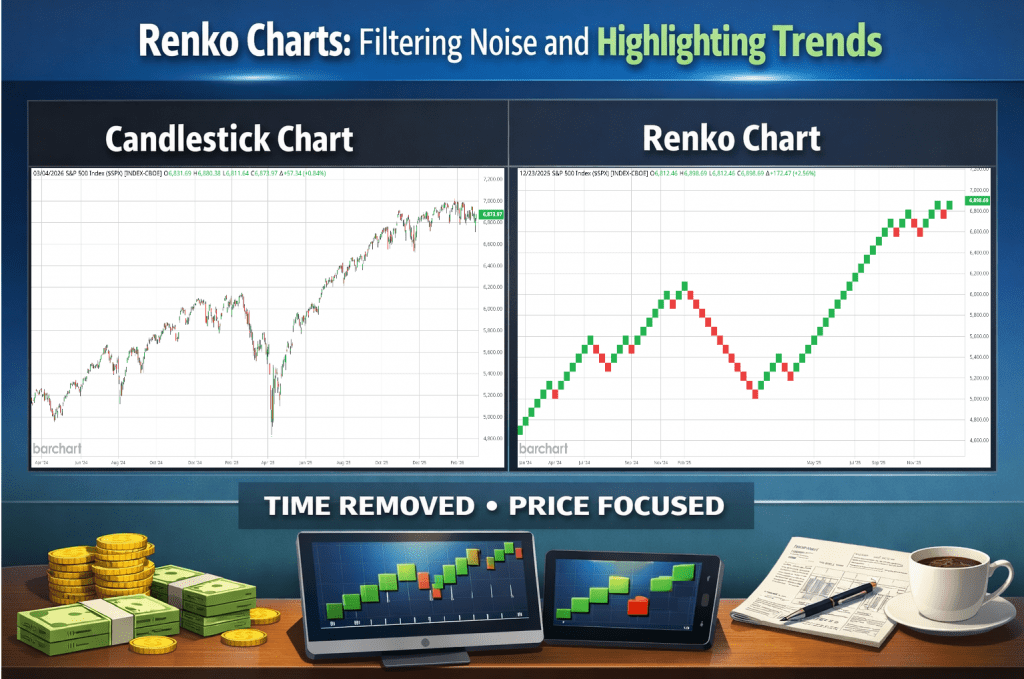
A candlestick chart prints a new bar every timeframe. Renko is different. It prints new bricks when price moves enough to form them, based on your brick-size setting.
The benefit: Renko can filter out small fluctuations and help trends stand out.
The tradeoff: during very fast movement, price can travel far before your next brick is confirmed, depending on your settings and platform behavior.
If you want a refresher on how bricks form, start here: Renko Chart Basics and What Is a Renko Chart and How I Use It.
Timeframe and Brick Size: The Real Key (Not the Market)
Most “Renko works” or “Renko does not work” debates are really about timeframe + brick size.
- Small brick size = more bricks, more signals, more noise, more whipsaws
- Large brick size = fewer signals, cleaner structure, later entries and exits
- Lower timeframe = faster decisions, more event risk, more emotional pressure
- Higher timeframe = clearer trend context, fewer decisions, often better for discipline
If you are experimenting with brick size, these pages will help you dial it in:
- ATR-Based Renko Brick Size Calculation
- Renko Brick Size Backtesting in TradingView
- Free Renko Brick Size Calculator
Fast Markets and Breaking News: What Renko Traders Need to Know
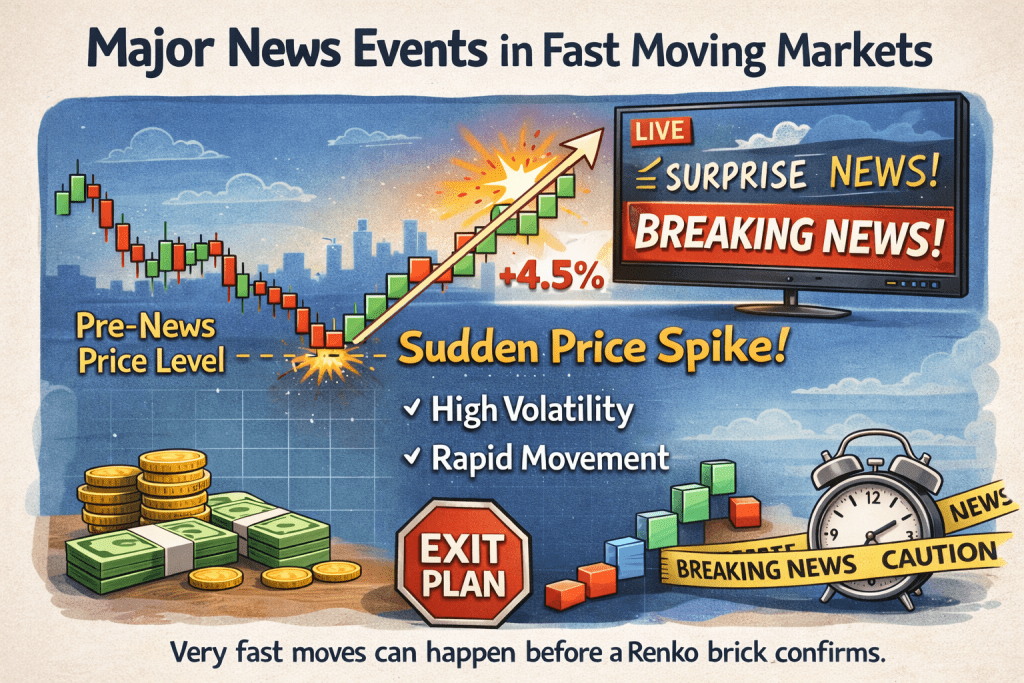
This is the nuance that matters, especially for 1-minute and 5-minute workflows.
During major news, price can move aggressively inside a short window. If you are waiting for confirmation (or a close condition on your platform), you may not “see” the full speed of the move until after it has already happened.
That does not mean short timeframe Renko is wrong. It means news-driven volatility can create larger-than-expected outcomes quickly, so risk controls become the whole game.
Practical risk ideas for fast markets:
- Reduce position size around scheduled events (earnings, CPI, FOMC)
- Consider wider stops or no-trade windows during high-impact news
- Backtest “news filter” rules instead of guessing
- Use a clear exit plan (do not improvise under pressure)
If exits are something you are working on, this is a helpful companion: Renko Stop Loss and Take Profit: 7 Exit Methods and Renko Chart Exit Rules.
Renko Charts for Stocks (My Favorite Fit for Trend Clarity)
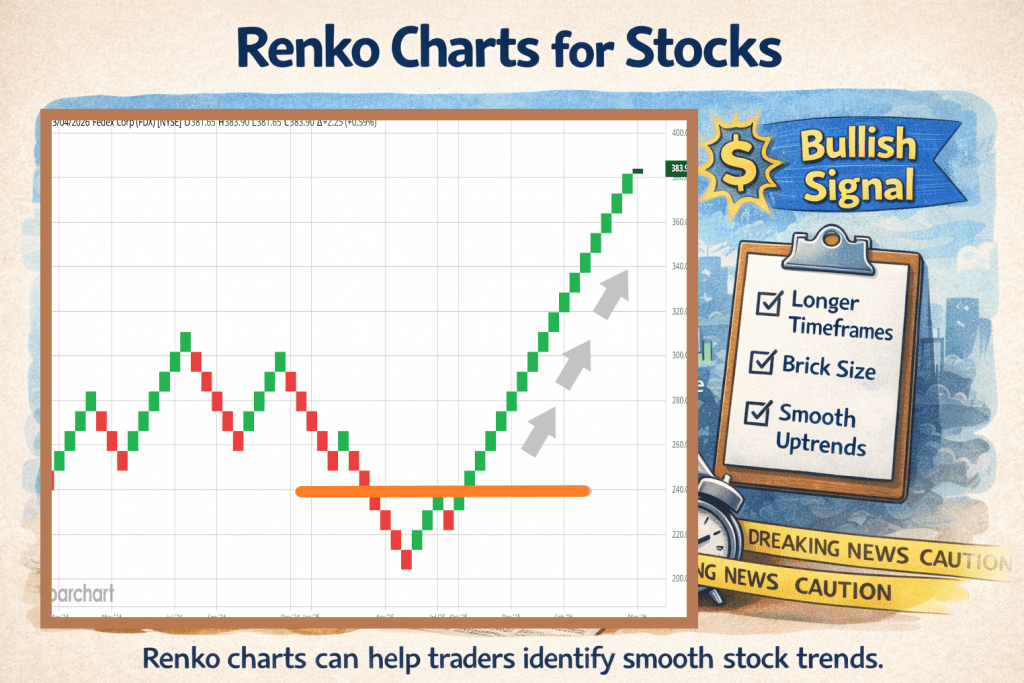
Stocks and broad ETFs are often a natural match for Renko, especially if you lean mid- to long-term. Many stocks trend for weeks, months, or longer, which gives Renko time to do what it does best: highlight structure.
Why stocks can work well with Renko:
- Longer trend persistence (cleaner directional movement)
- Strong technical structure (support, resistance, breakouts)
- Easier to combine with trendlines and simple rules
If you want a practical starting point for signals and simple rules, these pages connect nicely:
Renko Charts for Forex (Best on Higher Timeframes)
Forex can work with Renko, but it is often a better fit when you are not forcing it into ultra-fast decision making. Currencies can chop for long periods, and news spikes can be sharp.
A common approach is using larger brick sizes and higher timeframes (like 4H or Daily) to focus on broader swings. If you are curious about timeframe comparisons, you might like: Renko Backtest: Daily vs 4-Hour EURUSD.
Renko Charts for Crypto (Possible, but Volatility Changes the Rules)
Crypto is volatile, and volatility creates bricks quickly. That can be good for trend detection, but it also means reversals can be violent, especially during liquidations and headline events.
Crypto Renko tends to be most usable when you:
- Use higher timeframes to see the real trend context (1H, 4H, Daily)
- Choose a brick size that is realistic for the asset’s volatility (often ATR-based)
- Stay strict with risk rules because price can move quickly
If you are building or testing strategies, make sure you actually measure it. Here is a solid starting point: Backtesting Renko Chart Strategies.
Renko Charts for Futures (Trend Systems Yes, Order Flow Scalping Less So)
Futures traders do use Renko, especially for trend continuation and breakout logic. The challenge is that many futures traders rely heavily on time, volume, and order flow tools, and Renko is not built to highlight those details.
So, futures + Renko can be a fit, but it depends on your style. If your plan is trend-focused, Renko can help. If your plan is pure tape reading, other chart types may be better.
Recommended Settings by Market (Starting Points Only)
These are not “best” settings. They are reasonable starting points to test, based on how Renko behaves in different environments. Always backtest and adjust.
| Market | Goal | Common Timeframes | Common Brick Approach |
|---|---|---|---|
| Stocks / ETFs | Trend clarity, fewer decisions | Daily, 4H | ATR-based or moderate fixed |
| Forex | Swing structure, avoid chop | 4H, Daily | Often larger fixed or ATR-based |
| Crypto | Momentum trends with strict risk | 1H, 4H, Daily | Usually ATR-based |
| Futures | Trend continuation systems | Varies | Fixed ticks or ATR-based (strategy-dependent) |
Different markets can behave very differently, which is why brick size should not be a one-size-fits-all setting. To see how this ties into your trading approach, here’s a practical guide on how to choose the best Renko brick size for your strategy across different market conditions.
My Approach: Trend First, Fewer Trades, Clear Exits
My personal preference is using Renko for mid- to long-term trend analysis because it helps me stay focused on direction instead of noise. I would rather take fewer, higher-quality decisions than constantly react to every small movement.
If you want a simple collection of strategy ideas (that you can test and adapt), start here: Renko Trading Strategies and Mastering Renko Chart Strategies.
Frequently Asked Questions
Are 1-minute and 5-minute Renko charts “bad”?
No. They can work for certain traders and certain systems. The key is understanding fast-market behavior. News-driven spikes can create rapid movement, and you need risk rules that match that environment.
Do Renko charts hide price action during news?
Renko filters noise by design, and depending on your platform and settings, very fast movement can be difficult to interpret in real time. This is why many traders reduce risk or avoid trading during high-impact news windows.
Is ATR-based Renko better than fixed-size?
It depends. ATR-based bricks adapt to volatility, which can help across different regimes. Fixed-size bricks can be simpler and more consistent for certain systems. The correct answer is the one you can backtest and execute consistently. If you want help choosing, see: ATR-Based Renko Brick Size Calculation.
What platform should I use to test Renko strategies?
Many traders use TradingView for charting and strategy testing. You can learn more about TradingView here: TradingView. For a Renko testing workflow, see: Backtesting Renko Chart Strategies.
Conclusion: Choose Markets That Match Your Renko Style
If your goal is cleaner trend structure and better discipline, Renko often fits naturally with stocks and higher-timeframe approaches. Forex, crypto, and futures can still work, but the faster and more volatile the environment gets, the more important risk controls become.
Most importantly, do not argue about Renko in theory. Test it. Measure it. Then decide what matches your personality and goals. Educational only, not financial advice.
Next steps:
- Review: Renko Charts Guide
- Dial in brick size: Brick Size Calculator
- Backtest ideas: Renko Backtesting Tips