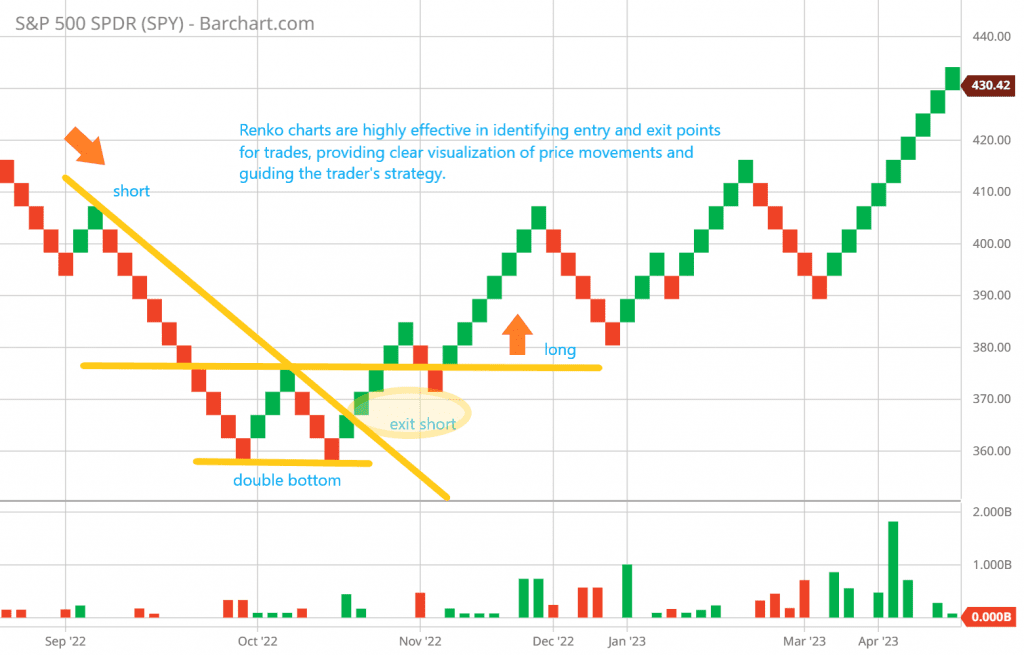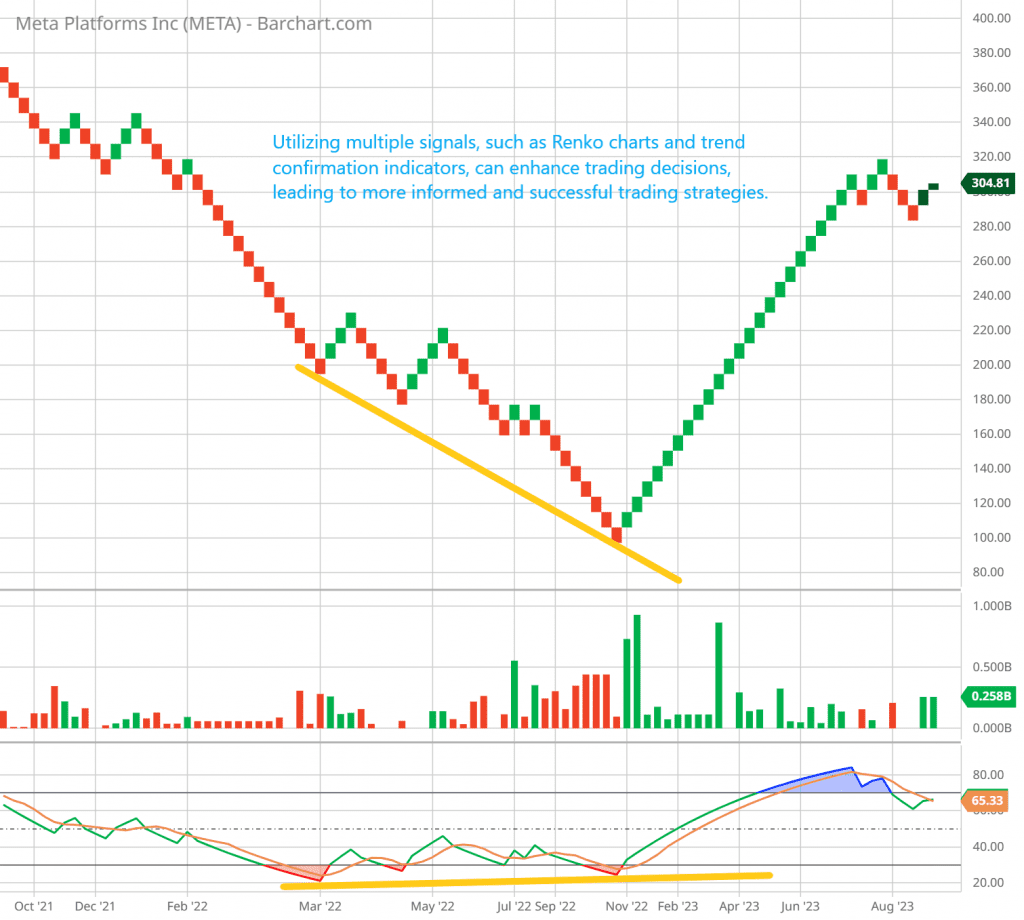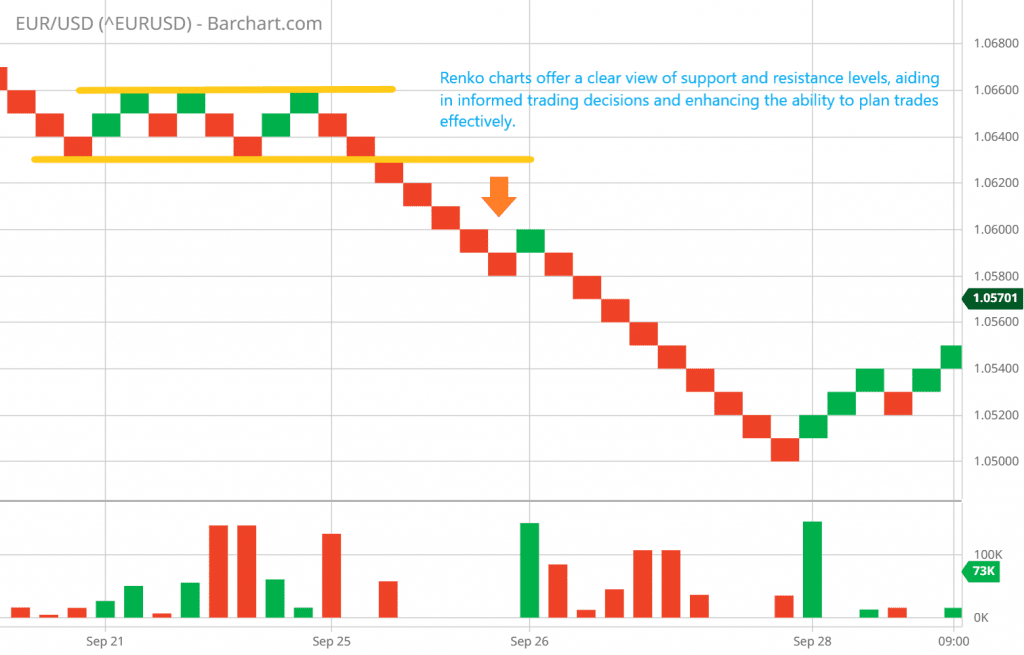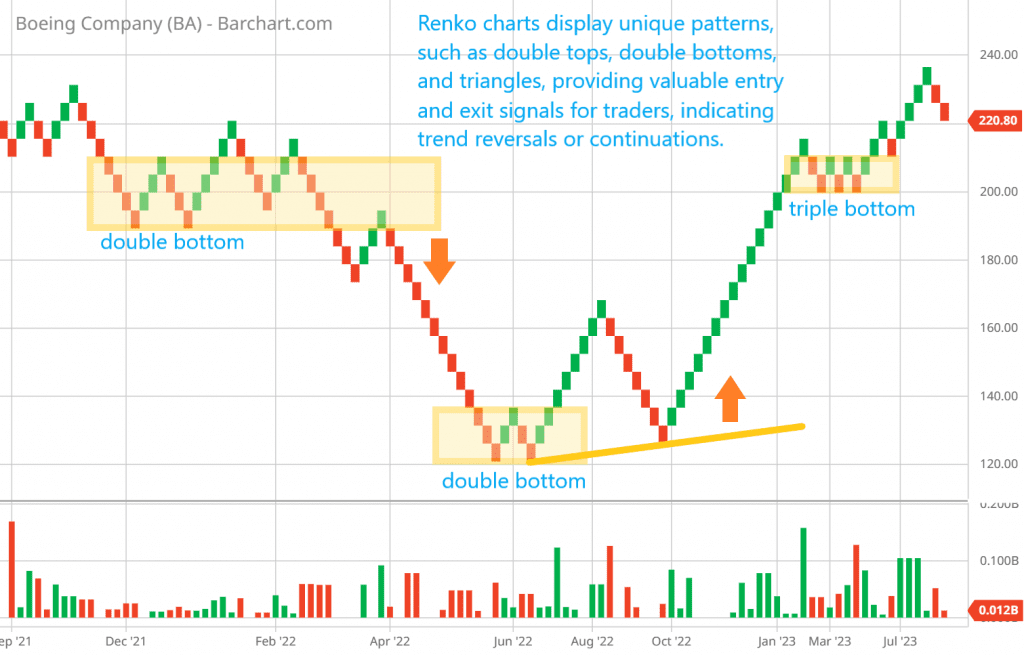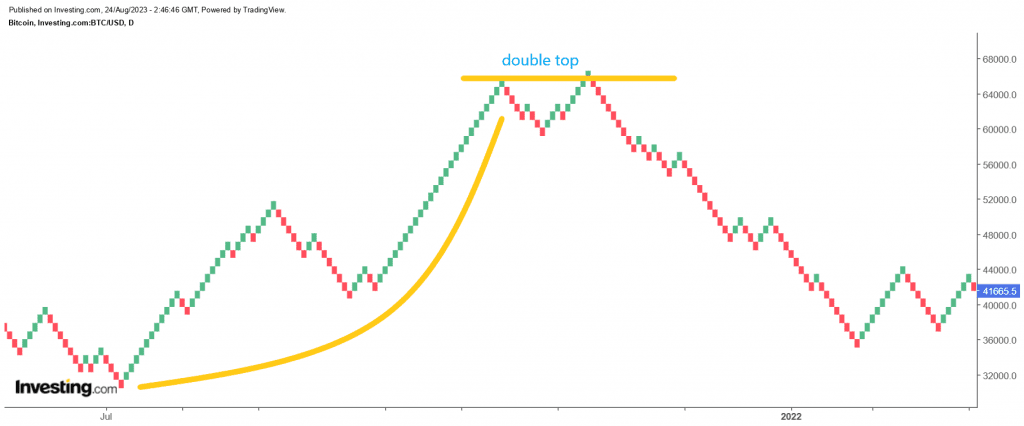
Renko charts already filter smaller price movements, so adding indicators should have a clear purpose. Instead of filling the chart with overlapping signals, I prefer using Renko chart indicators for specific jobs such as identifying trend direction, confirming momentum, evaluating pullbacks, or watching for breakouts.
In this guide, I’ll look at five indicators I like to experiment with on Renko charts: Supertrend, MACD, Bollinger Bands, RSI, and moving averages. I’ll explain what each indicator measures, how it can complement Renko price structure, and some simple rules you can test.
The goal isn’t to find one perfect indicator or setting. It’s to give each indicator a specific job and determine through testing whether it adds useful information to your Renko strategy.
5 Renko Chart Indicators at a Glance
- Supertrend: trend direction and potential trailing-exit framework
- MACD: momentum and trend confirmation
- Bollinger Bands: volatility compression and expansion
- RSI: momentum, pullbacks, and divergence
- Moving Averages: trend bias and price structure context
My approach: start with the Renko chart itself. Add an indicator only when you can explain exactly what additional information you want it to provide.
Before testing indicators, make sure you understand how your Renko bricks are being constructed. Brick size can change the swings, reversals, entries, and indicator behavior you see on the chart. My ATR Renko brick size guide and Renko Brick Size Calculator can help you choose values to test.
How to Choose the Best Renko Chart Indicator
Instead of asking which indicator is universally best for Renko charts, I think it’s more useful to ask:
What job do I want the indicator to perform?
Renko already gives you a visual representation of price structure. An indicator should ideally add information that isn’t obvious from the bricks alone.
| If You Want to Evaluate… | Indicator to Experiment With |
|---|---|
| Trend direction | Supertrend or Moving Average |
| Momentum | MACD |
| Volatility compression and expansion | Bollinger Bands |
| Pullback momentum | RSI |
| Momentum divergence | RSI or MACD |
| Trend bias | Moving Average or Supertrend |
You don’t necessarily need an indicator at all. Renko swing highs, swing lows, trendlines, support and resistance, and patterns can provide enough structure to create testable trading rules.
If you do add indicators, try to avoid several tools that measure essentially the same thing. For example, stacking multiple momentum indicators may give you several versions of similar information rather than independent confirmation.
For structure-based entry examples, see my Renko Buy and Sell Signals guide.
5 Renko Chart Indicators Compared
| Indicator | Primary Role | What I Would Test | Watch For |
|---|---|---|---|
| Supertrend | Trend | Trend confirmation and trailing exits | Repeated direction changes in sideways conditions |
| MACD | Momentum | Momentum agreement, zero-line behavior, divergence | Signals occurring after an extended move |
| Bollinger Bands | Volatility | Compression followed by expansion | Repeated signals during directionless movement |
| RSI | Momentum | Pullbacks, momentum shifts, divergence | Treating overbought or oversold readings as automatic reversals |
| Moving Averages | Trend | Trend bias, pullbacks, crosses | Repeated crosses during consolidation |
These aren’t rankings. Each indicator measures something different, and its usefulness depends on the rules you’re testing.
1. Supertrend With Renko Charts
Supertrend is a trend-following indicator built from price and ATR. On a Renko chart, it can provide an additional way to define trend direction or create an objective exit condition.
I don’t treat every Supertrend direction change as an automatic trade. Instead, I like experimenting with Supertrend as a filter alongside Renko structure.
A Renko + Supertrend Experiment
- Identify the direction of the Renko price structure.
- Check whether Supertrend agrees with that direction.
- Define a specific Renko entry condition, such as a swing breakout or pullback continuation.
- Decide whether the entry occurs immediately or requires additional confirmation.
- Test an opposite Supertrend change, Renko structure break, or another predefined rule as the exit.
Supertrend period and multiplier settings affect how responsive the indicator is. More responsive settings can change direction more frequently, while less responsive settings may remain with a move longer. Neither is automatically better, so I prefer testing several reasonable combinations.
For a full walkthrough, see my Renko Supertrend Strategy.
2. MACD With Renko Charts
MACD measures the relationship between moving averages and can be used to study momentum and trend direction. I find it more useful when it has a defined role rather than treating every MACD crossover as a trading signal.
Some MACD conditions you can test with Renko include:
- MACD signal-line crosses that agree with Renko direction
- movement above or below the zero line
- momentum strengthening during a Renko breakout
- momentum weakening while Renko continues making new highs or lows
- MACD divergence around potential Renko reversals
Example MACD Confirmation Framework
Suppose Renko breaks above an important swing high. Instead of entering solely because MACD is bullish, you could test whether requiring MACD to agree with the Renko breakout changes the strategy’s results.
Then test the same Renko setup without the MACD condition. That comparison can tell you whether the indicator is actually adding value or simply delaying entries.
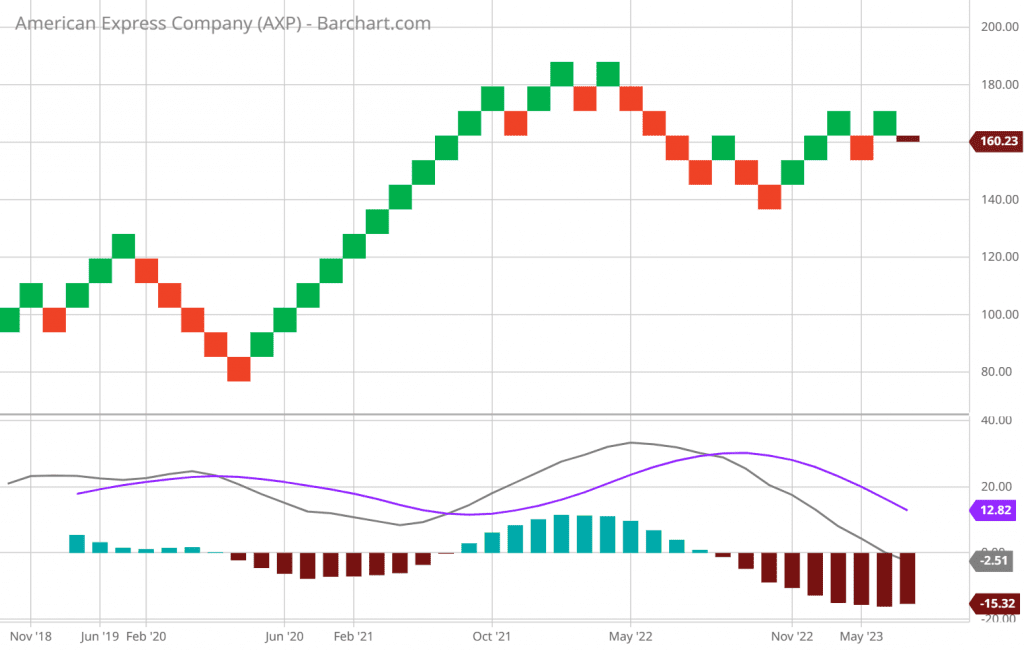
MACD can also be paired with W and M patterns or other reversal structures. My Renko RSI and MACD reversal confirmation example explores that idea in more detail.
3. Bollinger Bands With Renko Charts
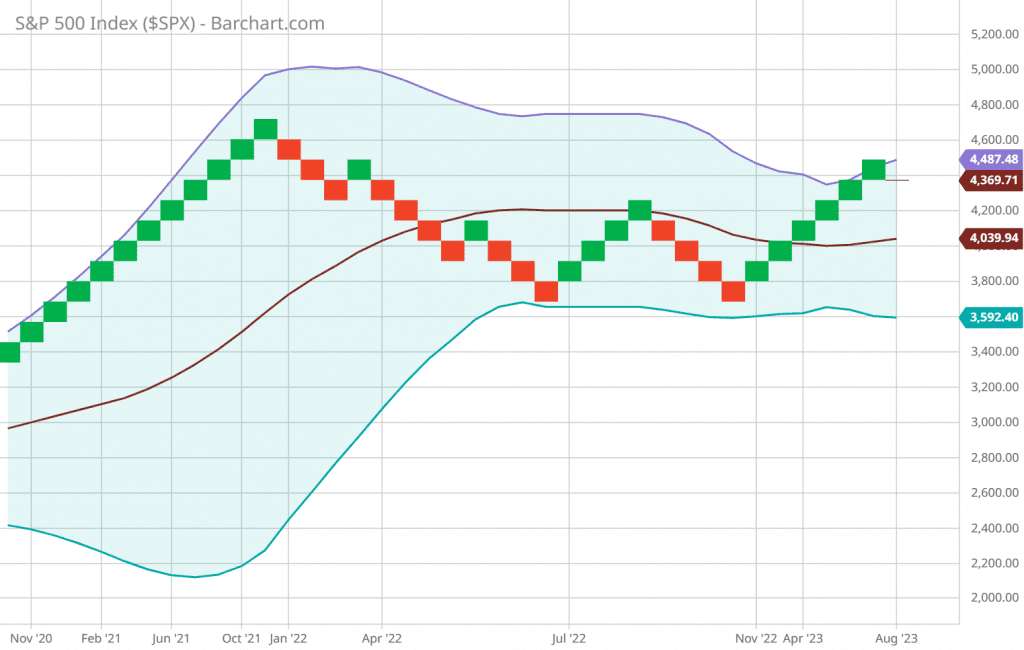
Bollinger Bands provide a visual representation of volatility around a moving average. Instead of using them as a simple overbought or oversold tool, I like the idea of testing them for compression and expansion.
When the bands contract, volatility has decreased relative to the recent period. When they expand, volatility has increased.
A Renko Bollinger Band Breakout Experiment
- Identify a period where the Bollinger Bands have contracted.
- Mark the important Renko swing boundaries around the consolidation.
- Wait for Renko to break one of those structural boundaries.
- Observe whether the Bollinger Bands begin expanding.
- Test immediate versus confirmed entries.
- Use a predefined structure-based or indicator-based exit.
The important distinction is that the band itself doesn’t have to be the trading signal. It can provide volatility context while Renko structure provides the actual setup.
4. RSI With Renko Charts
RSI measures momentum on a bounded scale from 0 to 100. Although RSI is often associated with overbought and oversold readings, those readings don’t automatically mean price is about to reverse.
During a strong trend, RSI can remain elevated or depressed while Renko continues moving in the same direction. That’s why I prefer using RSI as a source of context rather than automatically trading against the trend.
Three RSI Ideas to Test With Renko
- Trend pullbacks: watch momentum weaken during a Renko pullback and then strengthen again with the larger trend.
- Momentum confirmation: compare RSI direction with a Renko structure breakout.
- Divergence: compare new Renko highs or lows with RSI momentum to identify potential disagreement.
Divergence doesn’t guarantee a reversal. It tells you that price structure and momentum aren’t moving together in the same way they were previously. That can become a reason to watch the Renko structure more closely.
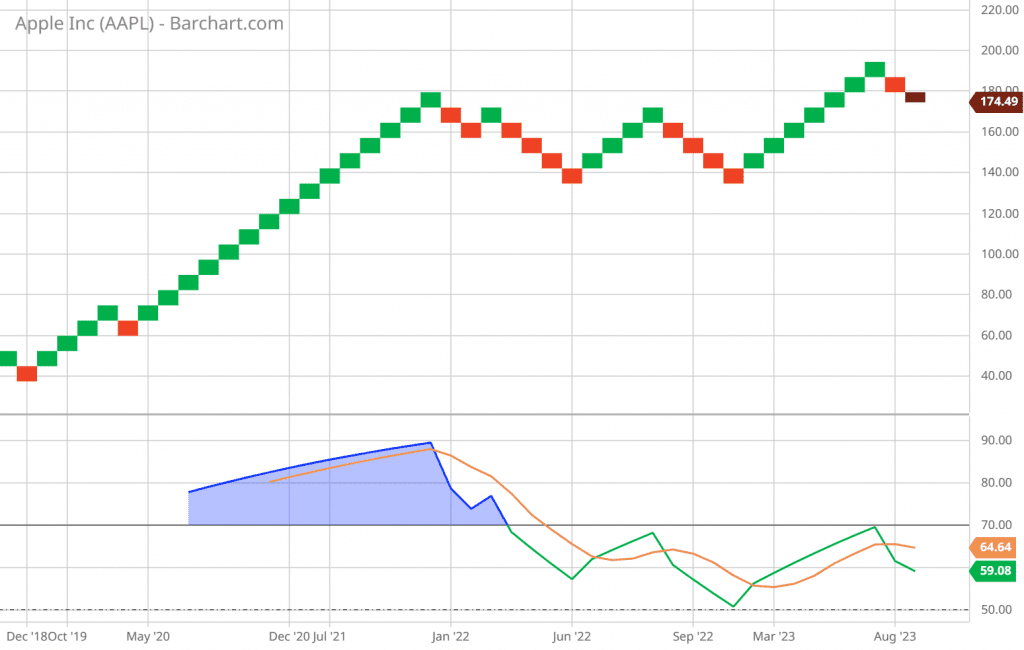
RSI can also be combined with price formations. See my Renko chart patterns guide for W, M, and other structures you can experiment with.
5. Moving Averages With Renko Charts
Moving averages are one of the simplest ways to add trend context to a Renko chart. They can be used as a trend filter, a pullback reference, or as part of a crossover strategy.
One straightforward experiment is to define bullish conditions when Renko remains above a moving average and bearish conditions when it remains below the average.
Moving Average Ideas to Test
- Trend filter: evaluate bullish setups only above the moving average and bearish setups only below it.
- Pullback: watch how Renko behaves when price returns toward the moving average during an established trend.
- Crossover: compare a faster and slower moving average as an objective trend condition.
- Exit: test whether a move through the moving average provides a useful exit condition.
Moving averages can produce repeated crosses when price moves sideways. That’s why I prefer combining an MA with Renko structure instead of assuming every crossover represents a new trend.
For more detail, see my Moving Averages With Renko Charts guide.
How to Combine Renko Chart Indicators Without Overcomplicating the Chart
If you want to combine indicators, one approach is to give each tool a different job.
| Job | Possible Tool | Question It Answers |
|---|---|---|
| Price structure | Renko bricks | What is price actually doing? |
| Trend | Supertrend or Moving Average | Which direction am I evaluating? |
| Momentum | MACD or RSI | Does momentum support the setup? |
| Volatility | Bollinger Bands | Is volatility contracting or expanding? |
| Risk / exit | Renko structure or predefined rule | What invalidates or ends the trade? |
You don’t need one tool from every row. In many cases, Renko structure plus one indicator may be enough for the experiment you’re trying to run.
Example: Renko + Supertrend + MACD
In this combination, each component can have a separate purpose:
- Renko: defines price structure and the actual setup.
- Supertrend: defines trend bias.
- MACD: provides momentum confirmation.
The next step would be to compare that three-part strategy against the same Renko setup without MACD. If performance doesn’t improve in a meaningful and repeatable way, the extra indicator may not be helping.
Example: Renko + Moving Average + RSI
Another experiment could use a moving average to define trend direction while RSI evaluates momentum during a pullback.
The Renko structure still determines whether an actual entry setup exists. The indicators provide context rather than replacing price structure.
ATR, Brick Size, and Renko Indicators
ATR deserves special attention because it can play two different roles in a Renko workflow.
ATR-Derived Fixed Brick Size
One approach is to use ATR as a reference for choosing a fixed Renko brick value. For example, you can calculate ATR, apply a multiplier, and use the resulting value as the fixed brick size for your test.
Once that fixed value is selected, every brick on that chart uses the same numerical brick size unless you manually change it.
Native or Dynamic ATR Renko
A platform may also offer an ATR-based Renko construction method in which its Renko calculation uses ATR rather than a manually selected fixed value.
That is different from using ATR only to choose a starting fixed brick value. The distinction matters when you’re comparing historical charts and backtests.
Whichever method you use, brick construction can affect every indicator on this page because the indicators are being calculated from the resulting Renko data.
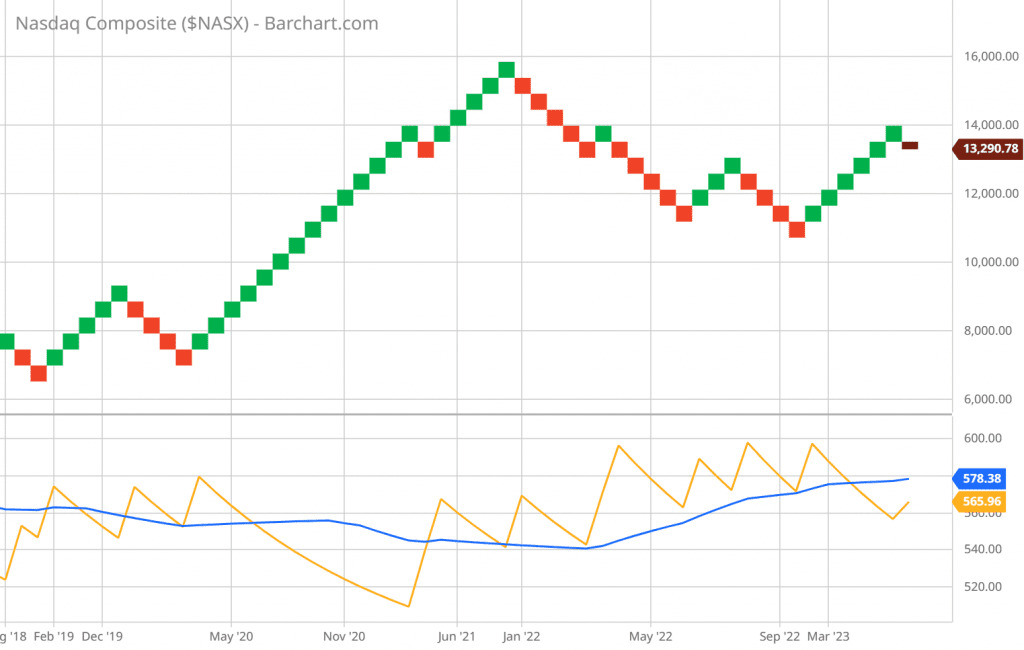
For a deeper explanation, see my ATR-Based Renko Brick Size guide and ATR vs Fixed-Size Renko.
How to Test Renko Indicator Settings
Indicator settings that look impressive on one completed chart can behave differently on another market or during another period. That’s why I prefer treating settings as variables to test rather than trying to find a universal combination.
- Choose one market and test period.
- Choose the Renko construction method and brick size.
- Define the entry using Renko structure.
- Add one indicator with one specific purpose.
- Choose a reasonable starting setting.
- Define the exit and risk rules.
- Run the test without changing the rules midway.
- Record return, drawdown, trade count, average trade, and other useful metrics.
- Repeat with the indicator removed.
- Compare whether the indicator materially changed the results.
That last comparison is especially useful. If adding an indicator makes the chart look more sophisticated but doesn’t improve the behavior you’re trying to improve, you may not need it.
My Renko strategy backtesting guide goes deeper into designing and evaluating these tests.
Common Mistakes When Using Indicators With Renko Charts
- Adding too many indicators. More confirmation isn’t automatically better, especially when several indicators measure similar things.
- Ignoring Renko structure. Indicators should complement the bricks rather than make you ignore obvious swing structure.
- Changing settings after every losing trade. Constant adjustment makes it difficult to determine whether a strategy is actually robust.
- Treating indicator signals as guarantees. Crossovers, divergences, overbought readings, and trend changes can all fail.
- Ignoring brick size. Different brick settings can materially change both Renko structure and indicator behavior.
- Optimizing one historical period. Settings that perfectly fit one completed chart may not behave similarly in other conditions.
- Using confirmation without measuring the tradeoff. Additional confirmation can remove some trades but can also create later entries.
One reason I continue to use Renko is that it encourages me to focus on price structure and avoid unnecessary complexity. I discuss that broader idea in How Renko Charts Can Strengthen Trading Psychology.
Renko Chart Indicators FAQ
What Is the Best Indicator for Renko Charts?
There isn’t one indicator that is best for every Renko strategy. Supertrend and moving averages can be tested for trend direction, MACD and RSI for momentum, and Bollinger Bands for volatility compression and expansion. Choose the indicator based on the job you need it to perform.
Do Renko Charts Need Indicators?
No. Renko structure can be used on its own with swing highs and lows, trendlines, support and resistance, breakouts, and chart patterns. Indicators are optional tools that can provide additional information or confirmation.
Does Supertrend Work With Renko Charts?
Supertrend can be applied to Renko as a trend filter, confirmation tool, or exit condition. Its period and multiplier affect responsiveness, so the settings should be tested as part of the complete strategy rather than assumed to work universally.
Can I Use MACD With Renko Charts?
Yes. MACD can be used to study momentum, signal-line crosses, zero-line behavior, and divergence alongside Renko structure. Test whether the MACD condition improves your specific setup compared with using the Renko signal alone.
Can I Use RSI With Renko Charts?
Yes. RSI can be used for momentum, pullback analysis, and divergence. An overbought or oversold reading isn’t automatically a reversal signal, particularly during a strong trend.
Which Moving Average Is Best for Renko?
There is no universal moving-average period that is best for every Renko chart. Different periods create different levels of responsiveness. Test reasonable settings while keeping the market, brick size, entry rules, and exit rules consistent.
Should I Use More Than One Indicator With Renko?
You can, but each indicator should ideally have a separate purpose. For example, Supertrend might define trend direction while MACD measures momentum. Adding several indicators that measure similar conditions can create redundant confirmation without necessarily improving the strategy.
Does Brick Size Affect Renko Indicators?
Yes. Changing the Renko brick size changes the chart structure that the indicator is analyzing. That can change indicator signals, crossover timing, momentum readings, and historical strategy results.
Build a Renko Strategy Around Price Structure First
My main takeaway is simple: start with Renko price structure and give every indicator a specific job.
Supertrend and moving averages can help define trend bias. MACD and RSI can provide momentum information. Bollinger Bands can provide volatility context. But none of those tools eliminates the need for clear entry, invalidation, exit, and risk rules.
If you’re ready to turn these ideas into complete setups, continue with my 3 Easy Renko Chart Strategies, Renko Buy and Sell Signals, or Advanced Renko Chart Strategies.
For calculators, tutorials, platform guides, videos, and additional experiments, visit my Renko Trading Resources.
You can also find my latest Renko experiments and tutorials on the Renko Trading Channel on YouTube.
Educational purposes only. The indicators, settings, strategies, and examples discussed here are ideas for testing and experimentation, not financial advice or recommendations to buy or sell any security.